Choosing the right ribbon blender for pharmaceutical manufacturing is an important decision because powder mixing directly affects the consistency and quality of the final formulation.
A ribbon blender may look relatively simple from the outside, but selecting the correct machine involves much more than choosing a particular capacity. Material characteristics, batch size, bulk density, moisture content, required mixing performance, discharge arrangement, cleaning procedure, material of construction, available space, and automation requirements can all influence the final equipment specification.
For pharmaceutical manufacturers, the objective should be to select a blender that is appropriate for the specific product and process, rather than simply choosing the largest or most economical machine.
A properly specified ribbon blender can provide an efficient solution for many powder and granule mixing applications. This guide explains the major factors to consider, from capacity and construction material to mixing requirements, cleaning, discharge, automation, maintenance, and supplier selection.
What Is a Ribbon Blender?
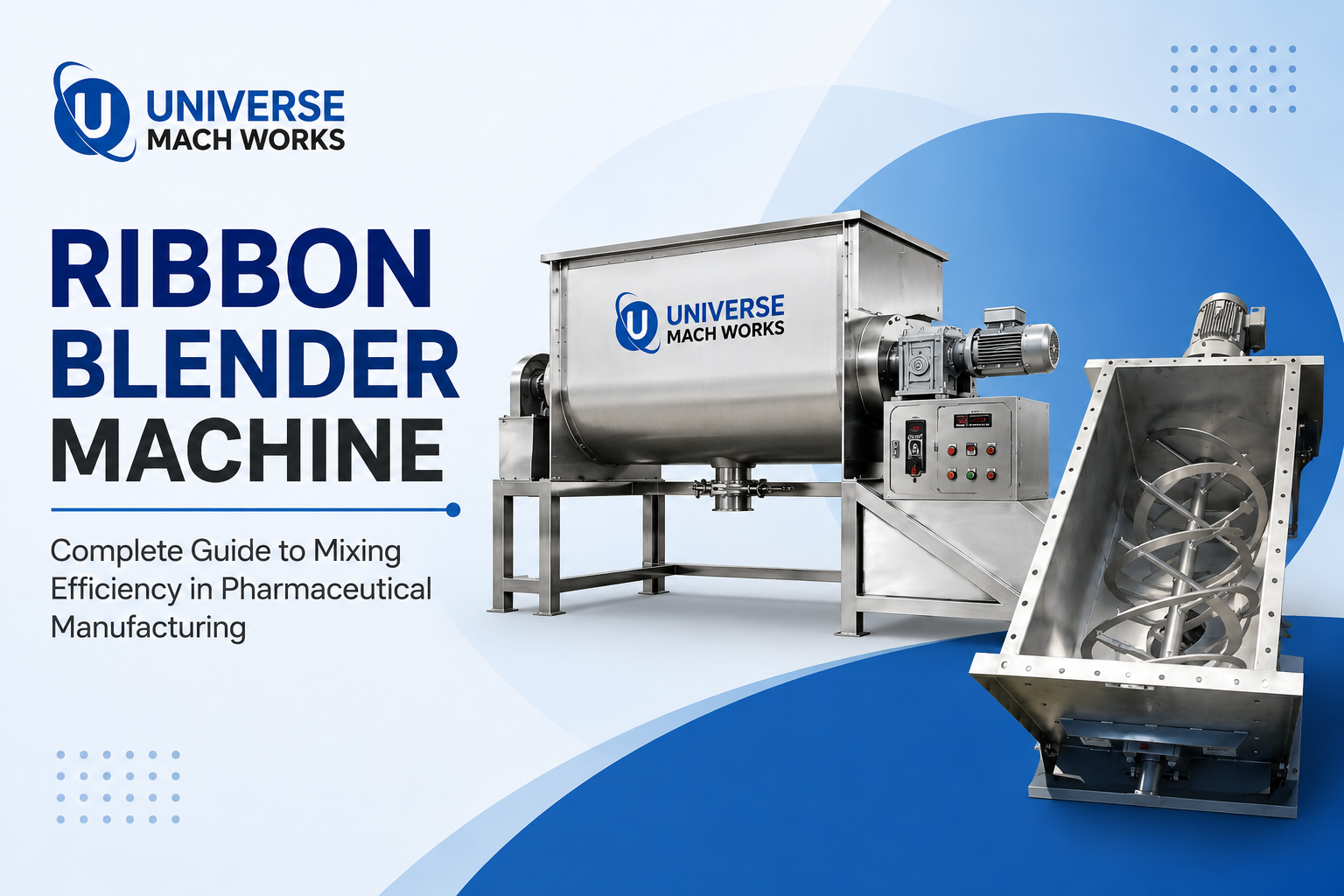
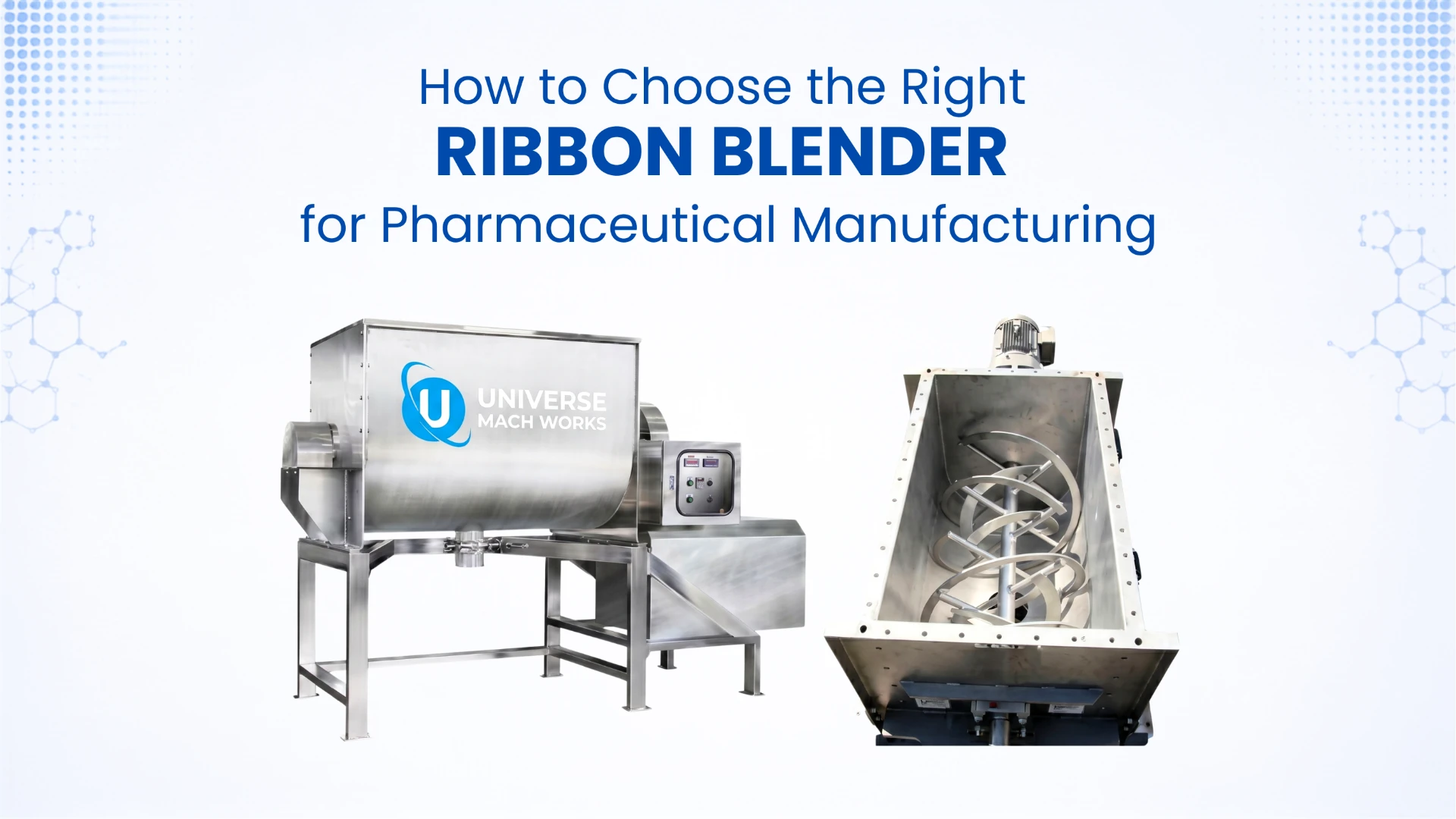
A Ribbon Blender is a horizontal batch mixing machine designed primarily for blending powders, granules, and other dry or semi-dry materials. The machine generally consists of a horizontal trough containing a rotating shaft fitted with ribbon-shaped mixing elements.
As the ribbons rotate, material moves through the mixing chamber, promoting the distribution of different ingredients throughout the batch. Exact suitability depends on the material characteristics and process requirements.
- Pharmaceutical powders
- Granules
- Nutraceutical ingredients
- Food powders
- Herbal formulations
- Chemical powders
- Cosmetic powders
- Dry blends
- Other compatible bulk materials
Why Is Ribbon Blender Selection Important?
Blender performance depends on the relationship between the machine design and the material being processed. Two products may have the same batch weight but behave very differently during mixing.
One powder may flow easily, have a relatively uniform particle size, and mix readily. Another may be cohesive, flow poorly, contain very fine particles, or have significant differences in bulk density. Selecting equipment only according to batch weight may therefore be insufficient.
A better selection process considers: Material + Batch Size + Mixing Requirement + Machine Design + Cleaning + Discharge + Automation.
1. Understand the Material You Need to Mix
The first step is to understand the material. Its behavior determines many parts of the final equipment specification.
Bulk Density
Bulk density affects the volume occupied by the material inside the blender. Two materials with the same weight can occupy very different volumes, so both weight and volume should be considered when determining capacity.
Particle Size
Large differences in particle size can potentially contribute to segregation, while very fine powders may behave differently from larger granules.
Flowability and Cohesiveness
Free-flowing powders behave differently from cohesive or poorly flowing materials. Some powders tend to stick together or form lumps, so the blender configuration may need careful evaluation.
Moisture Content and Product Sensitivity
Moisture can influence flow characteristics and mixing behavior. Some materials may also be sensitive to heat, shear, moisture, mechanical stress, or long mixing times. Communicate these characteristics to the ribbon blender manufacturer before finalizing the equipment.
2. Determine the Required Batch Capacity
A machine's nominal volume should not automatically be treated as its usable working capacity. The appropriate filling level depends on the material and machine design.
- Batch weight
- Bulk density
- Minimum batch size
- Maximum batch size
- Working volume
- Required headspace
- Product flow characteristics
- Future production requirements
Example
A request for a 500 kg blender is incomplete without the material's bulk density because 500 kg of different materials can occupy significantly different volumes. Required Blender Volume ≠ Batch Weight Alone. Capacity selection should be based on the actual material and process.
3. Consider Minimum and Maximum Batch Sizes
A company may purchase a large blender for future production but initially operate with smaller batches. Discuss the proposed machine's performance across the expected operating range.
- Current batch size
- Future batch size
- Minimum batch size
- Maximum batch size
- Number of batches per day
- Production expansion plans
4. Select the Appropriate Material of Construction
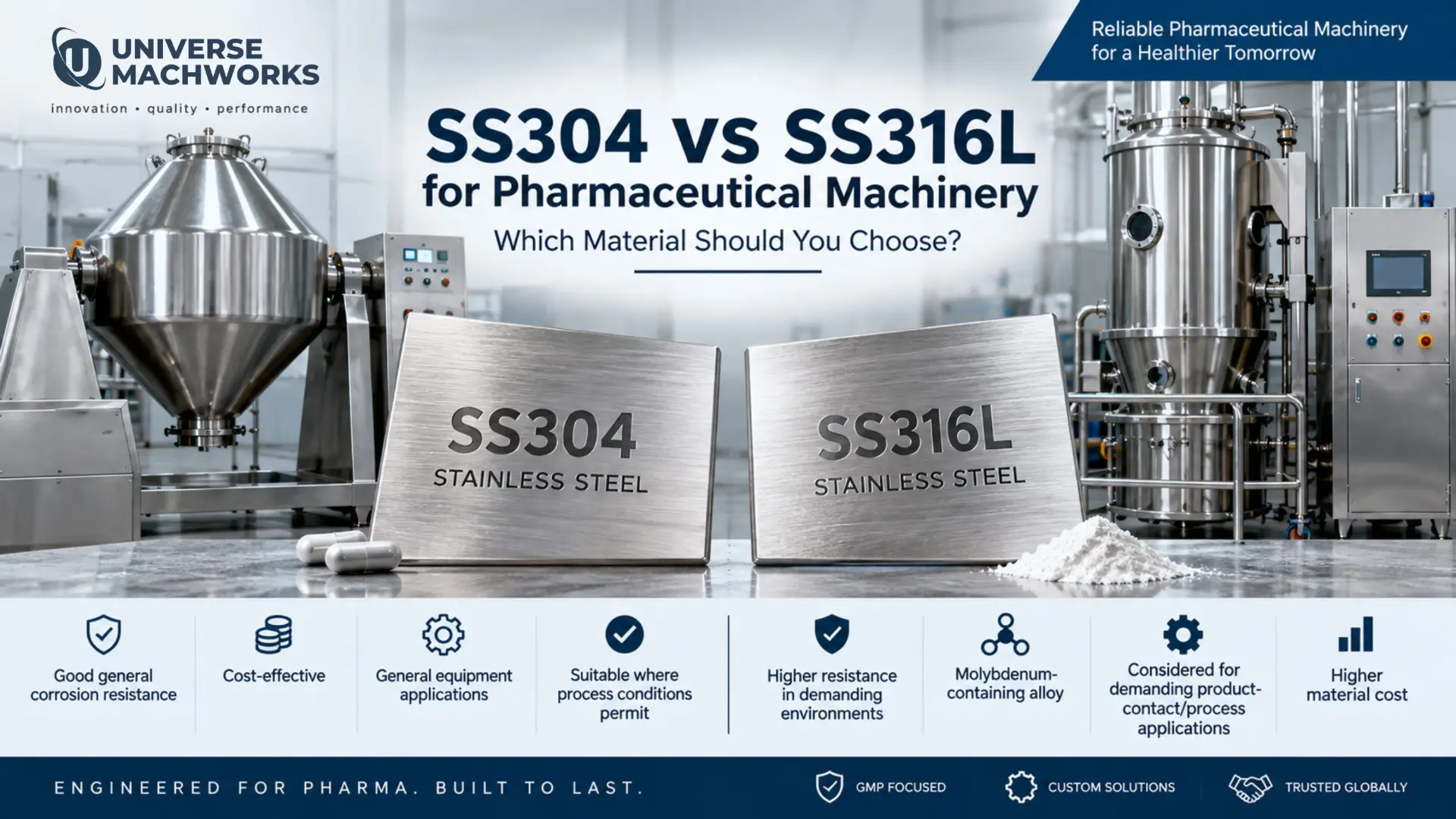
Material of construction is especially important in pharmaceutical processing. Common stainless-steel options include SS304 and SS316L, depending on the application.
SS304
SS304 offers good general corrosion resistance and is widely used across industrial processing applications. It may suit pharmaceutical machinery where the product and cleaning environment are compatible with the material.
SS316L
SS316L contains molybdenum and generally provides improved resistance to certain corrosive environments compared with SS304. It may be considered for more demanding product-contact or process applications, but should not automatically be assumed mandatory for every pharmaceutical machine.
- Product chemistry
- Cleaning chemicals
- Temperature
- Corrosion conditions
- Product-contact requirements
- Customer specifications
5. Evaluate the Ribbon and Agitator Design
The ribbon assembly creates movement within the mixing chamber. Its design should be considered in relation to product characteristics, mixing objective, batch size, material flow, required mixing time, and product sensitivity. Ribbon geometry should be selected for the application rather than treated as a one-size-fits-all component.
6. Define the Required Mixing Performance
Clearly explain what good mixing means for the application, such as consistent distribution of active ingredients, excipients, nutraceutical ingredients, powdered additives, granules, or other formulation components.
- Material properties
- Particle size
- Bulk density
- Fill level
- Ribbon configuration
- Mixing time
- Rotation conditions
- Loading sequence
A specific machine speed or mixing time will not suit every formulation. Actual process parameters should be established through appropriate trials and process evaluation.
7. Consider Segregation Risk
The material must remain sufficiently uniform during and after mixing. Segregation can be a concern when ingredients have substantially different particle sizes, densities, shapes, or flow properties. Loading sequence, mixing time, discharge arrangement, and downstream handling can all influence the final blend.
8. Choose the Right Discharge Arrangement
The machine should allow blended material to be removed efficiently and in a way that suits the production process. Finalize the discharge before fabrication because it can affect the machine design and plant layout.
- Required discharge location
- Downstream equipment
- Product retention
- Cleaning access
- Operator access
- Installation layout
9. Consider Cleaning Requirements
Cleaning is particularly important when equipment may be used for different products or batches. FDA CGMP guidance emphasizes that equipment should be appropriately designed for cleaning and maintenance, and product-contact surfaces should be suitable for their intended use.
- Accessibility of product-contact areas
- Internal geometry
- Weld quality
- Surface condition
- Product-retention areas
- Ease of inspection
- Cleaning method
- Frequency of cleaning
10. Surface Finish and Weld Quality
Stainless-steel grade alone does not determine equipment quality. Internal welds, surface condition, crevices, sharp corners, product-retention areas, finish consistency, and accessibility also matter. The required product-contact finish should be defined for the application and customer specification.
11. Decide the Level of Automation
A basic system may use manual controls, while an advanced installation may incorporate PLC, HMI, recipe management, timer controls, motor control, interlocks, automated sequences, and integration with other equipment.
Choose automation according to production scale, recipe count, batch consistency needs, operator requirements, plant automation strategy, and budget. Automation should solve an actual production requirement rather than being added simply because it is available.
12. Consider Motor and Drive Requirements
The motor and drive should be appropriate for the batch size, bulk density, material characteristics, starting load, mixing conditions, and operating cycle. Avoid copying another machine's motor specification because different products can impose different loads.
13. Think About Installation Space
Check the available plant space and how the machine will be transported into the production area. A machine may fit on paper but still create installation problems if access doors, lifting arrangements, or maintenance space are overlooked.
- Length, width, and height
- Door dimensions and access routes
- Ceiling height
- Maintenance clearance
- Loading arrangements
- Discharge location
14. Consider Future Expansion
Consider whether batch sizes will increase, new products will be introduced, automation will expand, the machine will join a larger production line, cleaning requirements will change, or additional documentation will be required. Planning for realistic future needs can prevent premature replacement.
Ribbon Blender vs Other Pharmaceutical Blenders
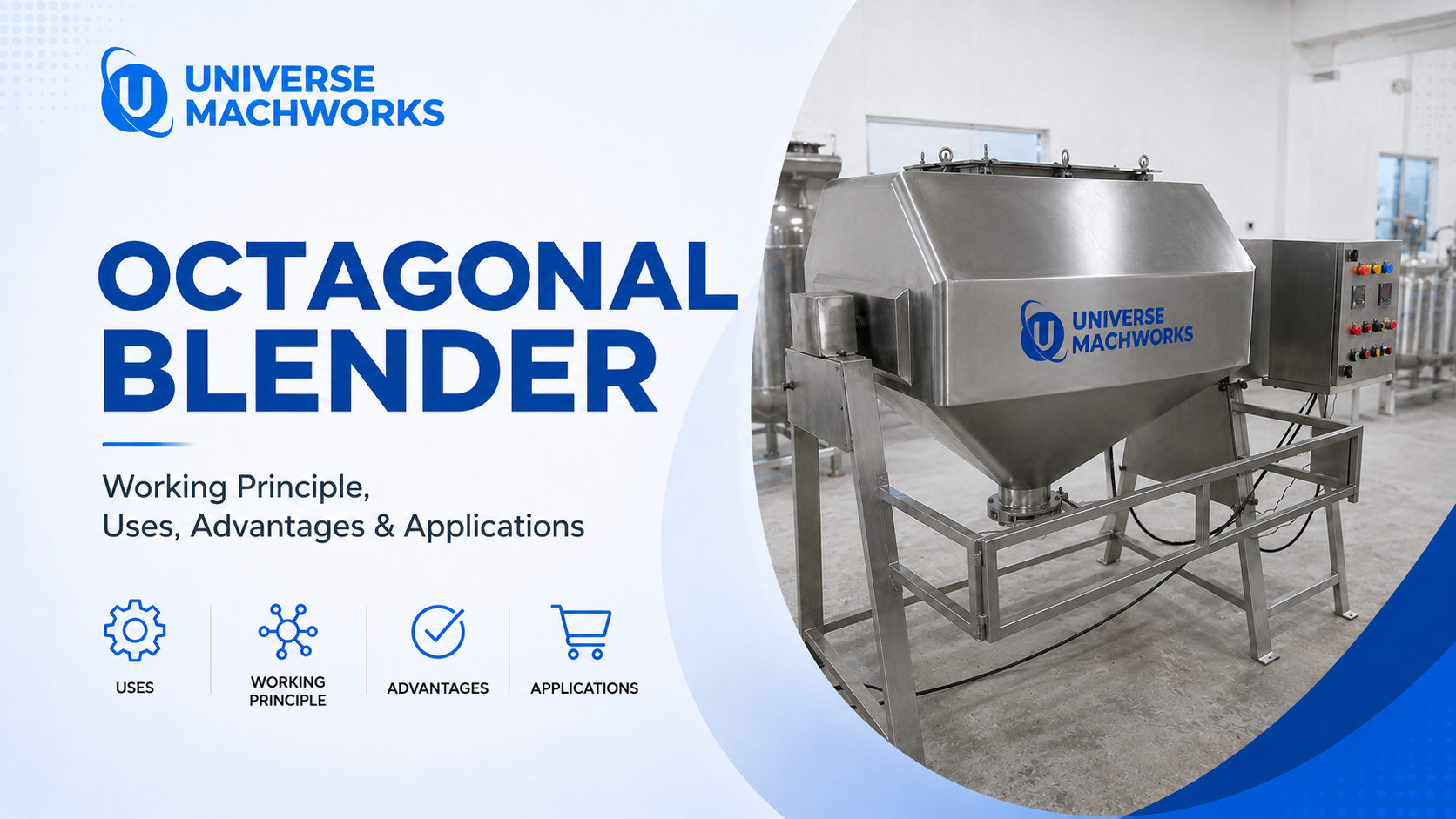
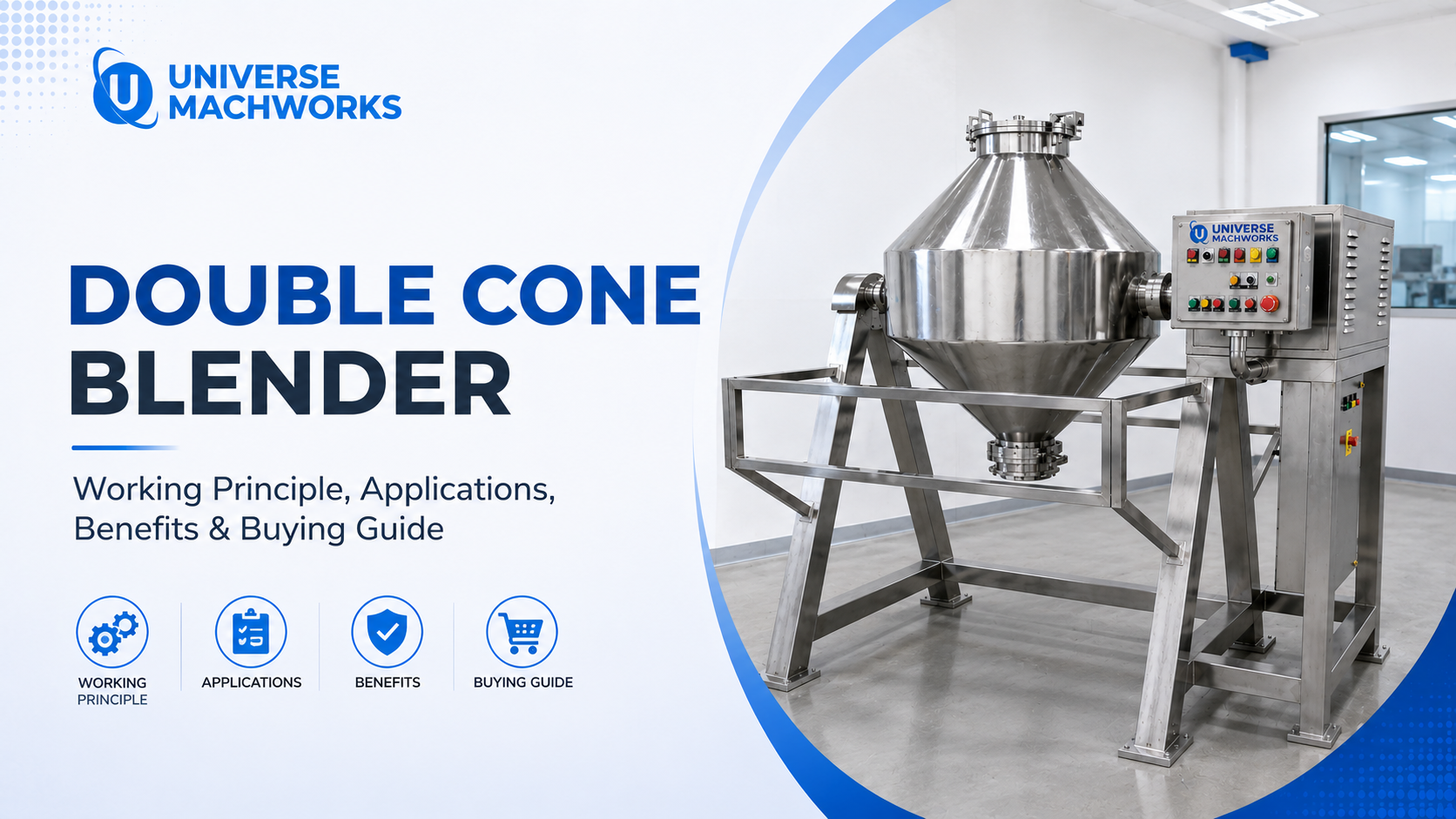
A ribbon blender is not automatically the right choice for every pharmaceutical powder. Other options include Octagonal Blenders, Double Cone Blenders, Bin Blenders, V-Blenders, High-Shear Mixers, and Mass Mixers.
| Factor | Ribbon Blender | Octagonal Blender | Double Cone Blender |
|---|---|---|---|
| Typical configuration | Horizontal trough | Rotating octagonal vessel | Rotating double-cone vessel |
| Common use | Powder/granule mixing | Powder/granule blending | Powder/granule blending |
| Mixing mechanism | Ribbon agitation | Vessel rotation | Vessel rotation |
| Process suitability | Depends on material | Depends on material | Depends on material |
| Cleaning requirements | Application-dependent | Application-dependent | Application-dependent |
| Automation | Available by configuration | Available by configuration | Available by configuration |
There is no universal best blender. The correct choice depends on the formulation and process.
Compare pharmaceutical blending equipment
How to Choose Ribbon Blender Capacity
The answer to ‘What ribbon blender capacity do I need?’ depends on more than desired batch weight.
Step 1
Determine the required batch weight.
Step 2
Determine the bulk density of the material.
Step 3
Convert batch weight into approximate occupied volume.
Step 4
Consider the appropriate working fill level.
Step 5
Consider minimum and maximum batch sizes.
Step 6
Discuss the final machine size with the manufacturer.
Questions to Ask a Ribbon Blender Manufacturer
Machine Design
- What ribbon configuration is proposed?
- What are the working and total volumes?
- What material of construction is being used?
Process
- What materials is the machine designed to mix?
- What batch-size range is recommended?
- How should the machine be loaded?
- What discharge arrangement is proposed?
Construction
- What stainless-steel grade is specified?
- Which parts are product-contact?
- What surface finish is provided?
- How are product-contact welds finished?
Controls and Support
- What control panel and safety interlocks are included?
- Is PLC/HMI automation available?
- What testing and documentation are supplied?
- Are installation support, spare parts, and after-sales service available?
Common Mistakes When Buying a Ribbon Blender
Choosing Capacity Based Only on Kilograms
Bulk density and working volume also need to be considered.
Selecting the Cheapest Machine
Initial price should not be the only criterion. Construction, maintenance, cleaning, service, and lifecycle requirements should also be evaluated.
Ignoring Product Characteristics or Minimum Batch Size
A blender that works well for one powder may perform differently with another, and a large machine may not be appropriate for small batches.
Ignoring Cleaning, Discharge, or Maintenance Access
Internal design must support cleaning and inspection, discharge must suit the downstream process, and service components should remain accessible.
Over-Specifying Material Without Process Evaluation
SS316L may be appropriate for some applications, but material selection should be based on actual process requirements.
New vs Refurbished Ribbon Blender
New Ribbon Blender
A new machine can be configured around the required capacity, material of construction, discharge, automation, dimensions, process requirements, and customer specifications.
Refurbished Ribbon Blender
A refurbished machine may suit a company seeking previously operated equipment that has undergone a defined restoration or servicing process.
- Machine condition
- Previous use where available
- Refurbishment work completed
- Components replaced
- Product-contact condition
- Testing
- Documentation
- Remaining service requirements
Used and refurbished should not automatically be treated as the same. Buyers should understand exactly what work has been performed.
Why Choose an Experienced Ribbon Blender Manufacturer?
Machine quality depends on more than the stainless-steel sheet. A capable manufacturer should understand powder behavior, mixing principles, fabrication, material selection, product-contact requirements, machine layout, drive requirements, cleaning, discharge, and customer-specific needs.
An experienced manufacturer can translate process requirements into a practical equipment specification. This discussion is especially important because machines with the same nominal capacity can be configured differently for different uses.
Why Choose Universe Mach Works?
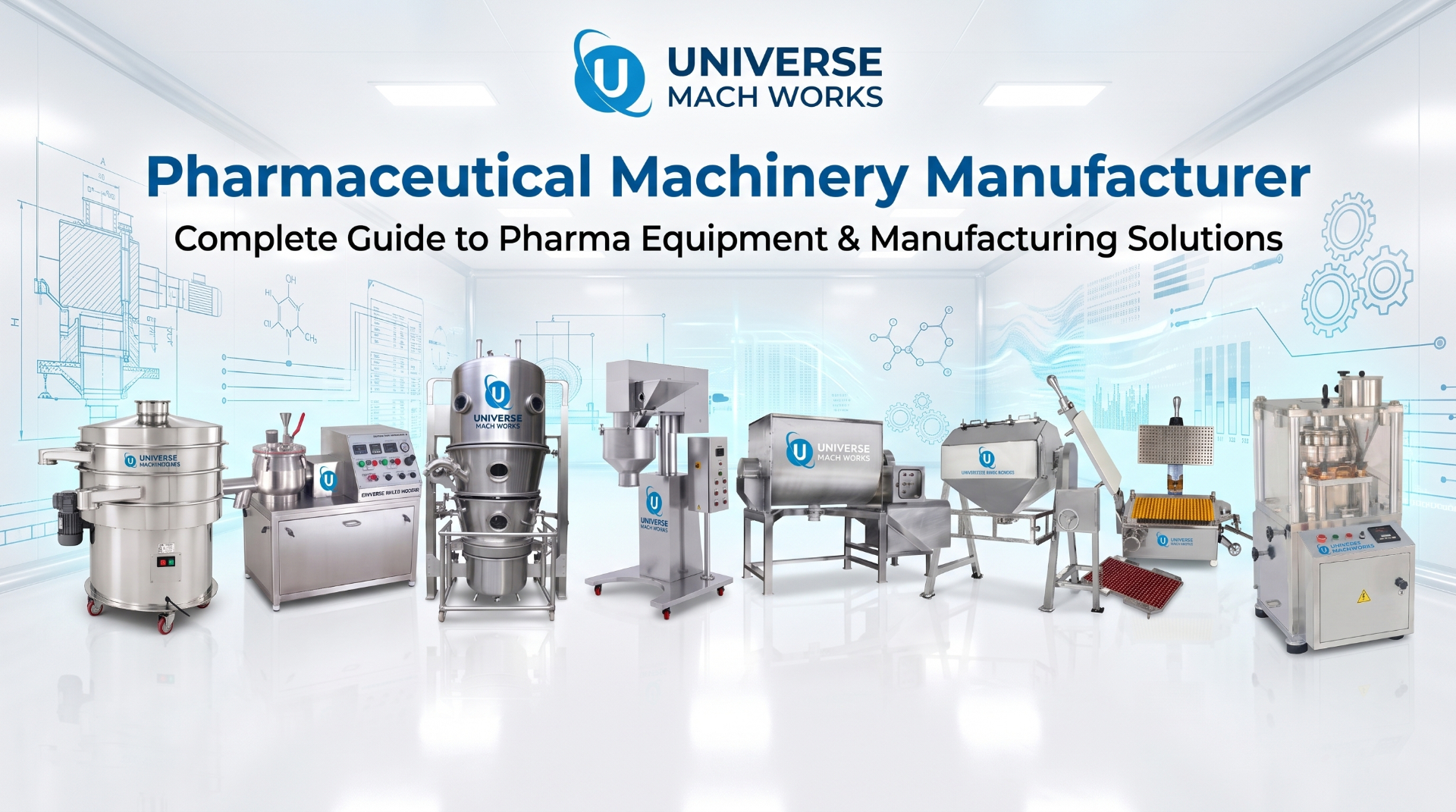
Universe Mach Works manufactures pharmaceutical and process machinery for pharmaceutical and allied manufacturing applications, including mixing, blending, granulation, drying, milling, sieving, tablet processing, capsule processing, filtration, and liquid processing equipment.
Ribbon Blender projects can be discussed according to batch capacity, construction material, product-contact requirements, mixing application, discharge arrangement, machine dimensions, controls, and customization. Customers should provide material characteristics, batch size, process requirements, and preferred configuration so the equipment can be specified appropriately.
Discuss your Ribbon Blender requirement
Ribbon Blender Selection Checklist
Product
- ☐ Product type identified
- ☐ Bulk density available
- ☐ Particle size understood
- ☐ Flowability evaluated
- ☐ Moisture content considered
- ☐ Product sensitivity considered
Capacity
- ☐ Batch weight defined
- ☐ Working volume considered
- ☐ Minimum batch size defined
- ☐ Maximum batch size defined
- ☐ Future requirements considered
Construction
- ☐ SS304/SS316L requirement defined
- ☐ Product-contact components identified
- ☐ Surface finish specified
- ☐ Weld quality discussed
Machine and Controls
- ☐ Ribbon configuration discussed
- ☐ Motor and drive selected appropriately
- ☐ Discharge and loading arrangements defined
- ☐ Maintenance access checked
- ☐ Manual or automatic operation decided
- ☐ PLC/HMI and safety requirements discussed
Project
- ☐ Plant dimensions checked
- ☐ Installation requirements discussed
- ☐ Testing defined
- ☐ Documentation agreed
- ☐ Spare-parts support confirmed
- ☐ After-sales service discussed
How Do You Choose a Ribbon Blender?
To choose the right ribbon blender, evaluate the material characteristics, batch size, bulk density, working volume, mixing requirements, material of construction, cleaning requirements, discharge arrangement, automation level, available installation space, and after-sales support. Select the final machine configuration for the specific product and process rather than capacity alone.
What Factors Affect Ribbon Blender Selection?
- Material characteristics
- Bulk density
- Particle size
- Batch size
- Working volume
- Mixing requirements
- Material of construction
- Cleaning requirements
- Discharge arrangement
- Automation requirements
- Installation space
- Maintenance and service requirements
Explore the Product
Ribbon Blender Machine by Universe Mach Works
View technical specifications, applications and request a customized quote.
View Ribbon Blender MachineFrequently Asked Questions
What is a ribbon blender used for?+
A ribbon blender is generally used for mixing powders, granules, and other compatible dry or semi-dry materials across pharmaceutical, nutraceutical, food, chemical, cosmetic, and other processing applications.
How do I choose the capacity of a ribbon blender?+
Select capacity using batch weight, bulk density, occupied volume, working fill level, minimum batch size, and maximum batch size rather than batch weight alone.
Is a ribbon blender suitable for pharmaceutical manufacturing?+
It can be suitable for pharmaceutical powder and granule mixing when its design and configuration are appropriate for the product and process.
What material is commonly used for pharmaceutical ribbon blenders?+
Stainless steel is commonly used, with SS304 and SS316L among the grades considered depending on the application and specification.
Is SS316L always required for a pharmaceutical ribbon blender?+
No. Material selection depends on product chemistry, cleaning conditions, corrosion requirements, product-contact requirements, and project specifications.
What is the difference between total volume and working volume?+
Total volume is the overall mixing-chamber volume. Working volume is the practical volume available for the intended operation and depends on machine design and material characteristics.
Can a ribbon blender mix different types of powders?+
It can handle many powder-mixing applications, but suitability depends on particle size, bulk density, flowability, cohesiveness, and segregation behavior.
What should I tell a ribbon blender manufacturer before requesting a quotation?+
Provide the material type, batch weight, bulk density, particle characteristics, production requirement, material-contact requirements, cleaning method, discharge requirement, available space, and automation preferences.
Can ribbon blenders be customized?+
Yes. Depending on the project, customization may include capacity, dimensions, material of construction, discharge arrangement, controls, and other machine features.
Is a ribbon blender better than an octagonal blender?+
Neither is universally better. The right blender depends on the material, process, batch requirements, cleaning needs, and desired mixing mechanism.
Can ribbon blenders be used for nutraceutical products?+
Yes, they can be considered for compatible nutraceutical powder and granule applications, subject to product and process requirements.
What should I check before buying a refurbished ribbon blender?+
Check its condition, operating history where available, refurbishment scope, replaced components, product-contact surfaces, testing, documentation, and remaining maintenance requirements.
Does ribbon blender mixing time remain the same for every product?+
No. Mixing time varies with material properties, batch size, machine configuration, fill level, and process requirements, and should be established for the specific application.
Does a larger ribbon blender always provide better production?+
Not necessarily. An oversized machine may not suit smaller batches or specific material characteristics. Match capacity to actual production requirements.
What makes a good pharmaceutical ribbon blender?+
A suitable machine combines appropriate capacity, material compatibility, effective mixing design, suitable product-contact construction, cleanability, appropriate discharge, reliable operation, and maintainability.
Conclusion
Choosing the right ribbon blender for pharmaceutical manufacturing requires a process-focused approach. The most important considerations are not simply machine capacity or purchase price.
The manufacturer and buyer should evaluate the material, bulk density, particle characteristics, batch size, mixing requirements, construction material, surface condition, cleaning procedure, discharge arrangement, automation, installation space, maintenance, and service support.
A useful sequence is: Understand the Product → Define the Process → Calculate Capacity → Select Construction → Configure the Blender → Evaluate Cleaning & Discharge → Finalize Controls → Test & Commission.
By following this approach, pharmaceutical manufacturers can make a more informed decision when comparing ribbon blender machines and suppliers. The objective should be to find a supplier capable of understanding the application and translating those requirements into an appropriate machine configuration—not simply supplying a standard machine based on capacity.