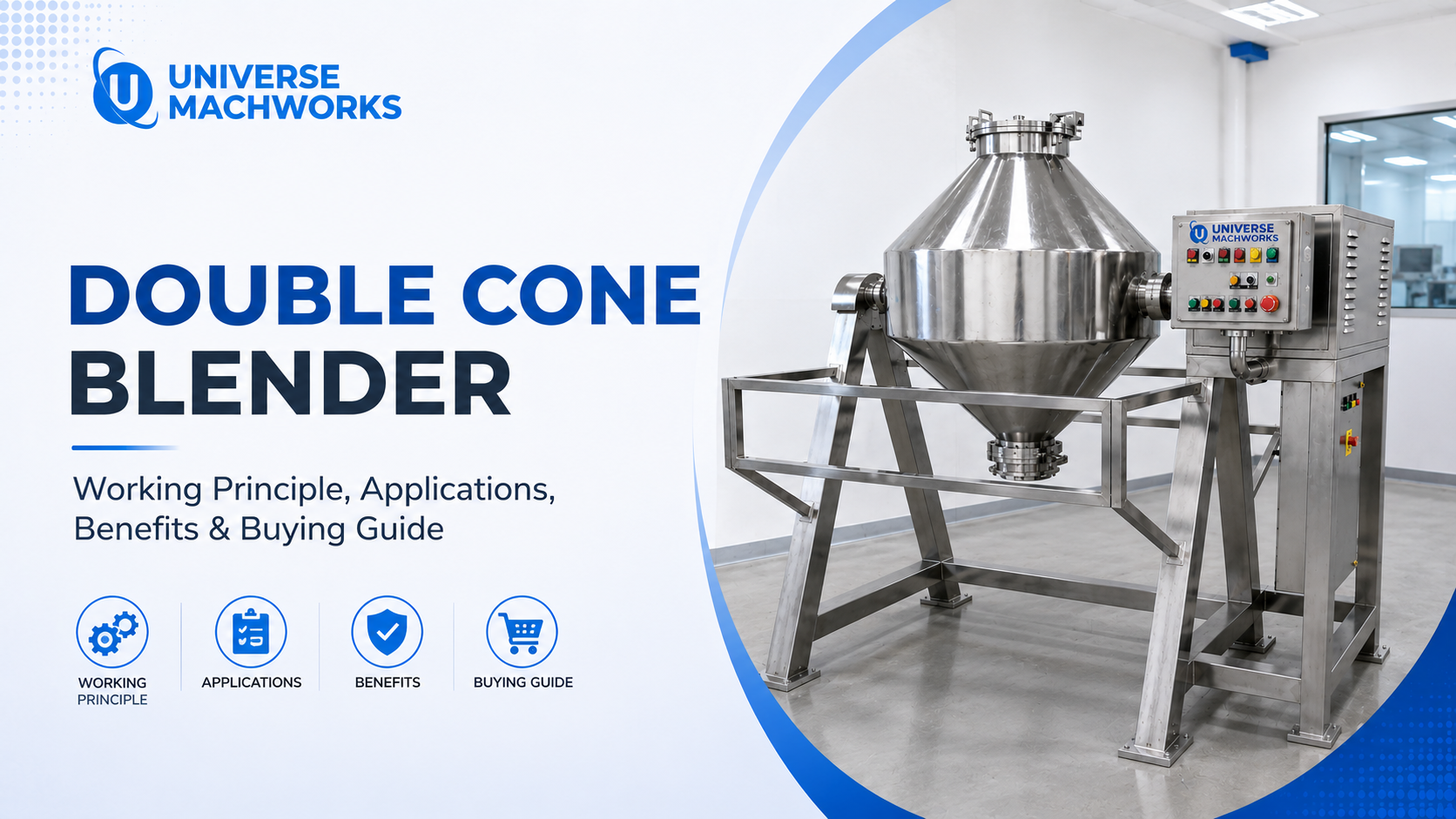
In pharmaceutical manufacturing, achieving a uniform blend of powders and granules is one of the most critical steps in ensuring product quality. Whether manufacturing tablets, capsules, nutraceutical supplements, food premixes, cosmetics, or specialty chemicals, consistent mixing directly influences the final product's performance, dosage accuracy, and stability. This is where the Double Cone Blender plays a vital role.
A Double Cone Blender is one of the most widely used powder blending machines in the pharmaceutical and process industries. Known for its simple design, gentle tumbling action, and high blending efficiency, it is ideal for mixing dry powders and free-flowing granules without causing particle degradation or excessive heat generation. The machine delivers excellent homogeneity while preserving the physical characteristics of sensitive ingredients.
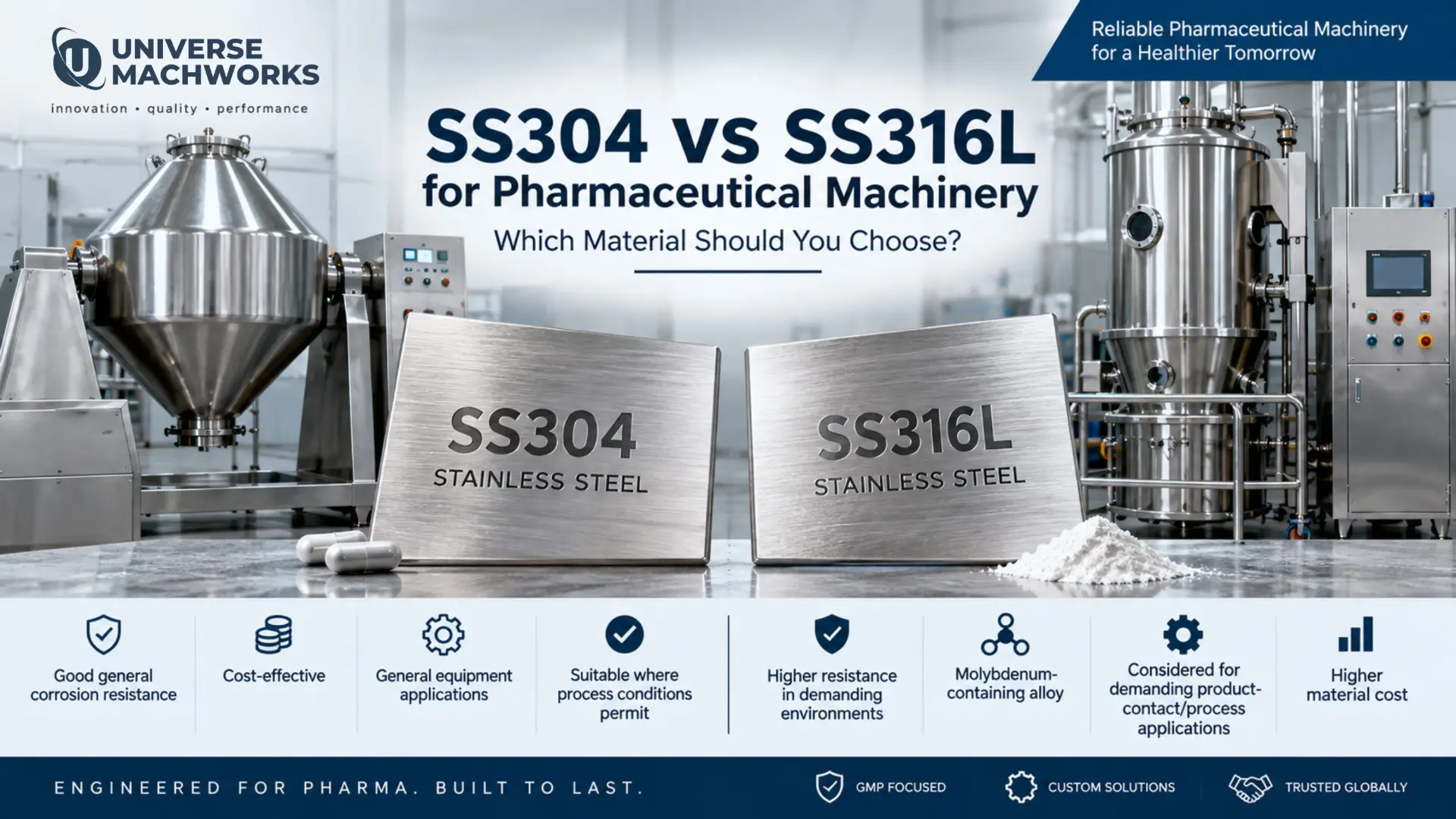
Modern Double Cone Blenders are designed according to GMP and cGMP standards, using high-quality SS304 and SS316L stainless steel to ensure hygienic operation, corrosion resistance, and easy cleaning. Their low-energy operation, robust construction, and versatility make them an essential part of pharmaceutical production lines worldwide.
Apart from pharmaceuticals, Double Cone Blenders are widely used in nutraceutical, food processing, cosmetic, chemical, herbal, and veterinary industries. They are suitable for blending ingredients of different bulk densities and particle sizes, making them one of the most versatile powder mixing solutions available.
As experienced pharmaceutical machinery manufacturers, we understand that selecting the right blending equipment can significantly improve production efficiency, reduce batch variation, and lower operating costs. In this comprehensive guide, you'll learn everything about the Double Cone Blender, including its working principle, components, blending process, applications, advantages, capacity range, and how it compares with other industrial blending machines.
What is a Double Cone Blender?
A Double Cone Blender is a batch-type powder blending machine designed to mix dry powders and free-flowing granules using a gentle tumbling action. It consists of two conical sections joined at their wider ends to form a double-cone-shaped mixing vessel. As the vessel rotates slowly around its horizontal axis, the material continuously cascades and tumbles inside, resulting in uniform mixing without mechanical agitation.
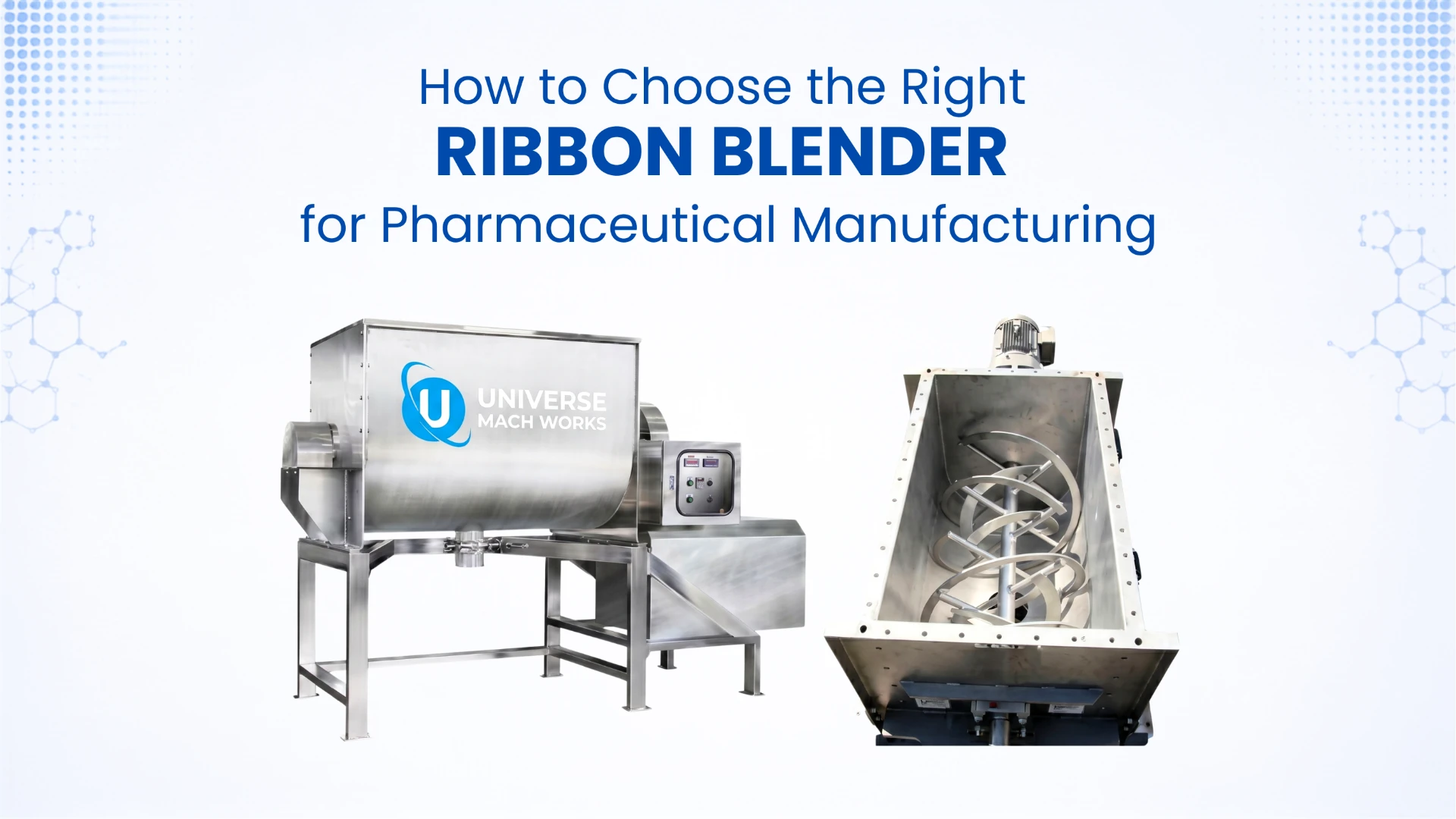
Unlike ribbon blenders or high-shear mixers, the Double Cone Blender relies entirely on gravity and rotational movement rather than internal mixing blades. This gentle blending action minimizes product degradation, making it ideal for fragile, heat-sensitive, or abrasive materials.
Because no high-speed impellers come into contact with the product, the machine generates very little friction or heat during operation. This helps preserve particle integrity and maintain the quality of sensitive pharmaceutical formulations.
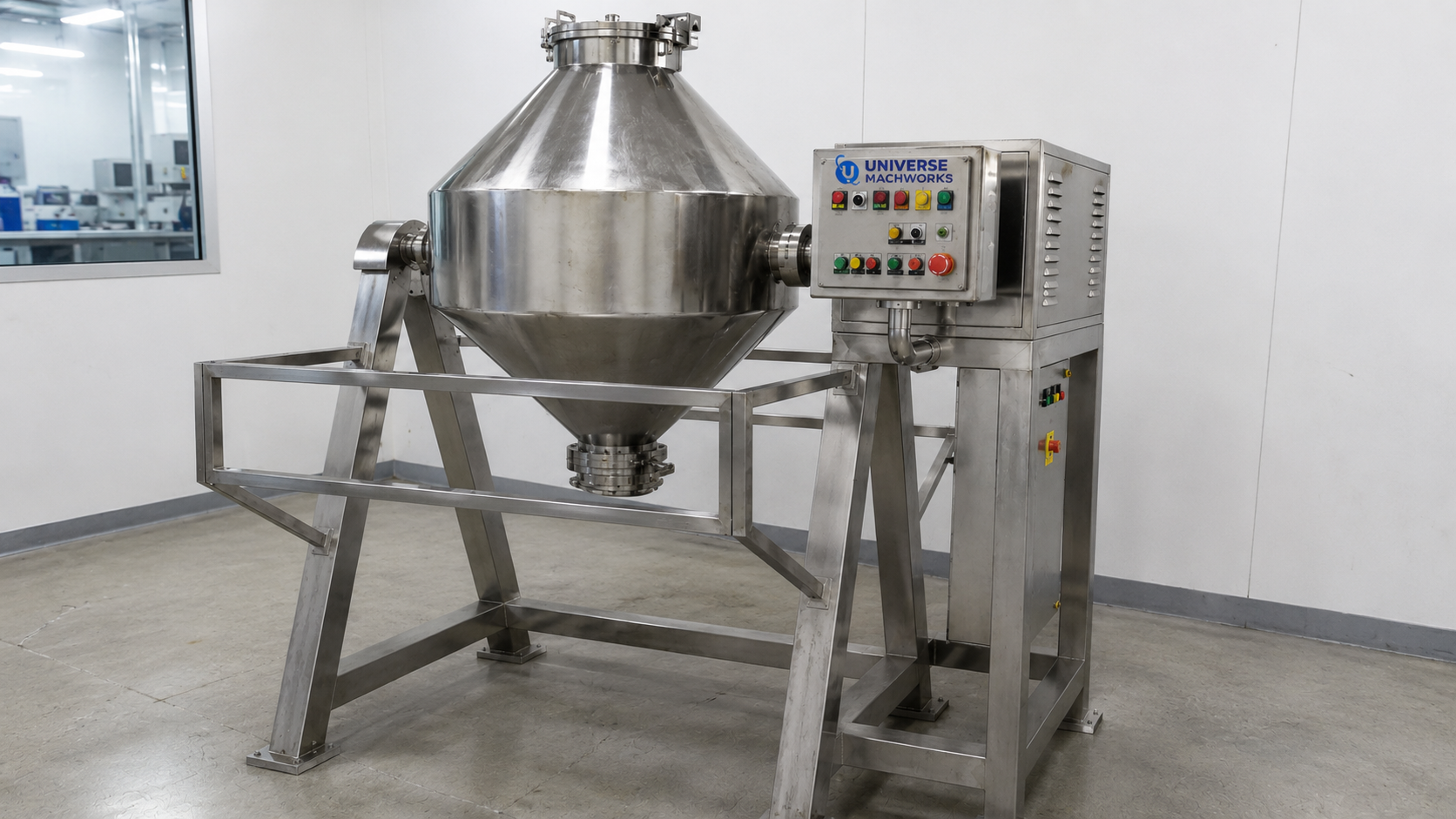
Double Cone Blenders are commonly used for blending:
- Pharmaceutical powders
- Tablet granules
- Capsule formulations
- Herbal powders
- Nutraceutical ingredients
- Food additives
- Chemical powders
- Cosmetic ingredients
These machines are valued for their simple design, low maintenance, excellent blending uniformity, and ease of cleaning, making them a preferred choice in industries where hygiene and consistency are critical.
Working Principle of a Double Cone Blender
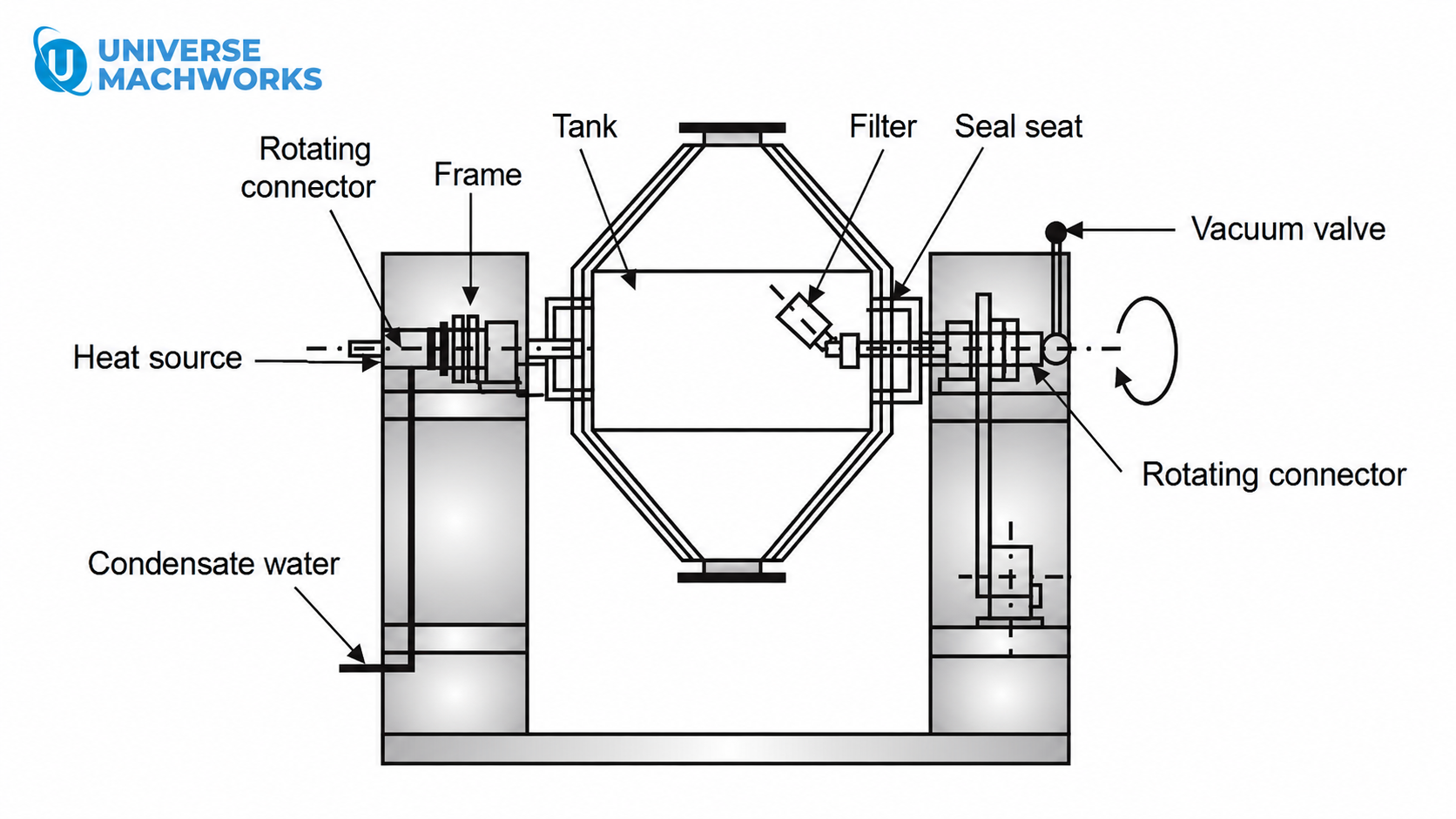
The working principle of a Double Cone Blender is based on tumbling and diffusion mixing. As the conical vessel rotates at a controlled speed, the material inside repeatedly moves from one cone to the other under the influence of gravity. This continuous cascading and folding action causes particles to redistribute evenly throughout the batch.
Unlike machines that rely on mechanical paddles or ribbons, the Double Cone Blender achieves homogeneous mixing through natural particle movement, reducing shear forces and protecting delicate materials.
Step 1: Material Loading
Measured quantities of powders or granules are loaded into the blender through the charging port. For optimum performance, the vessel is typically filled to 40–70% of its total capacity, allowing sufficient space for free movement of the material.
Step 2: Rotation Begins
The geared motor rotates the double-cone vessel at a predetermined speed. The rotational speed is carefully selected to achieve efficient mixing without causing segregation or excessive particle impact.
Step 3: Tumbling Action
As the vessel rotates, the material continuously tumbles from one side to the other. The changing geometry of the cone causes particles to repeatedly split, fold, and recombine, creating a highly uniform mixture.
Step 4: Diffusion Mixing
Individual particles move randomly throughout the vessel, eliminating concentration differences and producing a homogeneous blend without damaging the product.
Step 5: Blending Completion
After the required mixing time, typically between 10 and 30 minutes depending on the formulation, the machine stops automatically or manually.
Step 6: Material Discharge
The blended material is discharged through a butterfly valve or manually operated discharge port into containers or downstream processing equipment. The absence of internal agitators makes discharge easy while minimizing product retention and simplifying cleaning.
Types of Double Cone Blenders
Different manufacturing applications require different machine configurations. Modern pharmaceutical machinery manufacturers offer several types of Double Cone Blenders depending on production requirements.
1. Standard Double Cone Blender
The most commonly used model, designed for blending dry powders and granules in pharmaceutical, food, cosmetic, and chemical industries. Applications include tablet formulations, capsule blends, nutraceutical powders, and food ingredients.
2. Double Cone Blender with Intensifier Bar
Some formulations contain ingredients with poor flow properties or require breaking of soft agglomerates. An optional intensifier bar rotates at high speed inside the vessel to improve mixing and eliminate lumps while the vessel continues its tumbling motion. Ideal for cohesive powders, fine chemical blends, and difficult pharmaceutical formulations.
3. Vacuum Double Cone Blender
This configuration allows blending under vacuum conditions, reducing oxidation and preventing contamination. Suitable for moisture-sensitive products, oxygen-sensitive formulations, specialty chemicals, and high-value pharmaceutical ingredients.
4. Jacketed Double Cone Blender
A jacket surrounding the vessel allows heating or cooling during the blending process. Applications include temperature-sensitive materials, controlled drying, and specialized chemical processing.
5. Customized Double Cone Blender
Leading pharma machinery manufacturers also provide customized machines based on capacity, material of construction, automation level, PLC controls, VFD operation, discharge arrangement, and loading system. Customized solutions help manufacturers integrate the blender into existing production lines.
Main Components of a Double Cone Blender
- Double Cone Vessel — stainless steel double-cone-shaped chamber where blending takes place
- Charging Port — top-mounted loading opening with a secure lid to prevent contamination
- Butterfly Discharge Valve — bottom-mounted valve for quick and complete unloading
- Geared Drive System — heavy-duty geared motor rotates the vessel at controlled speeds
- Supporting Frame — robust fabricated frame that maintains operational stability
- Control Panel — Start/Stop controls, digital timer, VFD, PLC and optional HMI
- Bearings & Shaft Assembly — high-quality bearings for reduced vibration and long life
- Safety Guards — protective covers and interlock systems for operator safety
Step-by-Step Blending Process
- Step 1: Raw Material Preparation — ingredients are accurately weighed as per formulation
- Step 2: Loading — required quantity is loaded through the charging port
- Step 3: Vessel Rotation — geared motor rotates the vessel at controlled speed
- Step 4: Mixing — materials cascade, divide and recombine until homogeneous
- Step 5: Quality Verification — blend samples tested to verify uniformity if required
- Step 6: Material Discharge — finished blend discharged into containers or downstream equipment
Applications of Double Cone Blender
Pharmaceutical Industry
- Tablet formulations
- Capsule formulations
- API blending
- Excipient mixing
- Dry powder blending
Nutraceutical Industry
- Protein powders
- Vitamin formulations
- Health supplements
- Herbal powders
Food Processing Industry
- Spice blends
- Flour premixes
- Beverage powders
- Dairy ingredients
- Bakery premixes
Cosmetic Industry
- Face powders
- Talcum powder
- Cosmetic additives
- Beauty formulations
Chemical Industry
- Pigments
- Fine chemicals
- Industrial powders
- Specialty chemical formulations
Herbal & Ayurvedic Industry
- Herbal extracts
- Ayurvedic powders
- Botanical ingredients
- Natural health products
Industries Served
- Pharmaceutical Manufacturing
- Nutraceutical Companies
- Food Processing Plants
- Cosmetic Manufacturers
- Chemical Industries
- Herbal Medicine Manufacturers
- Ayurvedic Product Companies
- Veterinary Pharmaceutical Companies
- Biotechnology Industries
- Research & Development Laboratories
Benefits of Double Cone Blender
- Excellent Mixing Uniformity — highly homogeneous blending of powders and granules
- Gentle Mixing Action — prevents particle degradation and maintains product integrity
- Low Heat Generation — suitable for heat-sensitive formulations
- Minimal Product Loss — efficient discharge reduces material wastage
- Easy Cleaning — simple construction allows quick cleaning and batch changeovers
- GMP-Compliant Design — manufactured using hygienic SS304 and SS316L stainless steel
- Low Maintenance — few moving parts result in reduced maintenance requirements
- Energy Efficient — consumes less power compared to high-shear mixing equipment
- Long Equipment Life — robust construction ensures years of reliable industrial operation
Features of Double Cone Blender
- GMP-compliant construction
- SS304 / SS316L stainless steel
- Mirror-polished internal surfaces
- Heavy-duty geared motor
- Smooth and silent operation
- Variable speed control (optional)
- PLC & HMI automation (optional)
- Intensifier bar (optional)
- Butterfly discharge valve
- Easy loading and unloading
- Hygienic design
- Low vibration
- Low power consumption
- Easy maintenance
- Long service life
Capacity Range
| Working Capacity | Typical Application |
|---|---|
| 5–25 Litres | Laboratory & R&D |
| 50–100 Litres | Pilot Production |
| 200–500 Litres | Small Manufacturing |
| 750–1000 Litres | Medium Production |
| 1500–3000 Litres | Large Industrial Plants |
| Custom Capacities | Available on Request |
Double Cone Blender vs Ribbon Blender vs Octagonal Blender
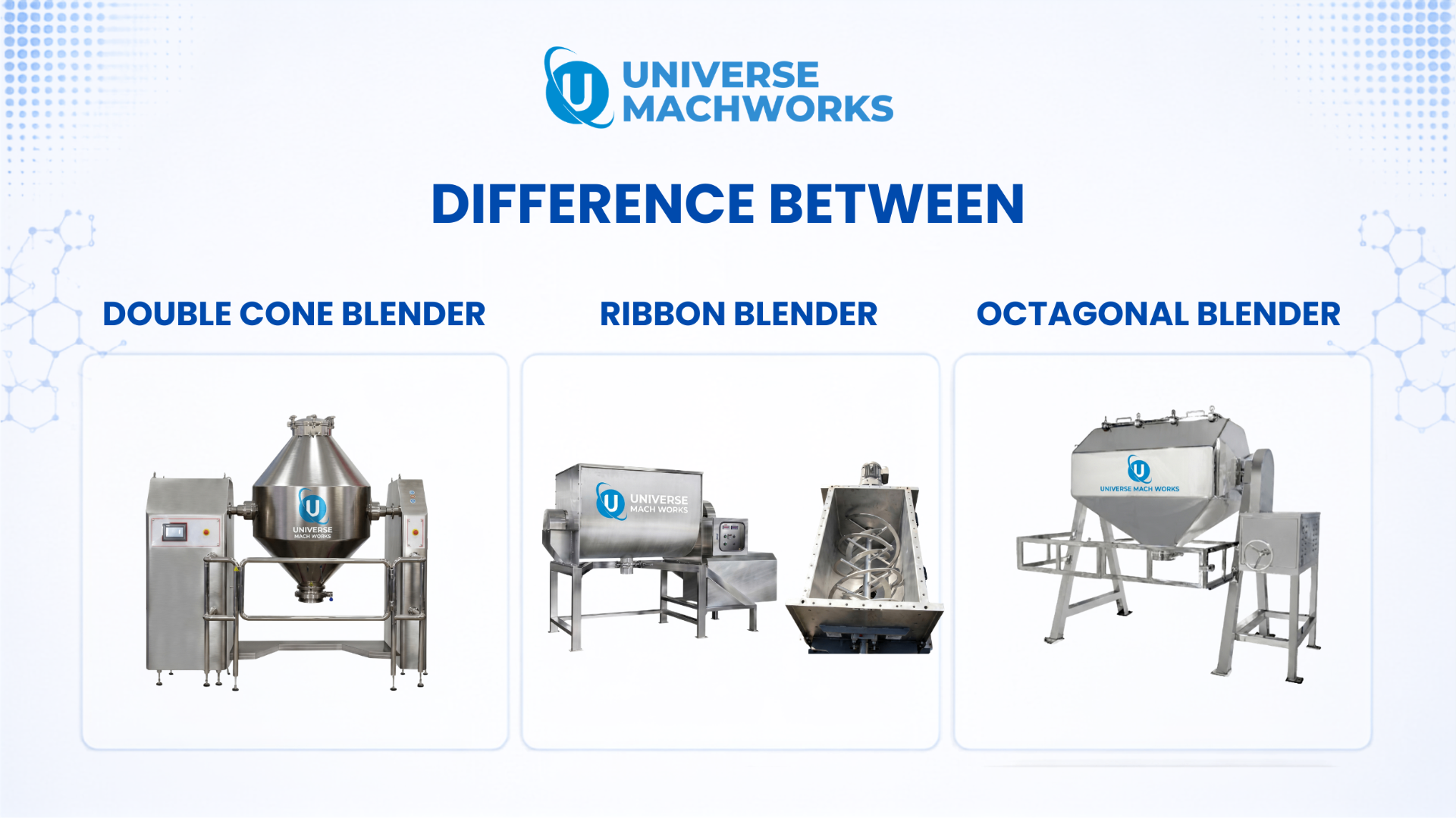
| Feature | Double Cone Blender | Ribbon Blender | Octagonal Blender |
|---|---|---|---|
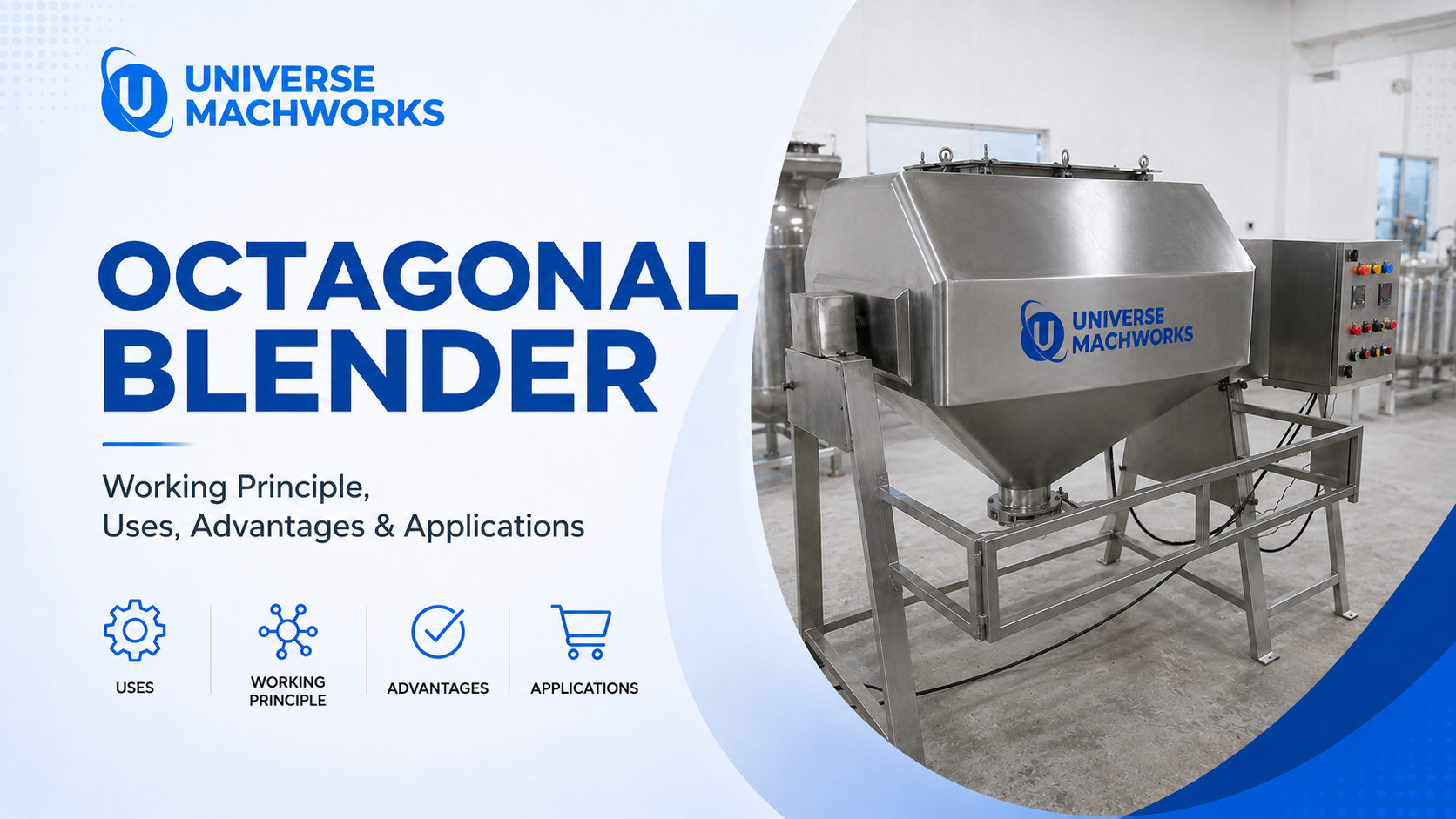
| Mixing Principle | Tumbling | Ribbon Agitation | Tumbling |
| Product Type | Dry Powders & Granules | Powders, Pastes & Bulk | Pharma Powders & Granules |
| Particle Damage | Very Low | Moderate | Very Low |
| Heat Generation | Minimal | Higher | Minimal |
| Mixing Uniformity | Excellent | Excellent | Excellent |
| Cleaning | Easy | Moderate | Easy |
| Power Consumption | Low | Moderate | Low |
| GMP Suitability | Excellent | Good | Excellent |
| Best For | Pharma & Nutraceutical Powders | Bulk Industrial Mixing | High-Precision Pharma Blending |
Double Cone Blender Buying Guide
Purchasing a Double Cone Blender is an important investment for pharmaceutical, nutraceutical, food processing, cosmetic, and chemical manufacturers. The right blender improves product consistency, production efficiency, and compliance with GMP standards, while the wrong choice can result in poor mixing, excessive downtime, increased maintenance costs, and inconsistent product quality.
A Double Cone Blender is often one of the most frequently used machines in powder processing lines. Since it directly influences blend uniformity, every purchasing decision should be based on technical requirements rather than price alone.
1. Production Capacity
The first consideration should always be your production requirements — batch size, number of batches per day, expected growth, and future expansion. Double Cone Blenders are available from 5 Litres for R&D to 3000 Litres or more for industrial production.
2. Product Characteristics
The machine should match the physical properties of the materials being blended: powder density, particle size, moisture content, flowability, particle fragility, and abrasiveness. Materials with high cohesiveness may require an optional intensifier bar.
3. Material of Construction
Choose machines manufactured using SS304, SS316 stainless steel with SS316L product contact parts for corrosion resistance, hygienic operation, easy cleaning, and GMP compliance.
4. Mixing Efficiency
A good Double Cone Blender should produce a highly homogeneous blend with minimal mixing time. Evaluate mixing uniformity, cycle duration, blend reproducibility, product retention, and discharge efficiency.
5. Automation Level
Modern Double Cone Blenders may include PLC controls, touchscreen HMI, digital timer, VFD, recipe management, and automatic cycle control — improving process consistency and reducing operator intervention.
6. Ease of Cleaning
Look for smooth internal surfaces, mirror-polished finish, easy dismantling, quick discharge, hygienic welds, and minimal dead zones to minimize downtime and contamination risks.
7. Safety Features
Choose machines equipped with emergency stop, safety guards, interlock systems, motor overload protection, protective covers, and a stable support frame.
8. Power Consumption
Modern geared drive systems provide low power consumption, smooth rotation, quiet operation, and reduced vibration, contributing to long-term savings.
9. Spare Parts & Technical Support
Confirm that the manufacturer provides genuine spare parts, technical support, installation, commissioning, preventive maintenance, and operator training.
10. Future Expansion
Choose a manufacturer capable of providing larger capacity models, automation upgrades, customized discharge systems, process integration, and additional accessories.
Common Buying Mistakes
- Buying based only on cost — leads to breakdowns, poor quality and short equipment life
- Ignoring production growth — undersized equipment often needs replacing
- Choosing incorrect capacity — oversized wastes energy, undersized limits productivity
- Ignoring material compatibility — poor blending performance for cohesive powders
- Poor quality construction — non-pharma grade steel causes corrosion and hygiene issues
- Overlooking after-sales support — delayed spares and downtime hurt production
- Skipping Factory Acceptance Testing (FAT) before dispatch
Maintenance Guide
Daily Maintenance
- Clean internal surfaces after every batch
- Inspect discharge valve
- Remove powder residues
- Check unusual noises
- Verify smooth rotation
Weekly Maintenance
- Inspect motor condition
- Tighten fasteners
- Check bearings
- Inspect safety guards
- Clean external surfaces
Monthly Maintenance
- Lubricate bearings
- Inspect gearbox
- Check electrical wiring
- Verify timer operation
- Inspect drive coupling
Annual Maintenance
- Replace worn seals
- Service geared motor
- Inspect frame alignment
- Replace damaged bearings
- Calibrate control system
- Complete preventive inspection
Cleaning & GMP Compliance
Cleaning is one of the most important aspects of pharmaceutical manufacturing. Improper cleaning can cause cross-contamination, product recalls, regulatory violations, and batch rejection.
GMP Features
- SS304 / SS316L construction
- Mirror polished surface
- Hygienic welding
- Easy dismantling
- Food-grade gaskets
- Minimal dead zones
- Smooth internal finish
Recommended Cleaning Procedure
- Stop the machine and disconnect power
- Empty all remaining product from the vessel
- Open the charging lid and discharge valve
- Clean all product-contact surfaces using approved pharmaceutical cleaning agents
- Rinse thoroughly and dry all components completely
- Inspect internal surfaces and reassemble as per SOP
- Document the cleaning process for GMP records
Troubleshooting
| Problem | Possible Cause | Solution |
|---|---|---|
| Poor Mixing Uniformity | Overloaded vessel | Reduce batch size to recommended fill level |
| Powder Segregation | Incorrect mixing speed | Optimize rotational speed and mixing time |
| Excessive Vibration | Loose fasteners | Tighten mounting bolts and inspect bearings |
| Gear Motor Overheating | Overloading or poor ventilation | Reduce load and inspect motor cooling |
| Powder Leakage | Worn gaskets or improper lid seal | Replace seals and check lid alignment |
| Slow Discharge | Product bridging or valve obstruction | Clean discharge valve and inspect flow |
| Abnormal Noise | Bearing wear or lack of lubrication | Lubricate or replace bearings |
| Machine Fails to Start | Electrical fault / overload trip | Check power supply, controls and motor protection |
ROI Analysis
Although a high-quality Double Cone Blender represents a significant capital investment, it provides excellent long-term returns by improving product quality, reducing waste, and increasing manufacturing efficiency.
- Higher blending efficiency
- Uniform batch quality
- Reduced product rejection
- Lower maintenance costs
- Minimal product wastage
- Reduced labor requirements
- Low energy consumption
- Long equipment lifespan
- Better GMP compliance
- Increased production capacity
| Parameter | Low-Quality Blender | Premium Double Cone Blender |
|---|---|---|
| Mixing Uniformity | Moderate | Excellent |
| Product Loss | Higher | Minimal |
| Energy Consumption | Higher | Lower |
| Maintenance Cost | High | Low |
| Machine Life | Shorter | Longer |
| ROI | Moderate | Excellent |
Industry Trends
The demand for advanced powder blending equipment continues to grow as pharmaceutical manufacturing becomes increasingly automated and quality-driven.
Smart Manufacturing
- PLC automation
- Touchscreen HMIs
- Recipe storage
- Production monitoring
- Digital timers
- Process data recording
Industry 4.0 Integration
- IoT-enabled equipment
- Predictive maintenance
- Remote diagnostics
- Cloud-based production monitoring
- Real-time performance analytics
Energy-Efficient Equipment
- High-efficiency geared motors
- Variable Frequency Drives (VFD)
- Lower power consumption
- Reduced operating costs
- Sustainable manufacturing practices
GMP-Focused Designs
- Hygienic construction
- Easy cleaning
- Minimal product retention
- Faster batch changeovers
- Improved validation support
Why Choose Universe Mach Works?
Choosing the right Double Cone Blender manufacturer is just as important as choosing the machine itself. At Universe Mach Works, we design and manufacture GMP-compliant pharmaceutical machinery that delivers reliable performance, long service life, and consistent product quality. Our Double Cone Blenders are engineered for pharmaceutical, nutraceutical, food, cosmetic, herbal, and chemical industries.
- GMP & cGMP compliant design
- SS304 & SS316L stainless steel construction
- Excellent mixing uniformity
- Precision engineering
- Heavy-duty geared drive system
- Low power consumption
- Hygienic mirror finish
- Easy cleaning & maintenance
- Optional PLC & touchscreen HMI
- Variable Frequency Drive (VFD) option
- Customized capacities available
- Fast spare parts availability
- Installation & commissioning support
- Experienced engineering team
- Pan India supply & export-ready machinery
- Competitive pricing and reliable after-sales service
Explore the Product
Double Cone Blender by Universe Mach Works
View technical specifications, applications and request a customized quote.
View Double Cone BlenderFrequently Asked Questions
What is a Double Cone Blender?+
A Double Cone Blender is a batch-type blending machine used to uniformly mix dry powders and granules through gentle tumbling.
What materials can be blended?+
It can blend pharmaceutical powders, granules, nutraceutical ingredients, food premixes, cosmetic powders, herbal formulations, and chemical powders.
Which industries use Double Cone Blenders?+
Pharmaceutical, nutraceutical, food processing, cosmetic, herbal, chemical, veterinary and biotechnology industries.
What is the working principle of a Double Cone Blender?+
The rotating double-cone vessel creates continuous tumbling and diffusion mixing, producing a homogeneous blend without mechanical agitation.
What is the recommended filling level?+
Typically, 40–70% of the total vessel capacity is recommended to ensure efficient tumbling and uniform mixing.
What is the ideal mixing time?+
Most pharmaceutical formulations achieve uniform mixing within 10–30 minutes, depending on material properties and batch size.
Can a Double Cone Blender mix granules?+
Yes. It is suitable for blending dry powders, granules, and free-flowing materials.
Is it suitable for fragile materials?+
Yes. Since there are no internal agitators, the gentle tumbling action minimizes particle breakage.
What material is used for construction?+
High-quality machines are manufactured using SS304 or SS316L stainless steel for superior hygiene and corrosion resistance.
Is a Double Cone Blender GMP compliant?+
Yes. Modern machines are designed to meet GMP and cGMP requirements.
What capacities are available?+
Standard capacities range from 5 litres for laboratory use to 3000 litres or more for industrial production.
Can the machine be customized?+
Yes. Capacity, material of construction, automation level, PLC controls, discharge systems, and intensifier bar can all be customized.
How often should the blender be cleaned?+
The machine should be cleaned after every production batch following validated cleaning procedures.
Does Universe Mach Works provide installation and after-sales support?+
Yes. We provide installation assistance, commissioning, operator training, technical support, and genuine spare parts.
Why choose Universe Mach Works?+
Universe Mach Works manufactures precision-engineered, GMP-compliant Double Cone Blenders with robust construction, excellent mixing efficiency, and reliable after-sales support.
Conclusion
A Double Cone Blender is one of the most reliable and efficient powder blending machines used in pharmaceutical and process industries. Its gentle tumbling action, simple design, and ability to achieve excellent mixing uniformity make it ideal for handling dry powders and free-flowing granules without damaging sensitive ingredients.
Compared with other blending technologies, the Double Cone Blender offers lower energy consumption, minimal maintenance, excellent hygiene, and consistent batch quality, making it a preferred choice for pharmaceutical, nutraceutical, food, cosmetic, herbal, and chemical manufacturers.
At Universe Mach Works, we are committed to delivering premium pharmaceutical processing equipment that meets modern manufacturing standards. Our Double Cone Blenders are built with precision engineering, GMP-compliant construction, and durable stainless steel materials to help manufacturers achieve superior mixing performance and long-term operational success.