High-Precision Tablet Compression Machine for Pharmaceutical Tablet Manufacturing
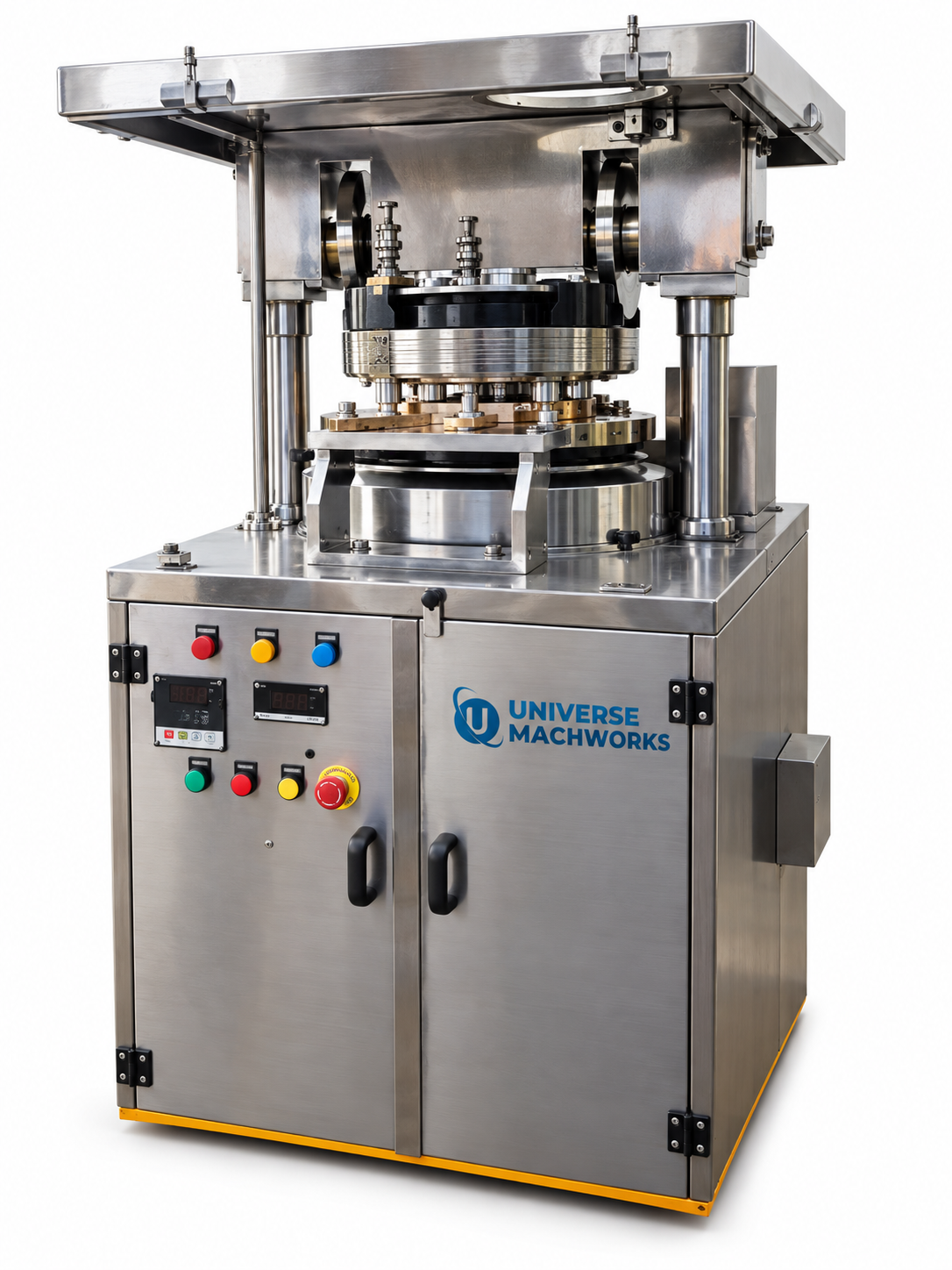
The Tablet Compression Machine is a pharmaceutical manufacturing machine designed to compress prepared powder or granules into tablets of consistent shape, size, weight, and hardness. Also known as a Rotary Tablet Press, the machine is widely used in pharmaceutical, nutraceutical, herbal, and other tablet manufacturing applications.
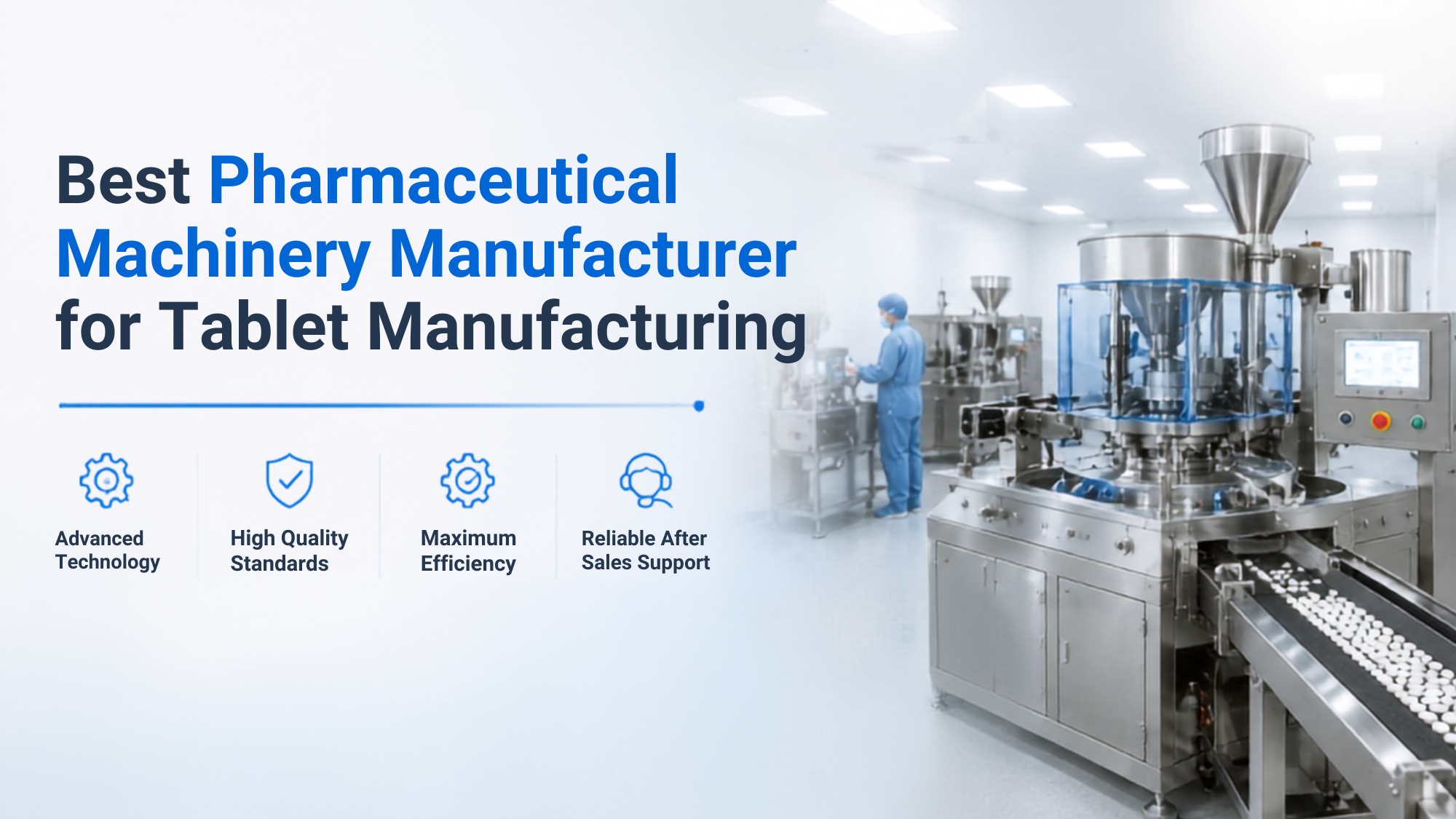
The machine shown features a robust stainless-steel construction, enclosed compression area, rotary tooling arrangement, control panel, and industrial-grade mechanical assembly designed for reliable tablet compression operations.
Universe Mach Works manufactures and supplies pharmaceutical machinery, including new, used, and refurbished tablet compression equipment, with customization available according to production and process requirements.
What is a Tablet Compression Machine?
A Tablet Compression Machine is mechanical equipment used to convert pharmaceutical powder or granulated material into solid tablets by applying controlled compression force.
The material is fed into dies positioned on a rotating turret. Punches compress the material inside the dies to form tablets. The finished tablets are then ejected and collected for subsequent processes such as dedusting, inspection, coating, or packaging.
Tablet compression is one of the most important stages in solid dosage manufacturing because the compression process directly affects tablet characteristics such as:
- Tablet weight
- Thickness
- Hardness
- Shape
- Mechanical strength
- Disintegration characteristics
- Overall tablet quality
Rotary Tablet Press – Working Principle
The working principle of a rotary tablet press is based on controlled powder filling followed by compression and tablet ejection.
The basic process involves:
1. Powder or Granule Feeding
Prepared pharmaceutical powder or granules are supplied to the machine's feed system.
2. Die Filling
The material enters the dies located on the rotating turret. The quantity of material entering each die determines the approximate tablet weight.
3. Weight Adjustment
The filling mechanism and machine settings regulate the amount of material retained in the die cavity.
4. Pre-Compression
Where applicable, the material undergoes an initial compression stage to remove trapped air and improve tablet formation.
5. Main Compression
The upper and lower punches apply controlled compression force to compact the material into the required tablet form.
6. Tablet Ejection
After compression, the lower punch rises and pushes the finished tablet out of the die.
7. Tablet Discharge
The compressed tablet is guided toward the discharge area for collection and further processing.
Key Features of Tablet Compression Machine
The machine can be configured with features suitable for pharmaceutical tablet manufacturing requirements.
Stainless Steel Construction
The machine is designed with stainless-steel external surfaces suitable for pharmaceutical production environments and easier cleaning.
Robust Compression Assembly
The compression section is engineered to withstand repeated mechanical operation during tablet production.
Rotary Turret System
The rotary turret accommodates the punch and die arrangement used for tablet formation.
Controlled Tablet Compression
Machine adjustments allow operators to control important compression parameters according to the formulation and required tablet characteristics.
Enclosed Compression Area
The compression zone can be enclosed to help protect the processing area and provide a cleaner operating environment.
Operator Control Panel
The machine incorporates an operator control panel for machine operation and monitoring.
Punch & Die Compatibility
The tablet press can be configured with suitable punch and die tooling depending on the tablet shape, size, and production requirements.
Easy Maintenance Access
The machine design provides access to important mechanical components for cleaning, inspection, lubrication, and maintenance.
Applications of Tablet Compression Machine
Tablet compression machines are used for manufacturing a wide variety of solid dosage products.
Typical applications include:
- Pharmaceutical tablets
- Nutraceutical tablets
- Herbal tablets
- Dietary supplement tablets
- Vitamin tablets
- Mineral tablets
- Effervescent tablets, where the machine configuration is suitable
- Industrial compressed products, depending on formulation and tooling
The suitability of a particular machine depends on the formulation characteristics, tablet dimensions, compression requirements, production capacity, and tooling configuration.
Industries Served
The Tablet Compression Machine can be used across several industries, including:
Pharmaceutical Industry
Used for manufacturing conventional pharmaceutical tablets and other solid dosage forms.
Nutraceutical Industry
Suitable for production of nutritional supplements, vitamins, minerals, and related tablet products.
Herbal Industry
Used for compressing suitable herbal and botanical formulations into tablets.
Food Supplement Industry
Applicable to various compressed food and dietary supplement formulations.
Contract Manufacturing
Can be integrated into tablet production lines operated by contract pharmaceutical and nutraceutical manufacturers.
Main Components of a Tablet Compression Machine
A rotary tablet compression machine generally consists of several important mechanical and operational components.
Main Components Include:
- Feed hopper
- Feeding system
- Rotary turret
- Punches
- Dies
- Upper punch assembly
- Lower punch assembly
- Pre-compression arrangement, where applicable
- Main compression rollers
- Weight adjustment mechanism
- Tablet ejection mechanism
- Tablet discharge system
- Drive system
- Control panel
- Safety/enclosure arrangement
- Machine frame and cabinet
The exact configuration can vary according to the machine model and application.
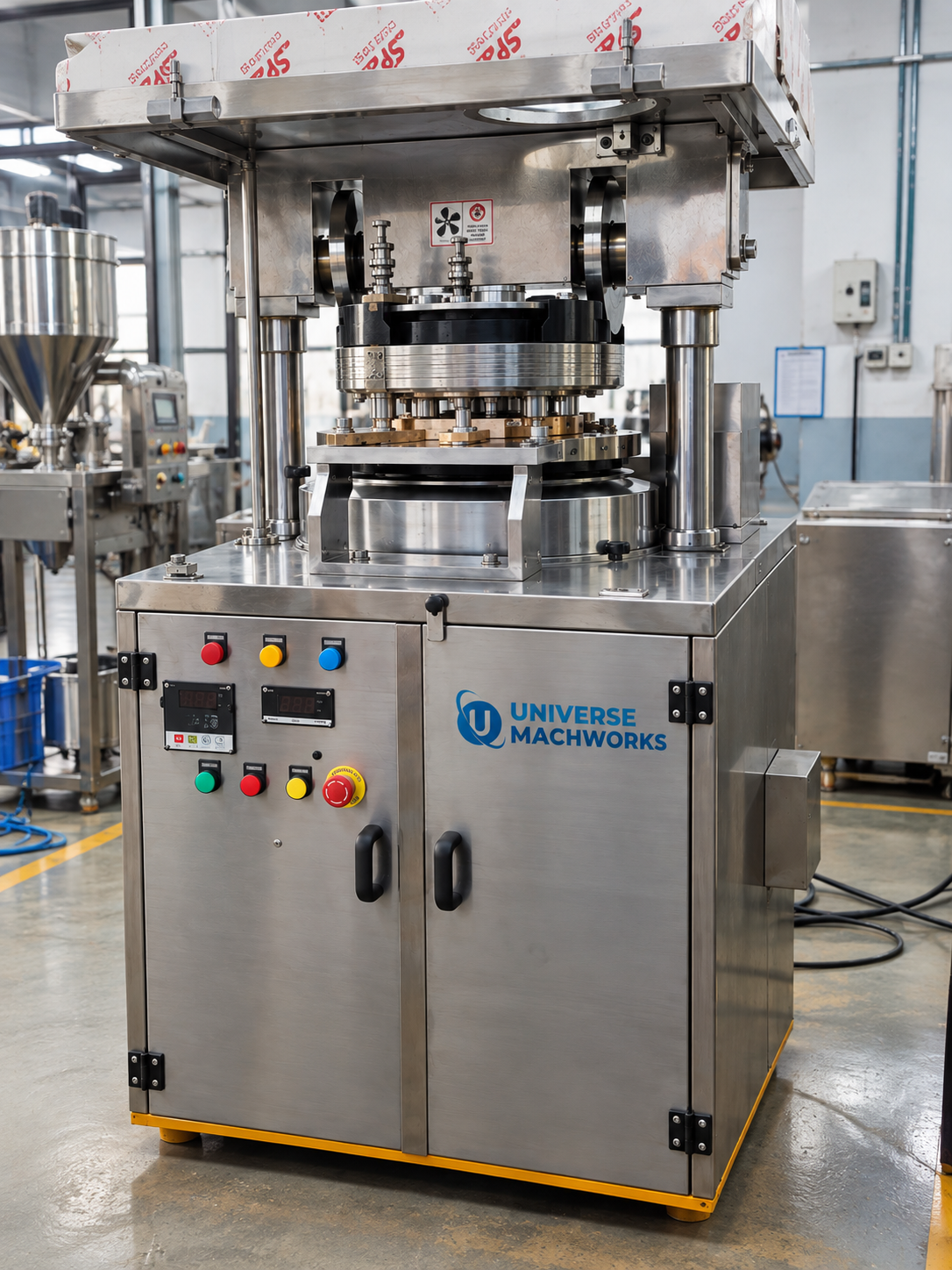
Tablet Compression Machine for Pharmaceutical Manufacturing
In pharmaceutical manufacturing, tablet compression is normally performed after processes such as dispensing, milling, blending, and granulation.
A typical solid dosage manufacturing sequence may include:
Dispensing → Sifting → Mixing/Blending → Granulation → Drying → Milling → Lubrication → Tablet Compression → Dedusting → Metal Detection → Coating → Packaging
The exact manufacturing process depends on the formulation and dosage form.
A tablet compression machine therefore works as an important part of a broader pharmaceutical tablet manufacturing line.
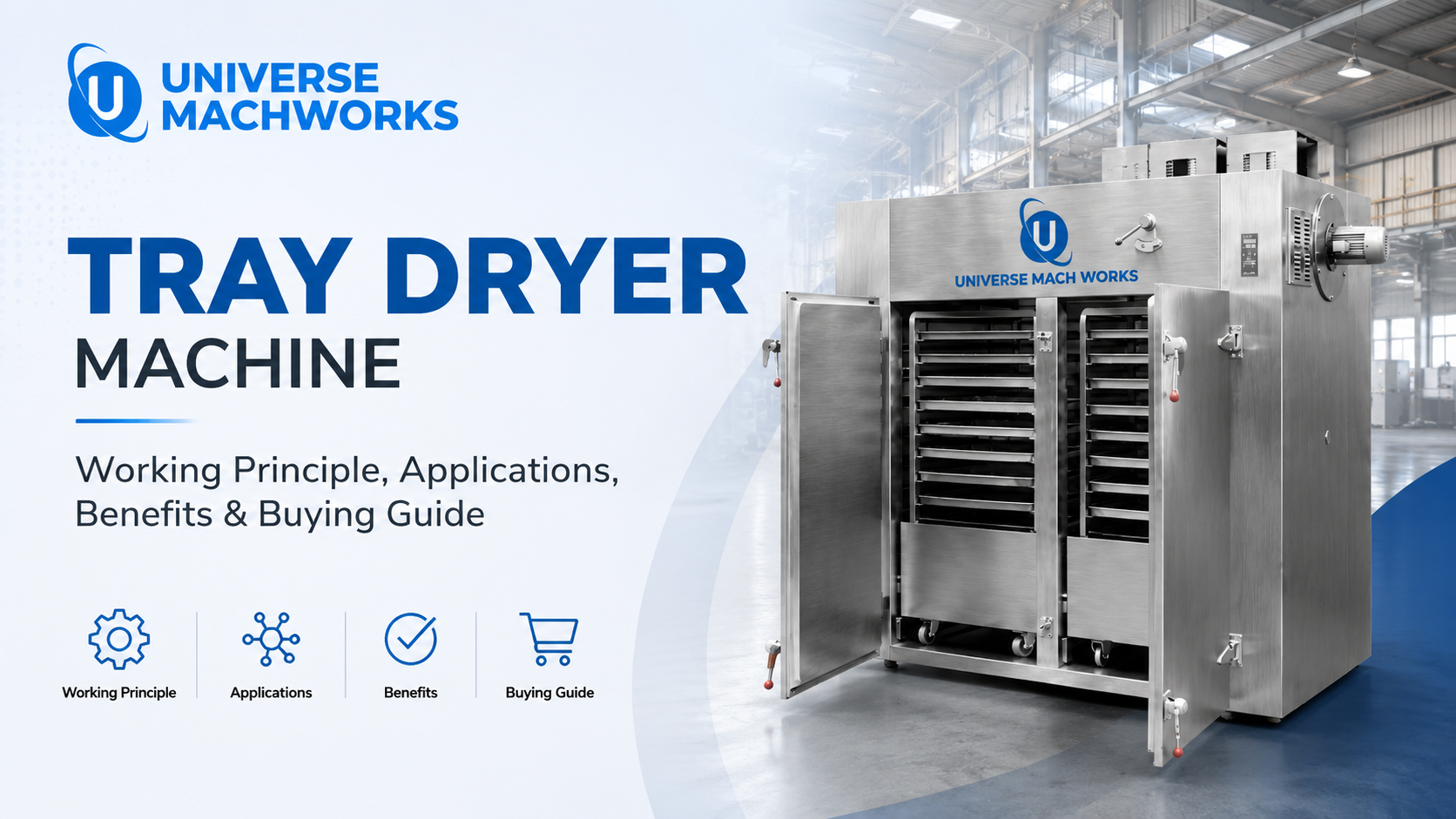
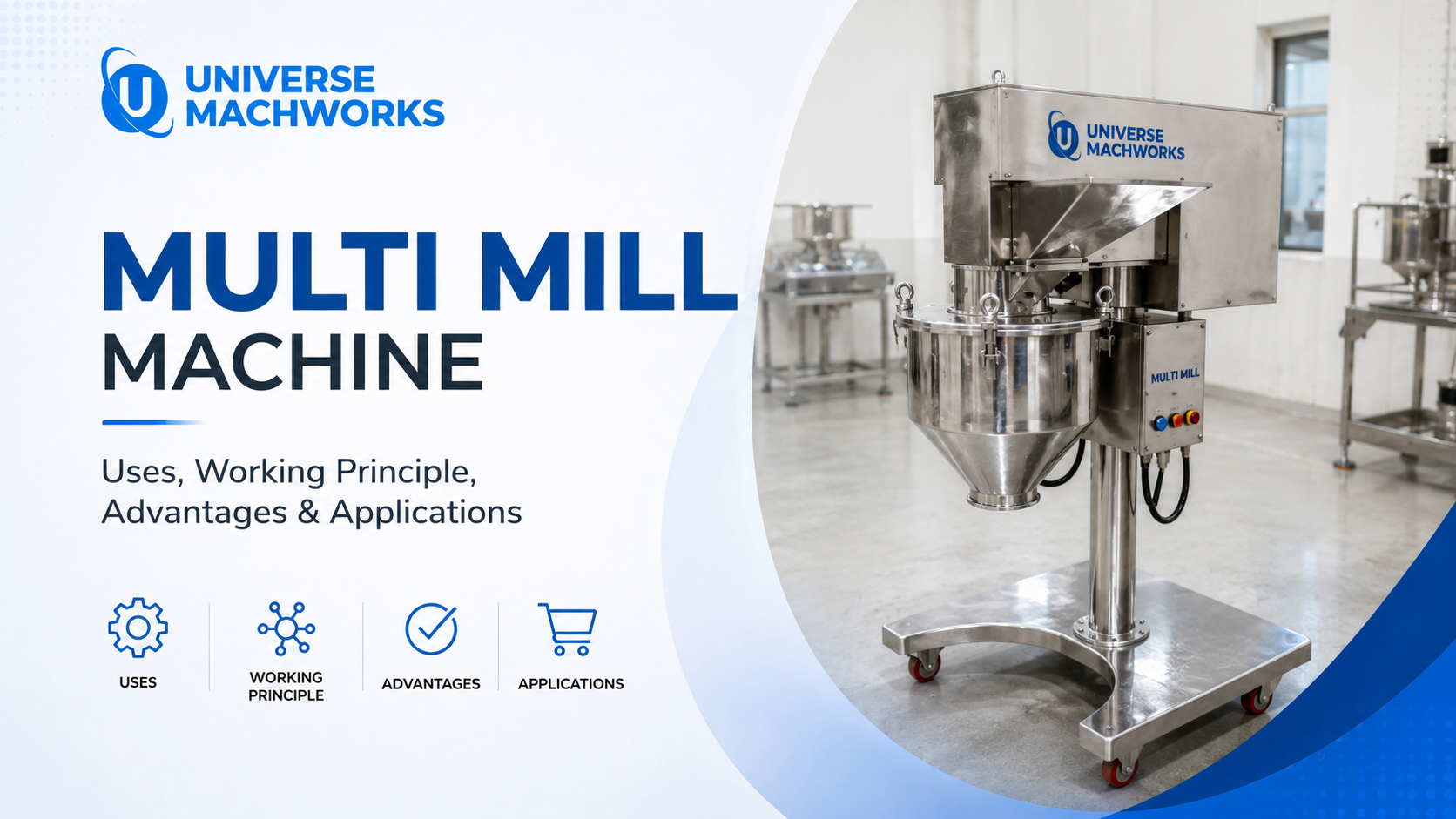
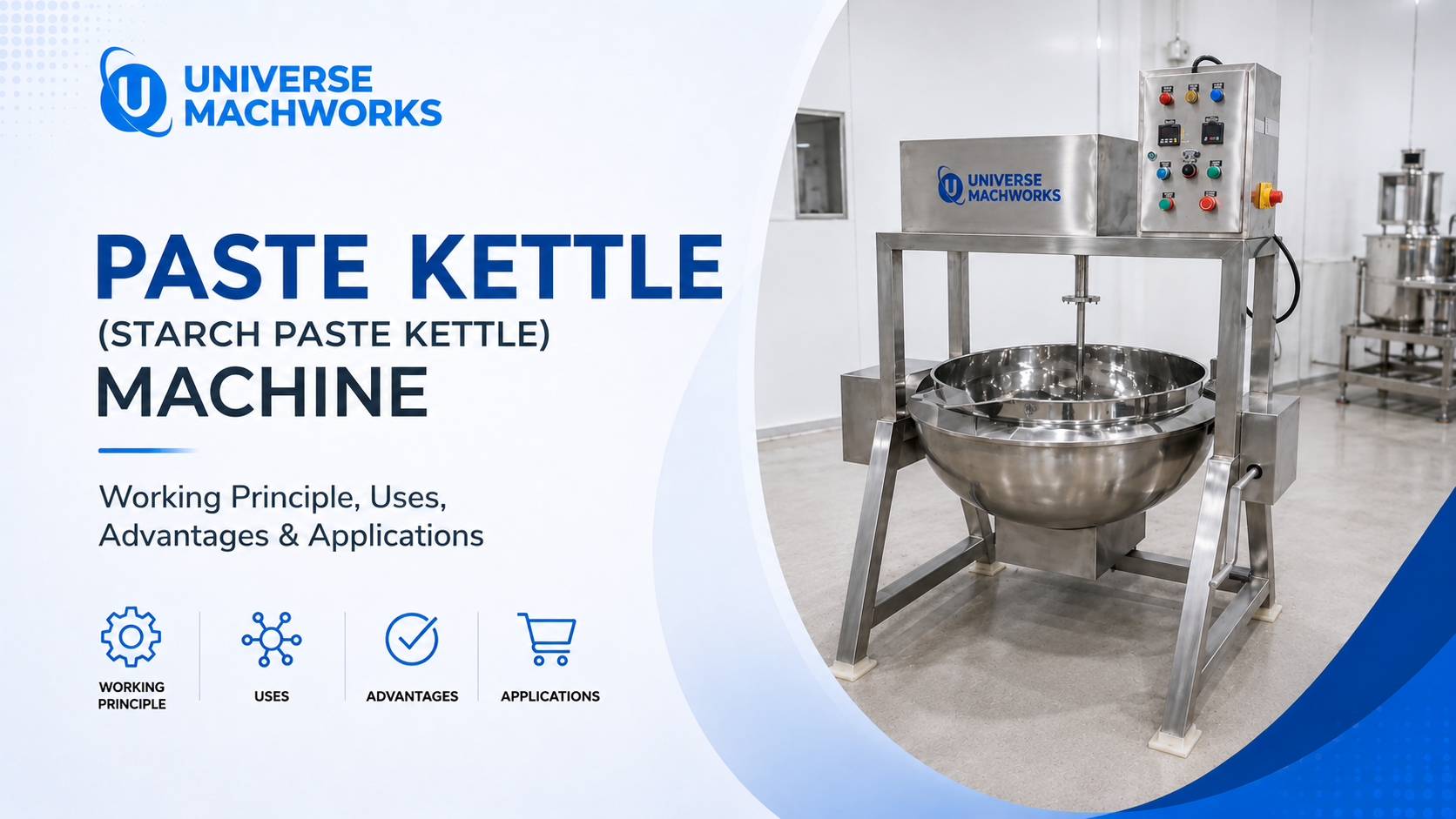
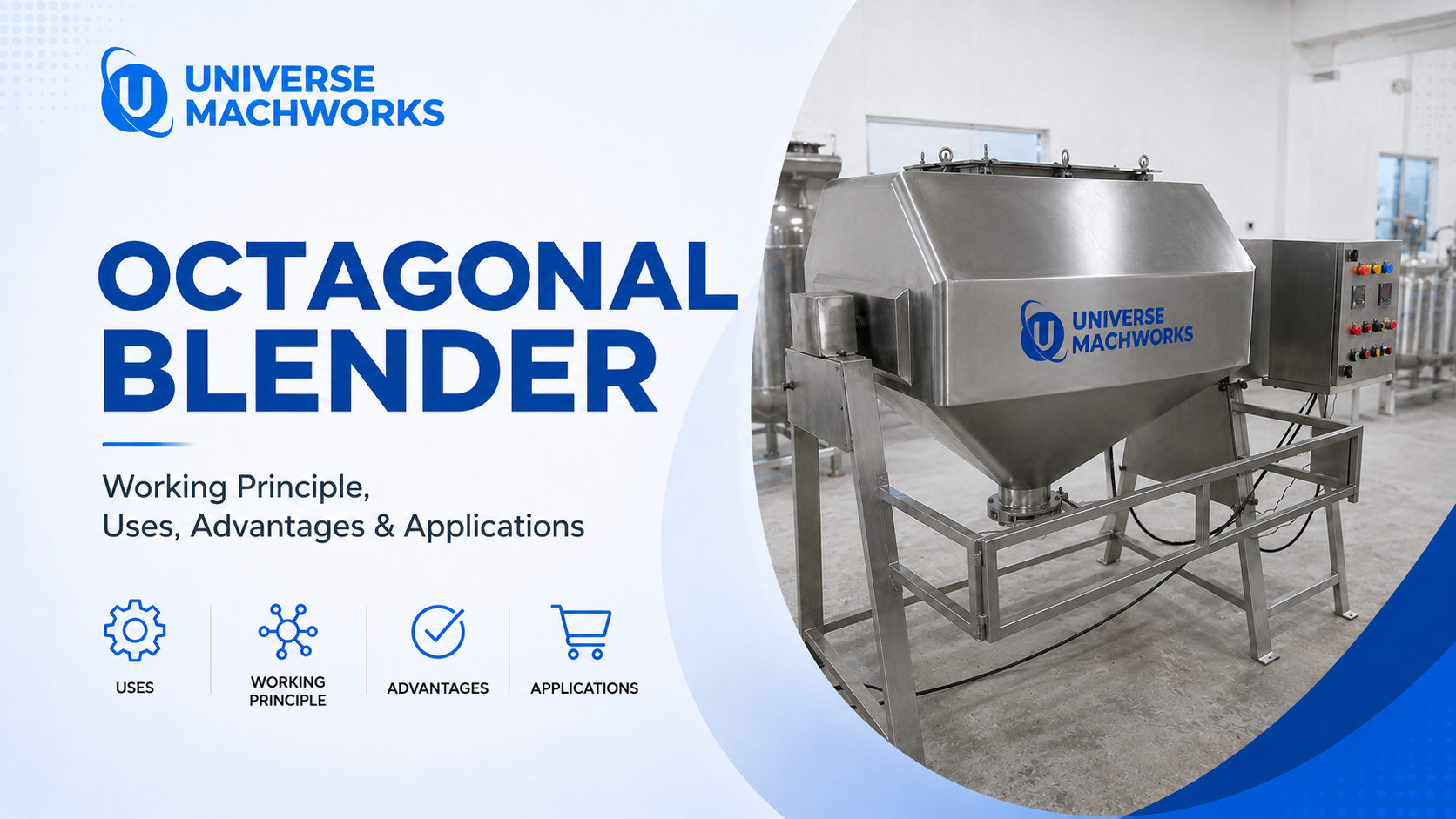
Equipment in a tablet manufacturing line
Tablet Compression Machine: Important Selection Factors
Selecting the right tablet press requires more than simply comparing machine prices.
Before purchasing a tablet compression machine, consider the following factors:
1. Production Requirement
Determine the required production quantity and operating schedule.
2. Tablet Size and Shape
The required tablet diameter, thickness, profile, and shape determine the tooling requirements.
3. Formulation Characteristics
Powder flowability, compressibility, moisture content, particle size, and formulation behavior can affect machine performance.
4. Compression Force
The required compression force depends on the formulation and desired tablet characteristics.
5. Tooling
Check punch and die compatibility with your required tablet design.
6. Automation Level
Consider whether the application requires conventional controls or a more advanced automated control system.
7. Material of Construction
Product-contact and exposed surfaces should be selected according to the intended application and cleaning requirements.
8. Cleaning Requirements
For pharmaceutical applications, machine accessibility and cleanability should be considered during equipment selection.
9. Maintenance and Spare Parts
Availability of punches, dies, wear parts, electrical components, and technical support should be evaluated before purchase.
10. Manufacturer Support
Choose a machinery supplier capable of providing technical assistance, installation support, servicing, and application guidance where required.
New, Used & Refurbished Tablet Compression Machines
Universe Mach Works can provide solutions based on different customer requirements and budgets.
New Tablet Compression Machine
A new machine can be specified according to the customer's production requirements, tooling configuration, construction requirements, and desired automation.
Used Tablet Compression Machine
A previously operated tablet press can be considered when the machine's condition, history, tooling, mechanical components, and suitability have been properly evaluated.
Refurbished Tablet Compression Machine
A refurbished machine can involve inspection, servicing, replacement of selected components, cleaning, mechanical restoration, and other agreed refurbishment work.
Important: The actual refurbishment scope should always be confirmed before purchase.
Benefits of Using a Tablet Compression Machine
A properly selected tablet press can provide several manufacturing benefits:
- Consistent tablet formation
- Controlled compression
- Repeatable production
- Efficient tablet manufacturing
- Compatibility with different tablet tooling configurations
- Reduced manual tablet-forming operations
- Integration into larger production lines
- Suitable for pharmaceutical and nutraceutical manufacturing
- Improved production consistency
Actual performance depends on formulation, tooling, machine configuration, operating parameters, and production conditions.
Tablet Compression Machine Maintenance
Regular maintenance is essential for reliable operation and consistent tablet production.
Recommended maintenance activities may include:
- Cleaning the compression area after production
- Inspecting punches and dies
- Checking compression rollers
- Inspecting lubrication points
- Checking drive components
- Inspecting electrical connections
- Checking machine guards and safety systems
- Inspecting feeding components
- Checking unusual vibration or noise
- Replacing worn components when necessary
The manufacturer's maintenance instructions should always be followed for the specific machine model.
Cleaning of Tablet Compression Machine
Cleaning is particularly important in pharmaceutical manufacturing because residues from previous products can create contamination and cross-contamination concerns.
Cleaning procedures should be developed according to the product, formulation, equipment design, manufacturing process, and applicable quality requirements.
Important areas to consider include:
- Hopper and feeding system
- Turret
- Punches and dies
- Compression area
- Product-contact surfaces
- Tablet discharge area
- Accessible machine surfaces
The machine should be designed and operated in a manner appropriate for its intended use and cleaning requirements.
Tablet Compression Machine vs Single Punch Tablet Press
| Feature | Tablet Compression Machine / Rotary Press | Single Punch Tablet Press |
|---|---|---|
| Operating principle | Rotary multi-station compression | Single compression station |
| Production suitability | Higher-volume production | Small-batch/R&D applications |
| Production speed | Generally higher | Generally lower |
| Tooling | Multiple punch & die stations | Single punch & die set |
| Application | Commercial production | Laboratory, development, small batches |
| Automation | Can be configured for higher automation | Generally simpler |
| Production scale | Medium to large, depending on configuration | Small-scale |
The appropriate machine depends on production volume, formulation, tablet requirements, and manufacturing objectives.
Tablet Compression Machine Manufacturer
Choosing the right Tablet Compression Machine Manufacturer is important because tablet presses are precision mechanical systems that require suitable design, tooling, maintenance, and technical support.
When evaluating a manufacturer, consider:
- Manufacturing capability
- Machine construction
- Tooling compatibility
- Quality of mechanical components
- Customization capability
- Documentation
- Installation support
- Spare parts availability
- Service support
- Experience with pharmaceutical machinery
Universe Mach Works provides pharmaceutical machinery solutions for manufacturers requiring new, used, refurbished, and customized equipment.
Why Choose Universe Mach Works?
Universe Mach Works provides pharmaceutical and process machinery solutions designed around individual manufacturing requirements.
Our Capabilities Include:
New Pharmaceutical Machinery
Equipment manufactured for new production requirements.
Refurbished Pharmaceutical Machinery
Previously operated machinery that can be inspected and refurbished according to the agreed scope.
Custom Manufacturing
Machine configurations can be discussed according to application and process requirements.
Technical Support & Installation
Support for equipment installation and technical requirements can be provided as applicable.
Pharmaceutical & Process Equipment
Solutions for pharmaceutical, nutraceutical, chemical, food, cosmetic, herbal, and other process industries.
Technical Specifications
The exact specifications should be provided according to the selected model and customer requirement.
| Specification | Details |
|---|---|
| Machine Type | Tablet Compression Machine / Rotary Tablet Press |
| Application | Tablet Manufacturing |
| Machine Construction | Stainless Steel / As per configuration |
| Compression System | Rotary Compression |
| Tooling | As per required tablet specification |
| Tablet Shape | As per tooling |
| Tablet Size | Application dependent |
| Compression Force | Model dependent |
| Production Capacity | Model and formulation dependent |
| Number of Stations | Model dependent |
| Drive System | As per machine configuration |
| Control System | As per configuration |
| Power Requirement | Model dependent |
| Product Contact Parts | As per application |
| Automation | As per requirement |
| Customization | Available as required |
Note: Final specifications should be confirmed based on the machine model, formulation, tablet dimensions, tooling, and customer's production requirements.
Get the Right Tablet Compression Machine for Your Production
Whether you are setting up a new pharmaceutical production line, expanding existing capacity, replacing equipment, or looking for a refurbished solution, selecting the right tablet compression machine requires careful evaluation of the formulation, tablet specifications, production requirements, tooling, and machine condition.
Universe Mach Works provides pharmaceutical machinery solutions for pharmaceutical, nutraceutical, herbal, chemical, food, and other process industries.
Looking for a Tablet Compression Machine?
Contact Universe Mach Works to discuss your tablet manufacturing requirements and machine configuration.
Explore the Product
Single Rotary Tablet Press Machine by Universe Mach Works
View technical specifications, applications and request a customized quote.
View Single Rotary Tablet Press MachineFrequently Asked Questions
What is a Tablet Compression Machine?+
A Tablet Compression Machine is equipment used to compress pharmaceutical powder or granules into solid tablets using controlled mechanical compression.
What is another name for a Tablet Compression Machine?+
A tablet compression machine is commonly referred to as a Tablet Press or Rotary Tablet Press, depending on its configuration.
What is a rotary tablet press used for?+
A rotary tablet press is used for continuous tablet compression in pharmaceutical, nutraceutical, herbal, and other suitable manufacturing applications.
Can a tablet compression machine manufacture different tablet shapes?+
Yes. Different tablet shapes can generally be produced by changing the appropriate punch and die tooling, subject to machine compatibility and process requirements.
What factors affect tablet compression?+
Important factors include formulation properties, powder flow, granule characteristics, tooling, fill depth, compression force, machine speed, and other process parameters.
Is a tablet compression machine suitable for nutraceutical products?+
Yes, tablet presses are commonly used for suitable nutraceutical, vitamin, mineral, herbal, and dietary supplement formulations.
What is the difference between a tablet press and a capsule filling machine?+
A tablet press compresses powder or granules into tablets, whereas a capsule filling machine fills suitable formulations into hard capsules.
Does Universe Mach Works supply refurbished tablet compression machines?+
Universe Mach Works can provide new and refurbished pharmaceutical machinery solutions depending on availability, machine condition, and customer requirements.
Can the tablet compression machine be customized?+
Machine configuration and tooling requirements can be discussed according to the required tablet dimensions, production process, material of construction, controls, and other application requirements.
Conclusion
Whether you are setting up a new pharmaceutical production line, expanding existing capacity, replacing equipment, or looking for a refurbished solution, selecting the right tablet compression machine requires careful evaluation of the formulation, tablet specifications, production requirements, tooling, and machine condition.
Universe Mach Works provides pharmaceutical machinery solutions for pharmaceutical, nutraceutical, herbal, chemical, food, and other process industries.
Contact Universe Mach Works to discuss your tablet manufacturing requirements and machine configuration.