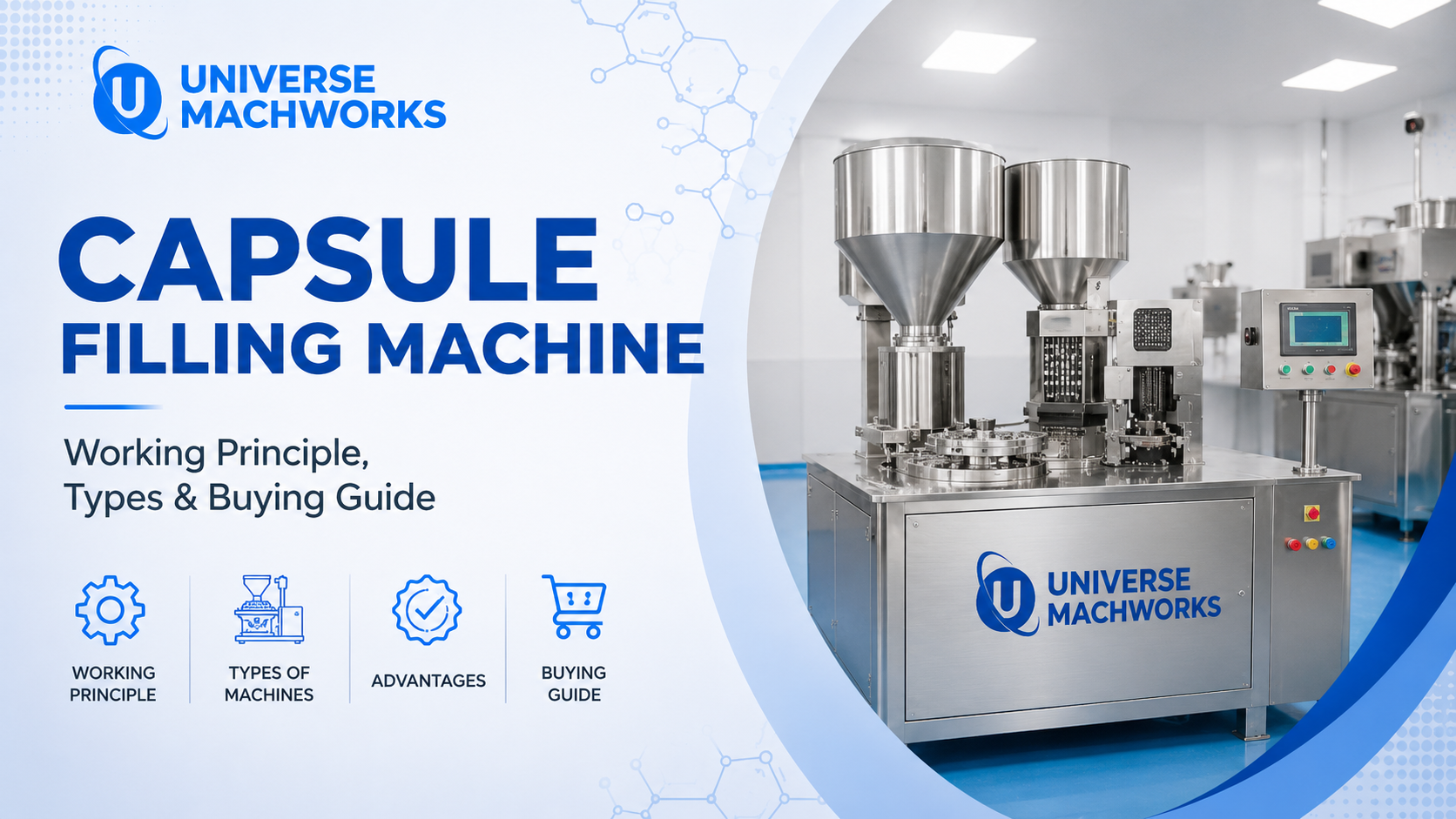
The pharmaceutical industry is built on precision, consistency, and compliance. Every capsule produced must contain the exact dosage of active pharmaceutical ingredients (APIs), maintain uniform weight, and meet stringent quality standards. Achieving this level of accuracy is nearly impossible without advanced pharmaceutical processing equipment. One of the most important machines in any modern capsule manufacturing facility is the Capsule Filling Machine.
Whether manufacturing prescription medicines, nutraceutical supplements, herbal formulations, probiotics, veterinary products, or cosmetic capsules, pharmaceutical companies rely on high-performance capsule filling equipment to ensure efficient, hygienic, and accurate production.
Modern capsule filling machines have transformed pharmaceutical manufacturing by automating the entire encapsulation process. They significantly reduce manual labor, increase production speed, minimize product wastage, and maintain batch-to-batch consistency. As pharmaceutical regulations continue to become more stringent, manufacturers are increasingly investing in automated capsule filling systems that comply with WHO-GMP, cGMP, and FDA requirements.
As experienced pharmaceutical machinery manufacturers, Universe Mach Works has worked with pharmaceutical, nutraceutical, food processing, cosmetic, and chemical industries for decades. In this comprehensive guide, you'll learn everything you need to know about Capsule Filling Machines — working principle, types, components, applications, advantages, and the key factors to consider before purchasing one.
What is a Capsule Filling Machine?
A Capsule Filling Machine is a specialized pharmaceutical machine designed to accurately fill empty hard gelatin or HPMC (vegetarian) capsules with powders, granules, pellets, micro-tablets, liquids (specialized machines), or combinations of these formulations before securely locking the capsules for further packaging.
The primary objective of the machine is to ensure that every capsule receives a precise quantity of formulation while maintaining high production efficiency and strict pharmaceutical quality standards. Even slight variations in fill weight can lead to rejected batches, product recalls, or regulatory penalties.

Modern pharmaceutical capsule filling machines perform capsule feeding, orientation, separation, product dosing, filling, locking, ejection, and (on advanced models) quality inspection in a single automated cycle.
- Pharmaceutical manufacturing
- Nutraceutical production
- Herbal medicine manufacturing
- Food supplements
- Veterinary pharmaceuticals
- Cosmetic products
- Chemical processing
Types of Capsule Filling Machines
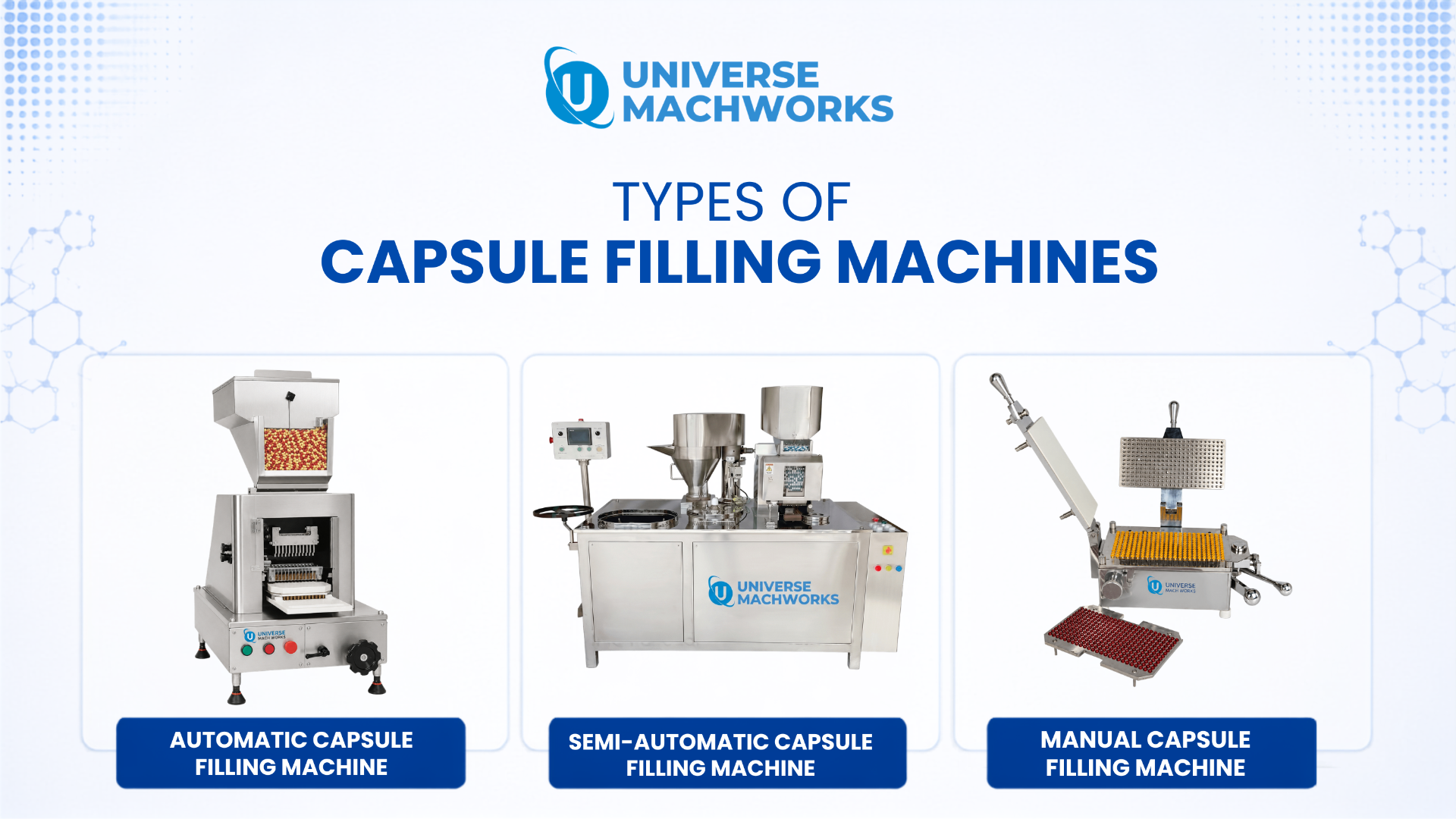
1. Manual Capsule Filling Machine
Manual capsule filling machines are primarily designed for research laboratories, educational institutions, small-scale production units, herbal manufacturers, and startup pharmaceutical businesses. Operators perform every stage manually — separation, powder filling, tamping, locking, and ejection.
- Lowest investment cost
- Simple operation
- Minimal maintenance
- Ideal for R&D
- Typical output: 300–2,500 capsules/hour
2. Semi-Automatic Capsule Filling Machine
Semi-automatic machines combine manual handling with automated filling operations. They offer a balance between productivity and affordability, making them ideal for medium-sized pharmaceutical manufacturers.
- Higher production capacity
- Better filling accuracy
- Lower labor requirement
- Cost-effective investment
- Typical output: 10,000–40,000 capsules/hour
3. Automatic Capsule Filling Machine
Fully automatic capsule filling machines are the preferred choice for modern pharmaceutical manufacturing facilities operating under WHO-GMP and cGMP regulations. They include automatic capsule feeding, servo-controlled dosing, vacuum separation, automatic locking, capsule rejection systems, dust extraction, PLC automation, HMI touchscreen controls, and batch data recording.
- Extremely high production speed
- Excellent weight accuracy
- Reduced product wastage
- Continuous GMP-compliant operation
- Typical output: 25,000–200,000+ capsules/hour
4. Liquid Capsule Filling Machine
Liquid capsule filling machines are specially designed to fill capsules with oils, suspensions, semi-solids, herbal extracts, and other liquid formulations. Common applications include fish oil, vitamin oils, CBD products, herbal extracts and essential oils.
5. Laboratory Capsule Filling Machine
Laboratory models are developed specifically for formulation development, clinical trials, pilot production, and pharmaceutical research. These compact machines provide exceptional accuracy while minimizing material consumption.
Working Principle of a Capsule Filling Machine
Although designs vary depending on automation level and manufacturer, the fundamental working principle remains largely the same — a series of synchronized mechanical operations that accurately fill empty capsules while maintaining production efficiency and dosage consistency.
Step 1 – Capsule Feeding
Empty capsules are loaded into the capsule hopper. An automatic capsule feeding system continuously supplies capsules into the machine without interrupting production.
Step 2 – Capsule Orientation
The machine automatically aligns capsules in the correct vertical position. Vacuum-assisted systems help achieve highly accurate capsule positioning before separation.
Step 3 – Capsule Separation
Using vacuum technology, the machine gently separates the capsule cap from the body without damaging delicate gelatin or HPMC capsules.
Step 4 – Product Dosing
Modern dosing systems use tamping pins, dosator systems, or servo-driven mechanisms to accurately measure powder, granules, pellets, micro-tablets, or combination fills.
Step 5 – Capsule Filling
The measured formulation is transferred into the capsule body with exceptional precision, with continuous fill-consistency monitoring on advanced machines.
Step 6 – Capsule Locking
After filling, the capsule cap is automatically rejoined with the body and securely sealed to prevent leakage during handling and storage.
Step 7 – Capsule Ejection
Finished capsules are discharged onto the collection conveyor or container. Some machines integrate polishing units before packaging.
Step 8 – Quality Inspection
Premium machines include automatic rejection systems capable of detecting empty, underfilled, overfilled, broken, or improperly locked capsules.
Components of a Capsule Filling Machine

- Capsule Hopper — stores empty capsules and feeds them into the machine
- Capsule Feeding System — vibration/gravity guides for uniform feeding
- Capsule Orientation Unit — aligns capsules before separation
- Vacuum Capsule Separation System — gently separates cap from body
- Dosing System — tamping pin, dosator, auger or servo-controlled
- Filling Station — transfers dose into capsule body
- Capsule Locking Mechanism — securely rejoins cap and body
- Capsule Ejection System — discharges finished capsules
- PLC Control Panel & HMI — recipe storage, batch data and diagnostics
- Safety & Dust Extraction System — interlocks, guarding, HEPA extraction
Applications of Capsule Filling Machines
Pharmaceutical Industry
- Antibiotics
- Painkillers
- Antacids
- Anti-inflammatory drugs
- Cardiovascular medicines
- Vitamin supplements
- Hormonal medicines
- Anti-diabetic formulations
Nutraceutical Industry
- Protein supplements
- Multivitamins
- Fish oil / Omega-3
- Probiotics
- Collagen
- Joint health supplements
- Immune boosters
Herbal & Ayurvedic
- Ashwagandha
- Turmeric
- Spirulina
- Moringa
- Triphala
- Herbal extracts
- Ayurvedic formulations
Other Industries
- Food supplements & functional foods
- Cosmetic beauty capsules
- Veterinary pharmaceuticals
- Specialty chemical encapsulation
- Biotechnology & research laboratories
Benefits of Capsule Filling Machines
- High production efficiency
- Accurate dosage & fill-weight consistency
- Reduced product wastage
- Improved product consistency
- Lower labor costs
- GMP / cGMP / FDA compliance
- Easy cleaning with SS304/SS316 construction
- Flexible product handling
- User-friendly PLC controls
- Excellent long-term ROI
Capsule Sizes Supported
| Capsule Size | Approximate Fill Capacity | Common Applications |
|---|---|---|
| 000 | 950–1400 mg | Large supplements, veterinary medicines |
| 00 | 650–1000 mg | Nutraceuticals, herbal products |
| 0 | 400–800 mg | Pharmaceutical medicines |
| 1 | 300–500 mg | Prescription drugs |
| 2 | 200–400 mg | Vitamins, supplements |
| 3 | 150–300 mg | Pediatric formulations |
| 4 | 120–210 mg | Small-dose medicines |
| 5 | 60–130 mg | Research & low-dose formulations |
Actual fill capacity depends on powder density, particle size, and formulation characteristics.
Manual vs Semi-Automatic vs Automatic Capsule Filling Machines
| Feature | Manual | Semi-Automatic | Automatic |
|---|---|---|---|
| Production Capacity | 300–2,500/hr | 10,000–40,000/hr | 25,000–200,000+/hr |
| Investment Cost | Low | Medium | High |
| Filling Accuracy | Moderate | High | Excellent |
| Labor Requirement | High | Moderate | Minimal |
| Automation | Manual | Partial | Full |
| Product Wastage | Higher | Lower | Minimal |
| GMP Suitability | Limited | Good | Excellent |
| Best For | Labs, R&D, Startups | Medium-scale plants | Large pharma & CMOs |
Capsule Filling Machine Buying Guide
Investing in a Capsule Filling Machine is a significant decision. The right machine improves production efficiency, ensures dosage accuracy, reduces operational costs, and helps meet stringent regulatory requirements. Below are the key factors every production manager, procurement team, engineer, and factory owner should consider before selecting capsule filling equipment.
1. Production Capacity
Match machine capacity to current output requirements and expected growth over the next five years — avoids both under-investment bottlenecks and over-capitalization.
2. Type of Product Being Filled
Select filling technology based on formulation — fine powders, granules, pellets, micro-tablets, herbal extracts, or combination fills each have different flow characteristics.
3. Capsule Sizes Supported
A versatile machine should accommodate sizes 000, 00, 0, 1, 2, 3, 4, and 5 with quick changeover between them.
4. Machine Construction
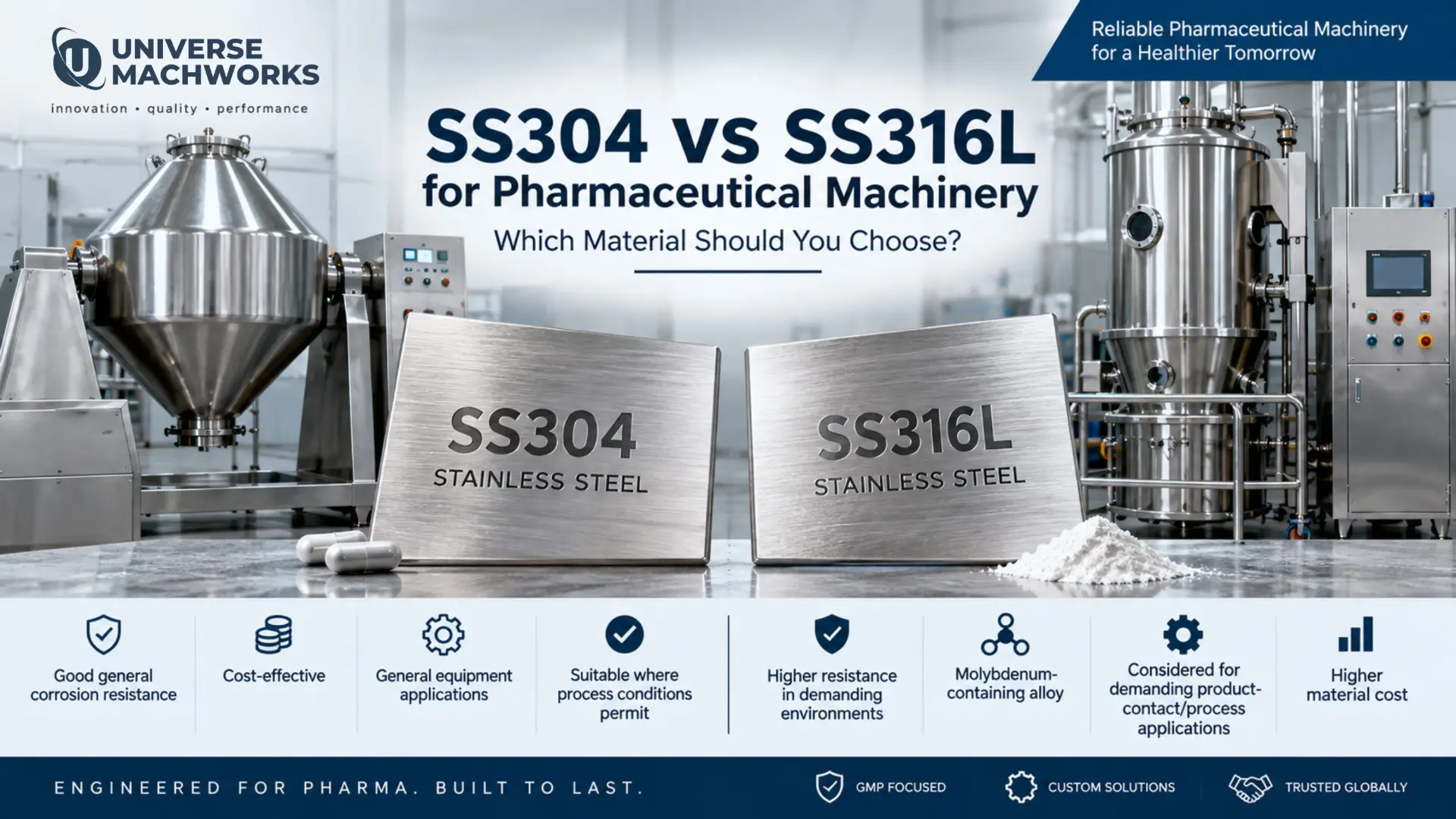
Choose SS304 body with SS316L product-contact parts, mirror-polished surfaces, food-grade gaskets and hygienic welding for contamination control.
5. Filling Accuracy
Prioritize machines capable of maintaining minimal fill-weight variation across long production runs to reduce rejection and ensure compliance.
6. Automation Level
PLC control, touchscreen HMI, servo-controlled dosing, recipe storage, batch recording, alarms and user access management improve productivity and reduce operator dependency.
7. Ease of Cleaning & GMP Compliance
Tool-free dismantling, smooth surfaces and easy access to product-contact parts reduce changeover downtime and support WHO-GMP / cGMP / FDA / CE requirements.
8. After-Sales Support
Verify the manufacturer offers genuine spare parts, quick dispatch, service engineers, preventive maintenance and operator training.
Common Mistakes Buyers Make
- Buying based only on price
- Ignoring future production growth
- Overlooking GMP requirements
- Selecting the wrong capacity
- Ignoring after-sales service
- Not checking machine documentation
- Poor factory planning (space, utilities, airflow)
Maintenance & Troubleshooting
Routine maintenance significantly extends machine life while ensuring consistent production quality. Daily cleaning of product-contact parts, weekly inspection of belts/chains/electricals, monthly lubrication and calibration, and annual seal replacement and gearbox service are recommended.
| Problem | Possible Cause | Recommended Solution |
|---|---|---|
| Weight variation | Incorrect dosing adjustment | Recalibrate dosing system |
| Empty capsules | Poor powder flow | Improve formulation flow properties |
| Capsule damage | Improper separation | Adjust vacuum pressure |
| Powder leakage | Worn sealing components | Replace seals and gaskets |
| Low production output | Blocked feeding system | Clean hopper and feeding mechanism |
| Capsule locking failure | Misaligned locking station | Realign locking mechanism |
Industry Trends
- Industry 4.0 & IoT-enabled machines
- Real-time production monitoring & predictive maintenance
- Servo-driven filling and vision inspection
- Energy-efficient, sustainable manufacturing
- Data-driven batch traceability
- Flexible multi-product manufacturing
Why Choose Universe Mach Works?
At Universe Mach Works, we combine precision engineering, GMP-compliant manufacturing, and dependable after-sales support to deliver pharmaceutical machinery that meets the demands of modern production facilities.
- GMP & cGMP compliant design
- SS304 & SS316L stainless steel construction
- Precision capsule filling technology
- PLC & touchscreen HMI options
- Custom machine configurations
- Energy-efficient design
- Reliable technical support & spare parts
- Installation, commissioning & operator training
- Pan India supply & export-ready machinery
- Competitive pricing
Explore the Product
Capsule Filling Machine by Universe Mach Works
View technical specifications, applications and request a customized quote.
View Capsule Filling MachineFrequently Asked Questions
What is a Capsule Filling Machine?+
A pharmaceutical machine used for filling hard gelatin or HPMC capsules with powders, granules, pellets, or other formulations with precise dosage.
What is the production capacity of an automatic Capsule Filling Machine?+
Depending on the model, automatic machines can produce from 25,000 to over 200,000 capsules per hour.
Which capsule sizes are supported?+
Most machines support capsule sizes 000, 00, 0, 1, 2, 3, 4, and 5.
What is the difference between manual and automatic capsule filling machines?+
Manual machines require operator involvement and are suitable for small batches, while automatic machines provide high-speed, accurate, and continuous GMP-compliant production.
What materials are used to manufacture the machine?+
High-quality machines use SS304 and SS316L stainless steel for hygienic, corrosion-resistant construction.
Is the machine GMP compliant?+
Yes. Modern capsule filling machines are designed according to GMP and cGMP requirements.
What formulations can be filled?+
Powders, granules, pellets, micro-tablets, and — with specialized models — liquids and semi-solids.
Can the machine be customized?+
Yes. Capacity, automation level, capsule sizes, control systems, and accessories can be customized to production needs.
Does Universe Mach Works provide installation and technical support?+
Yes. We offer installation guidance, commissioning support, operator training, spare parts, and after-sales service.
Why choose Universe Mach Works?+
Universe Mach Works delivers precision-engineered, GMP-compliant pharmaceutical machinery backed by expert support, durable construction, and dependable performance.
Conclusion
A Capsule Filling Machine is one of the most important pieces of equipment in modern pharmaceutical manufacturing. By automating the capsule filling process, it improves production efficiency, ensures accurate dosing, reduces product wastage, and helps manufacturers comply with stringent GMP standards.
Whether you're producing pharmaceutical medicines, nutraceutical supplements, herbal products, or veterinary formulations, selecting the right capsule filling machine is a long-term investment that directly impacts product quality and operational efficiency.
At Universe Mach Works, we manufacture high-quality pharmaceutical machinery engineered for precision, reliability, and long-term performance. With robust engineering, GMP-compliant construction, and dependable technical support, we help manufacturers build efficient and future-ready production facilities.