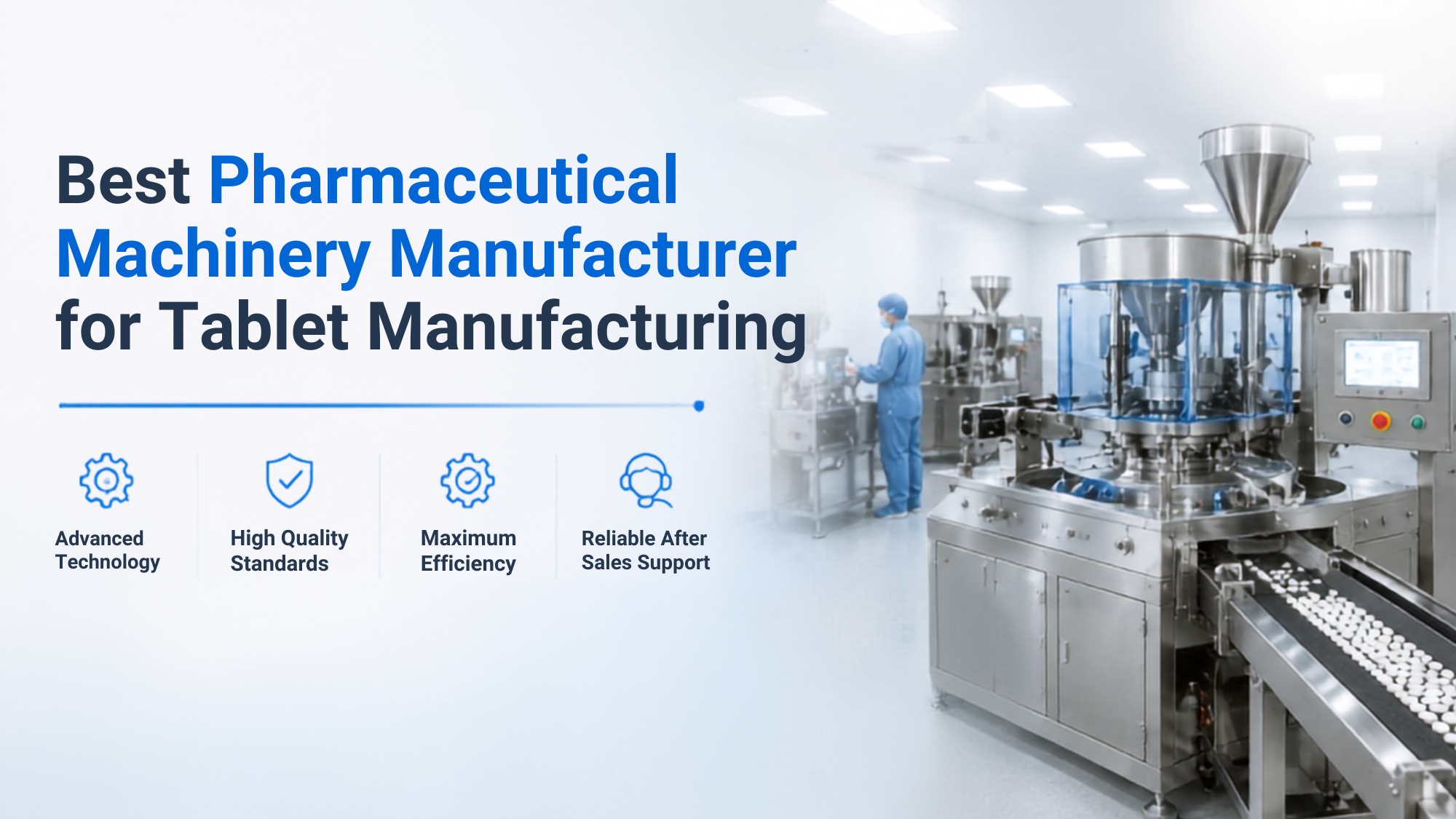
The pharmaceutical industry is one of the most quality-driven and highly regulated manufacturing sectors in the world. Every tablet produced must meet strict standards for dosage accuracy, weight variation, hardness, dissolution, stability, and safety before it reaches patients. Achieving this level of precision requires more than skilled operators — it depends on reliable pharmaceutical machinery designed for consistent and GMP-compliant production.
Tablet manufacturing is a complex, multi-stage process involving material handling, blending, granulation, drying, milling, compression, coating, inspection, and packaging. Each stage requires specialized equipment engineered to maintain product quality while maximizing production efficiency.
As global demand for pharmaceutical products, nutraceutical supplements, and herbal medicines continues to grow, manufacturers are increasingly investing in automated and high-performance tablet manufacturing equipment. Modern pharmaceutical machinery helps reduce production costs, improve batch consistency, minimize human error, and ensure compliance with international regulatory standards such as WHO-GMP and cGMP.
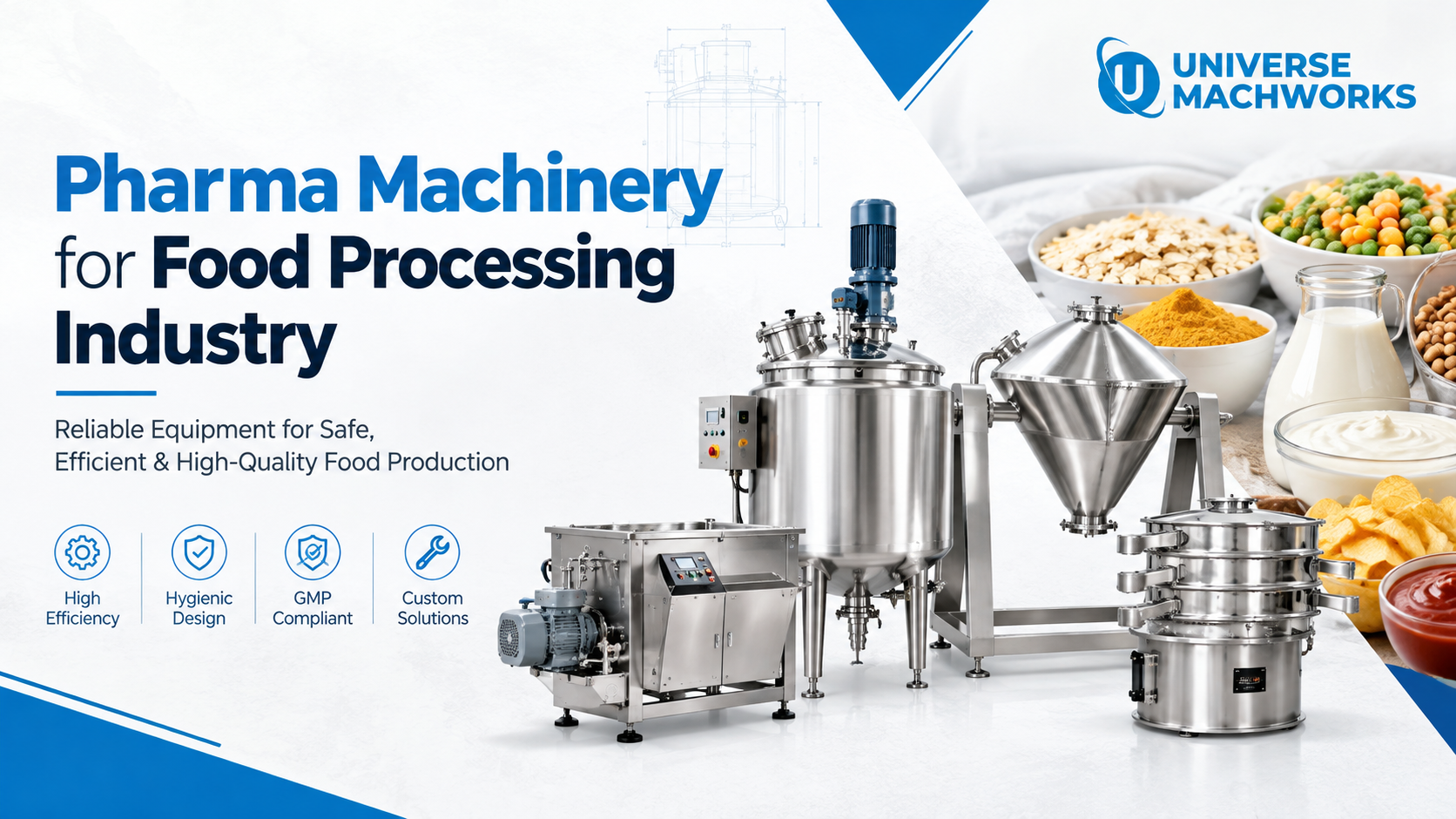
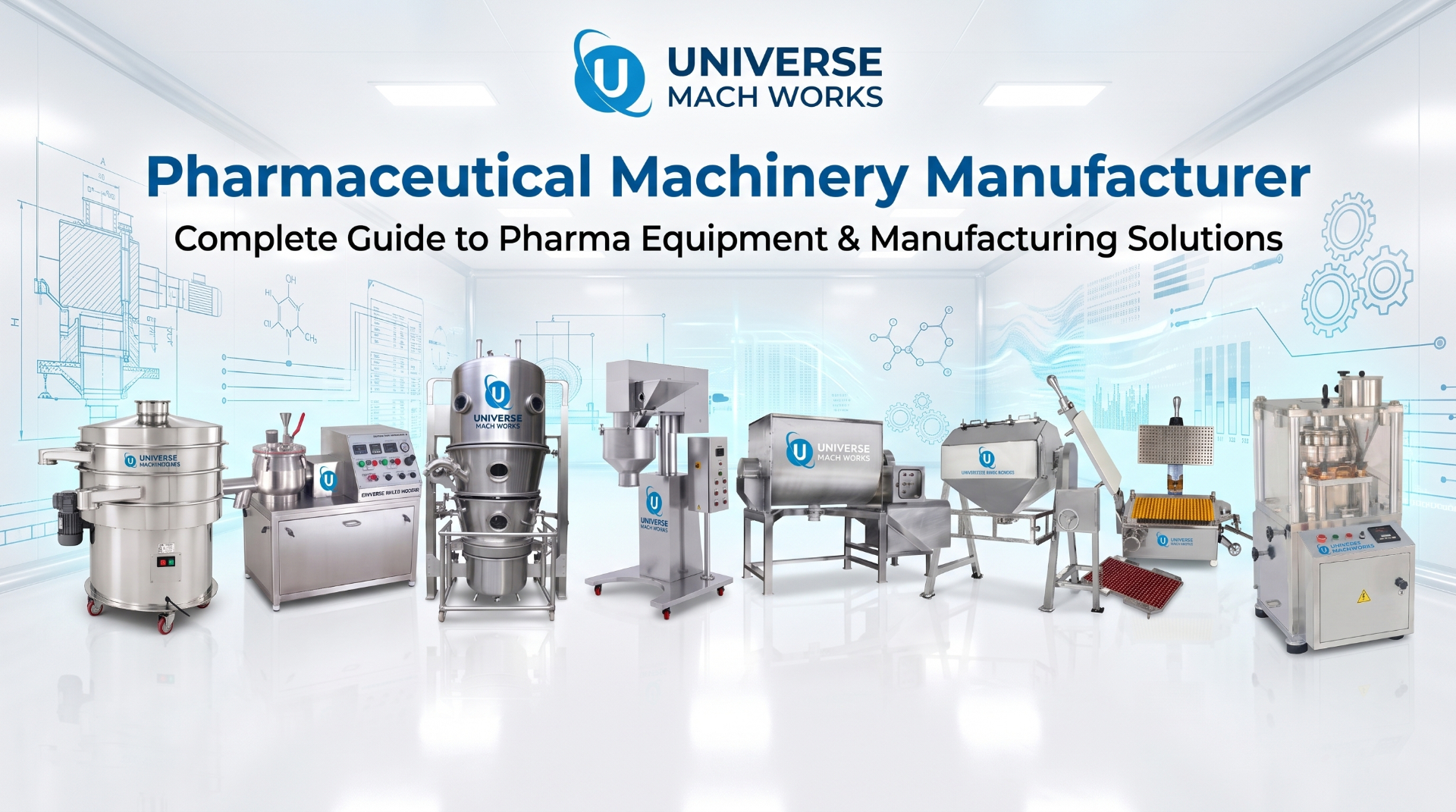
At Universe Mach Works, we specialize in manufacturing high-quality pharmaceutical processing equipment designed to support efficient, reliable, and compliant tablet production. From powder processing to tablet compression and packaging, our machinery is engineered to meet the evolving needs of pharmaceutical, nutraceutical, food processing, cosmetic, and chemical industries.
In this comprehensive guide, you'll learn everything about tablet manufacturing, the machines involved in each production stage, the complete manufacturing workflow, and how to choose the best pharmaceutical machinery manufacturer for your production requirements.
What is Tablet Manufacturing?
Tablet manufacturing is the process of converting Active Pharmaceutical Ingredients (APIs) and excipients into solid oral dosage forms known as tablets. It is one of the most common pharmaceutical manufacturing methods due to its accuracy, convenience, stability, and cost-effectiveness.
Tablets are widely used because they offer precise dosing, easy handling, long shelf life, and efficient large-scale production. Millions of tablets are manufactured every day for treating various medical conditions, making tablet production one of the most important segments of the pharmaceutical industry.
The manufacturing process involves multiple carefully controlled stages to ensure every tablet meets predefined quality specifications. Depending on the formulation, tablet manufacturing may involve wet granulation, dry granulation, or direct compression.
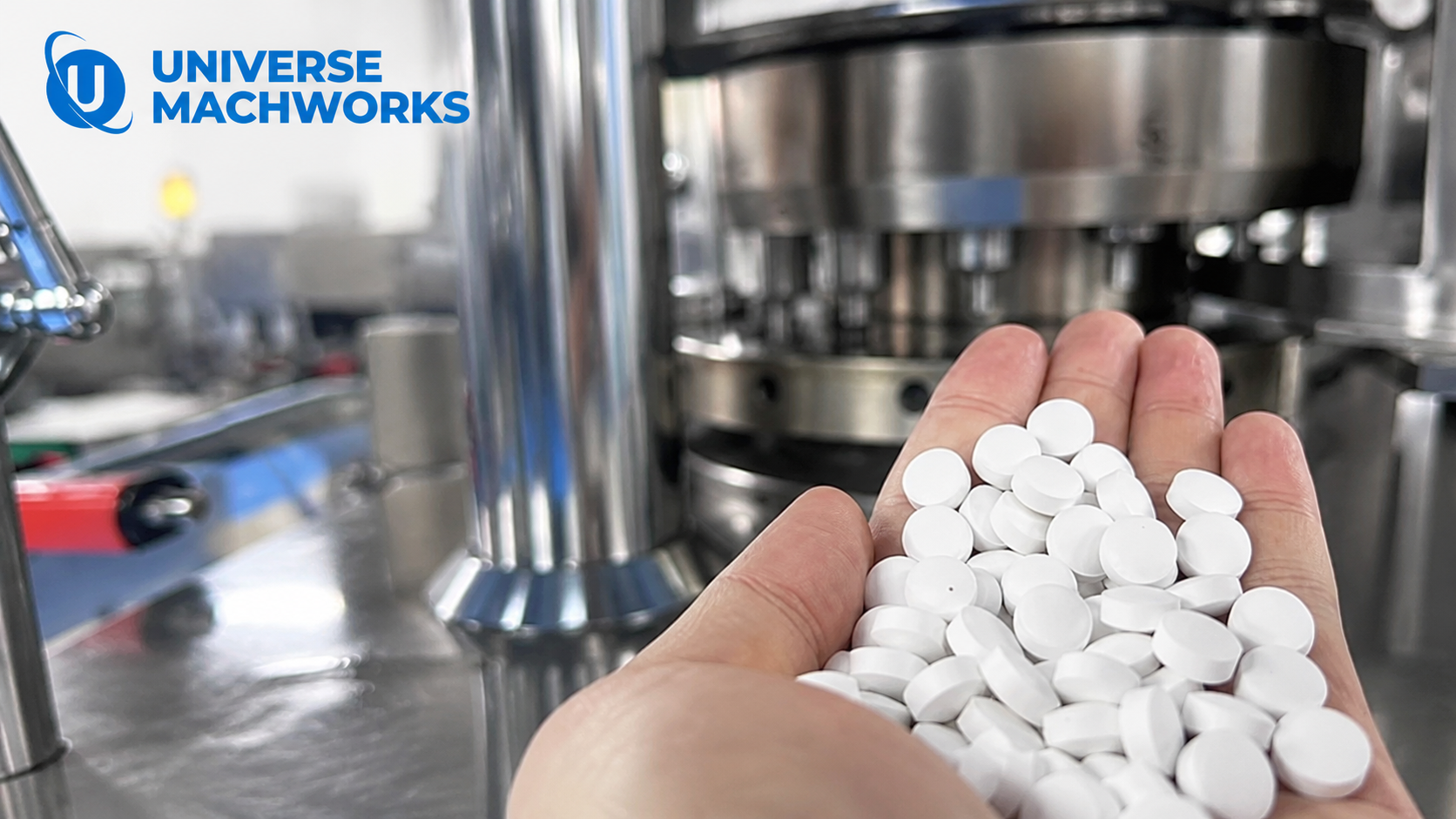
Common products manufactured through tablet production
- Prescription medicines
- Over-the-counter (OTC) drugs
- Nutraceutical supplements
- Herbal formulations
- Ayurvedic medicines
- Vitamin tablets
- Mineral supplements
- Veterinary medicines
Quality parameters every tablet must meet
- Uniform weight
- Correct dosage
- Tablet hardness
- Friability limits
- Dissolution rate
- Content uniformity
- Moisture control
- Stability requirements
Complete Tablet Manufacturing Process
Tablet manufacturing follows a systematic workflow in which raw materials pass through several processing stages before becoming finished pharmaceutical products. Every stage is designed to maintain product quality, improve manufacturing efficiency, and comply with regulatory requirements.
Step 1: Raw Material Receipt & Inspection
The process begins with the receipt of Active Pharmaceutical Ingredients (APIs) and excipients. Every raw material is inspected and tested for identity, purity, and quality before being approved for production.
- Identity testing
- Purity analysis
- Moisture content
- Particle size
- Microbial testing (where applicable)
Step 2: Material Dispensing
After approval, raw materials are accurately weighed according to the Batch Manufacturing Record (BMR). Precise dispensing is essential to ensure correct formulation and dosage, and modern dispensing systems help reduce human error and improve batch consistency.
Step 3: Sieving
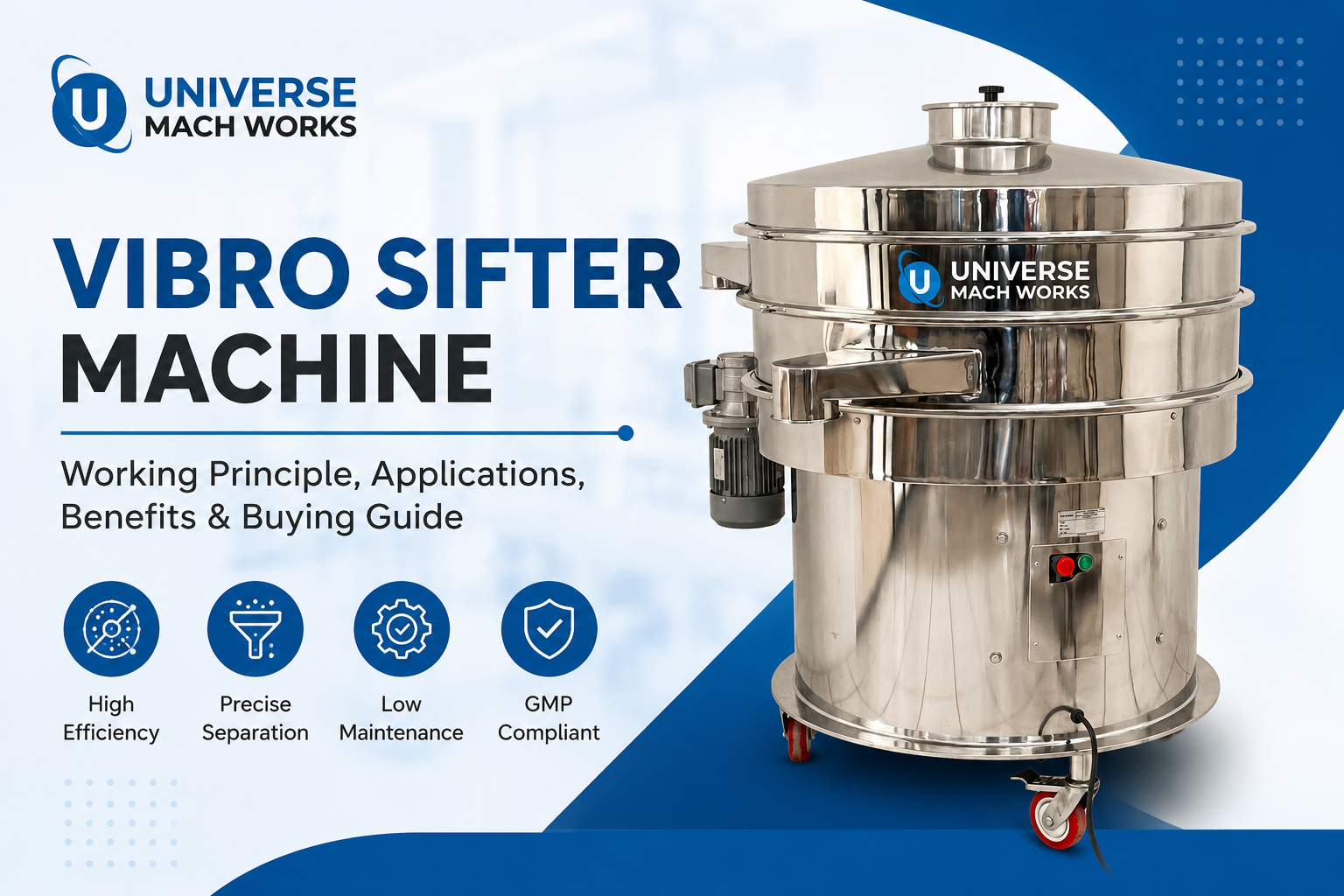
Raw materials often contain lumps or oversized particles that must be removed before mixing. A Vibro Sifter is used to remove foreign particles, break soft lumps, ensure uniform particle size, and improve powder flow — all of which contribute to better blending and granulation.
Step 4: Mixing & Blending
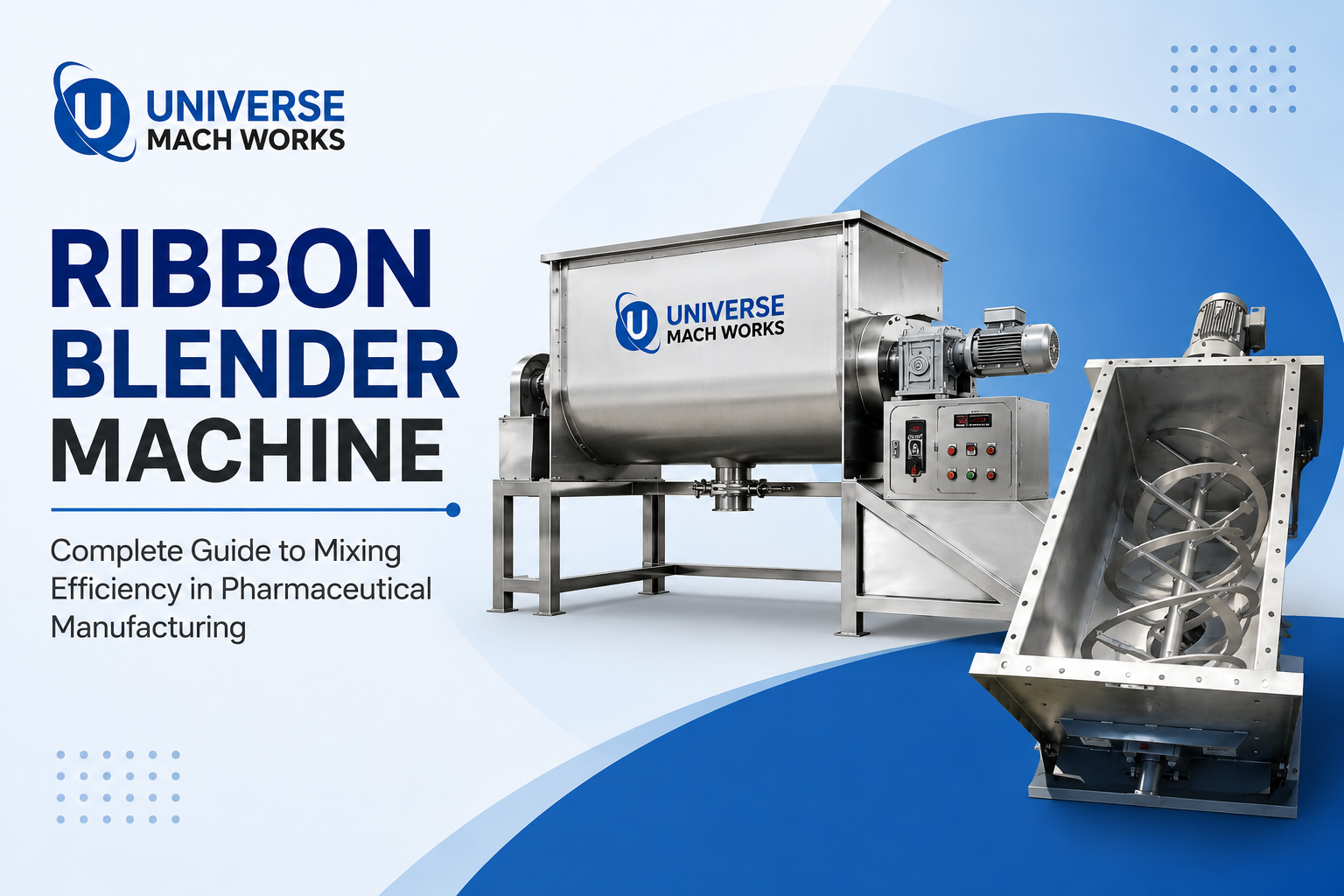
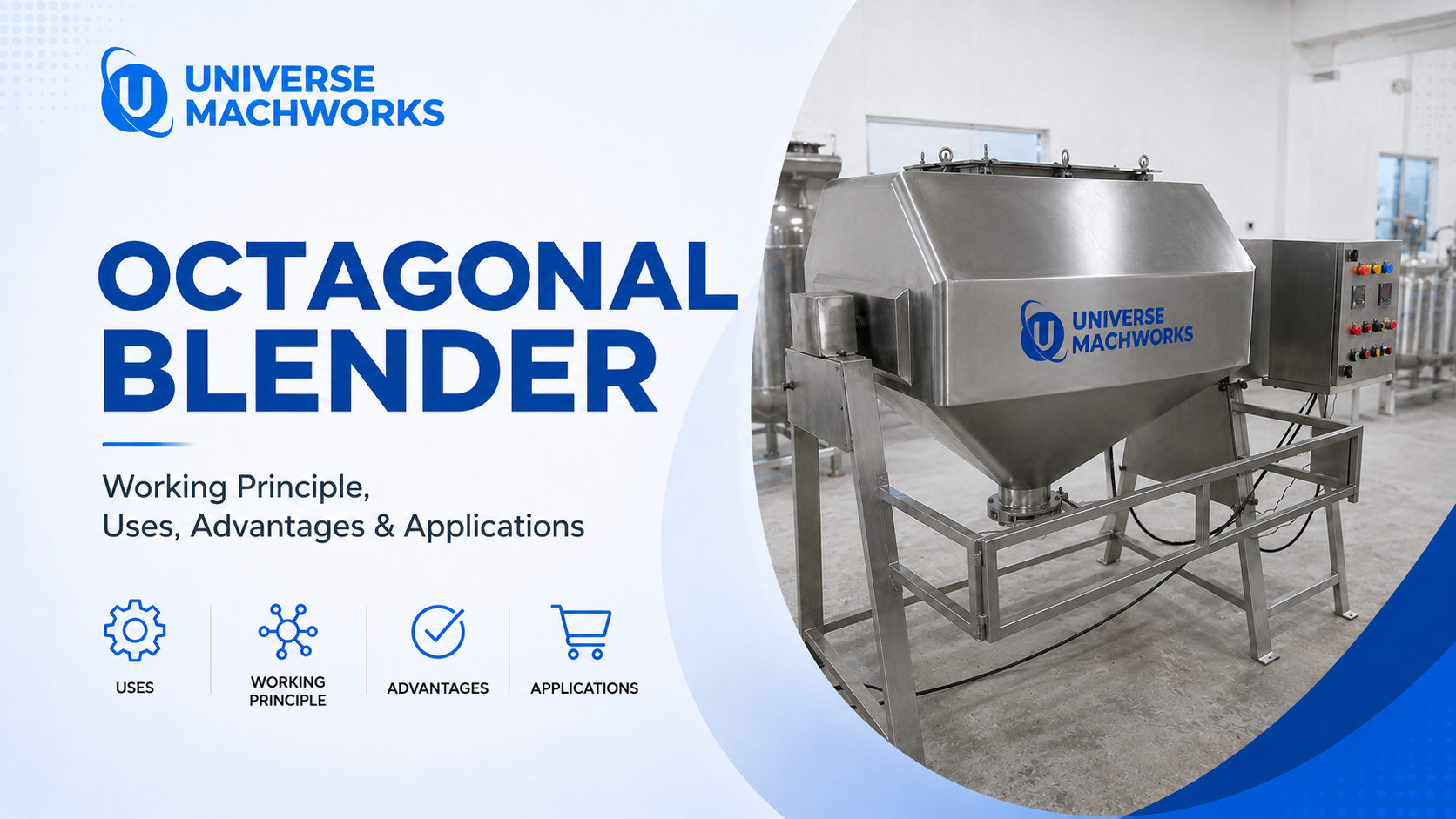
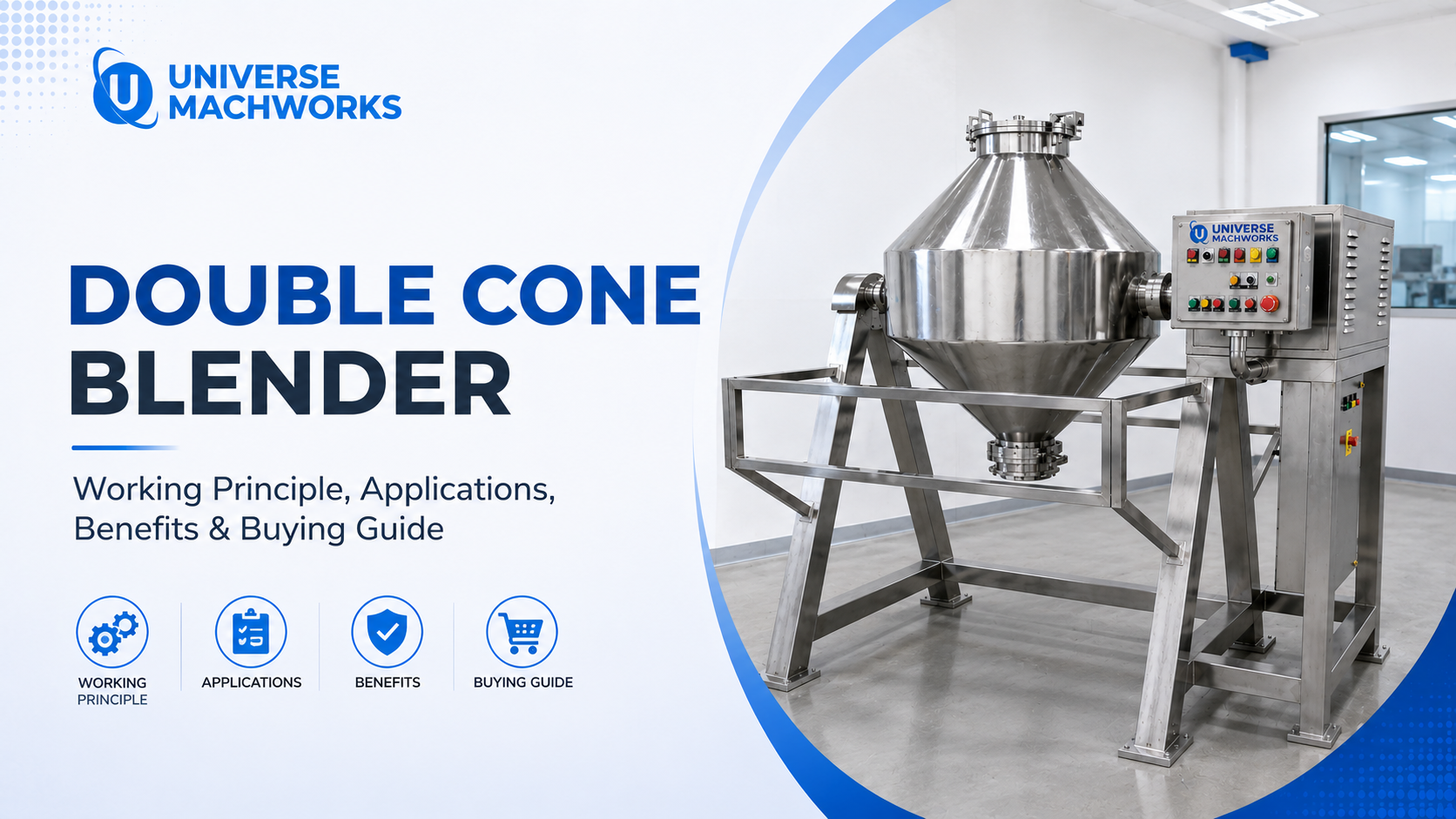
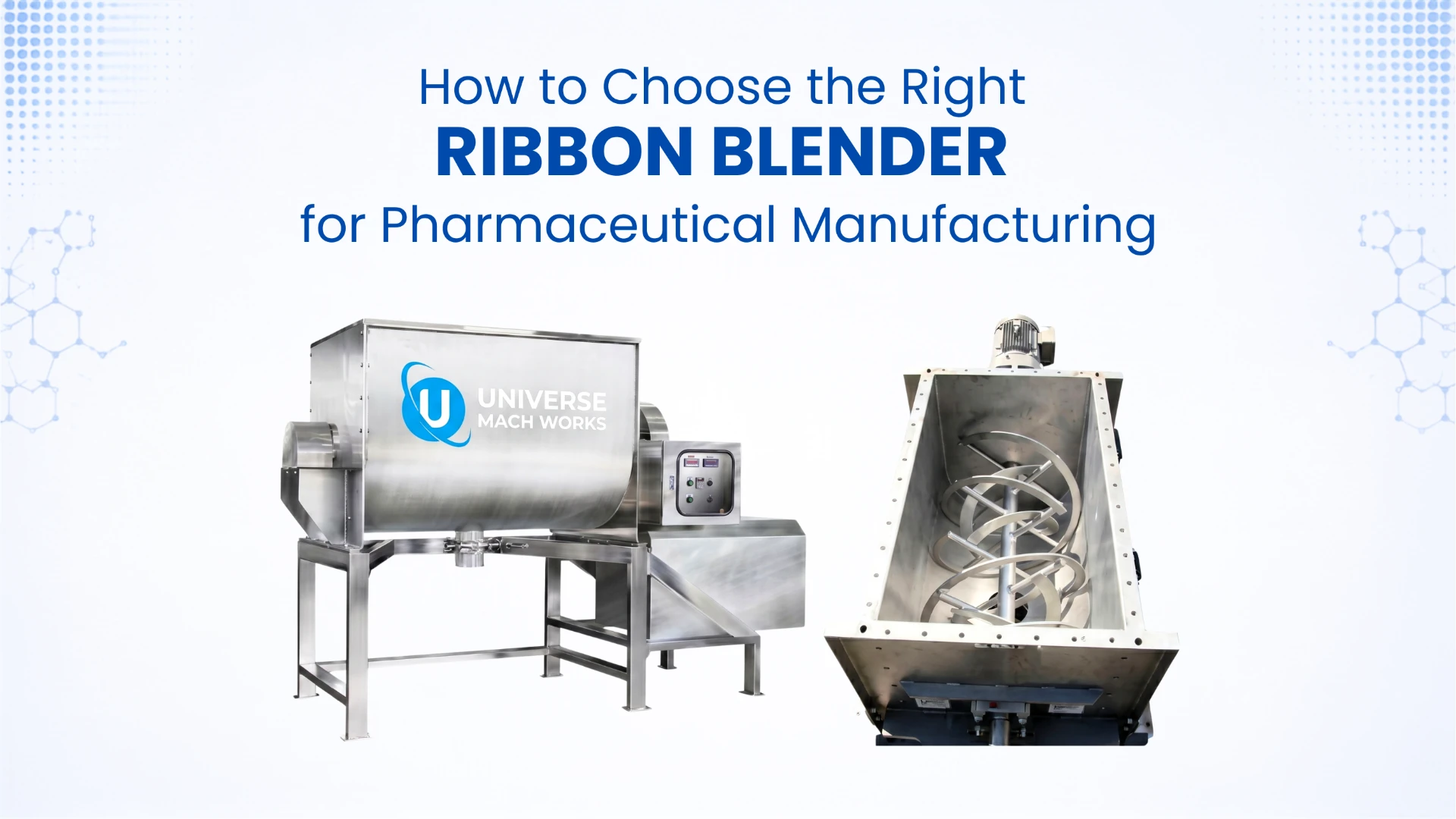
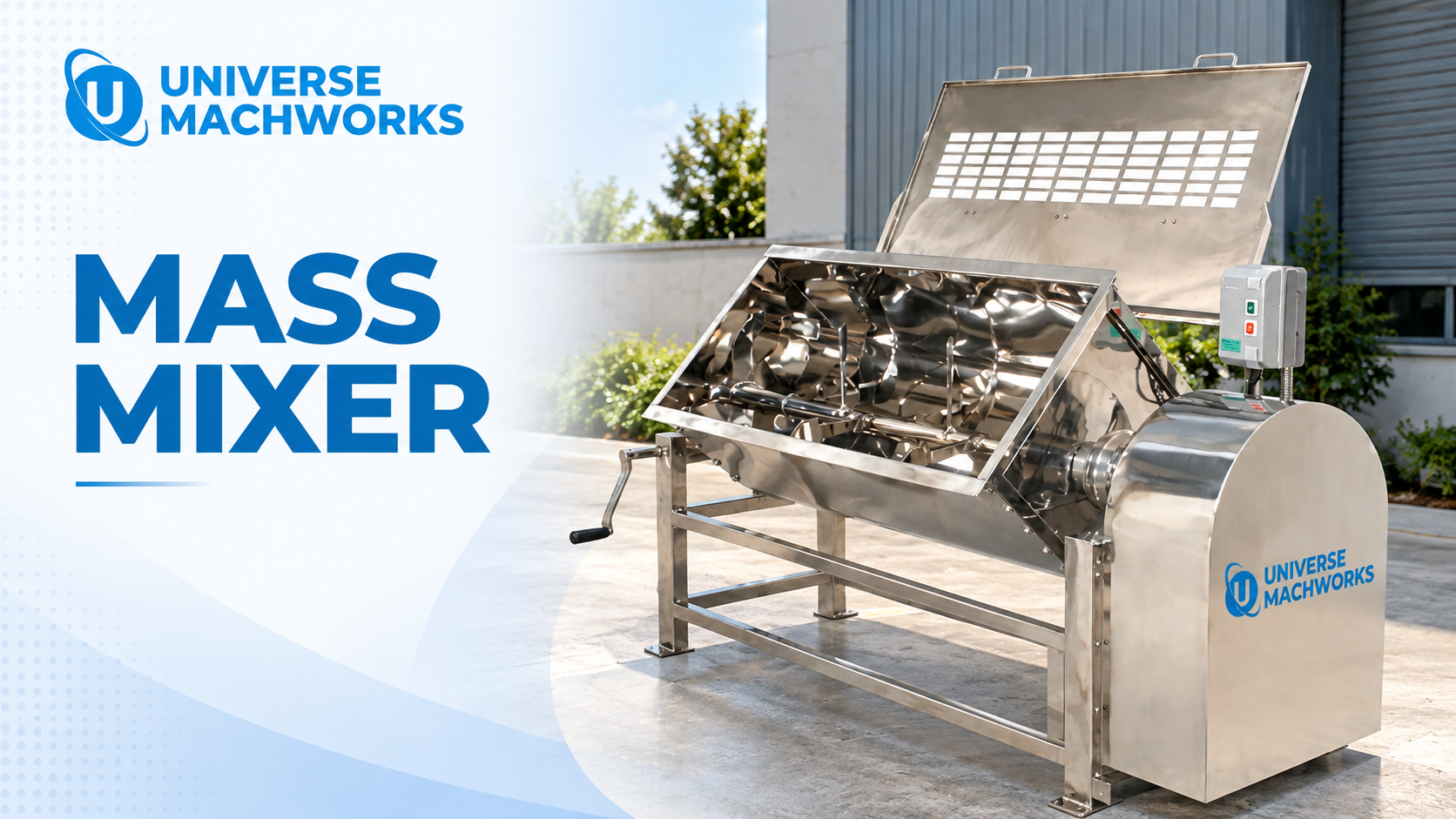
The weighed ingredients are blended to achieve a homogeneous mixture. Uniform mixing ensures that every tablet contains the correct amount of active ingredient. Depending on the formulation, manufacturers commonly use a Ribbon Blender, Double Cone Blender, Octagonal Blender, or Mass Mixer.
Step 5: Granulation
Granulation improves powder flowability and compressibility, making it easier to produce strong and uniform tablets. Wet granulation uses a binder solution to form granules and is commonly carried out using a Rapid Mixer Granulator (RMG). Dry granulation suits moisture-sensitive or heat-sensitive formulations, while direct compression can be used when the formulation offers excellent flow and compression properties.
Step 6: Drying
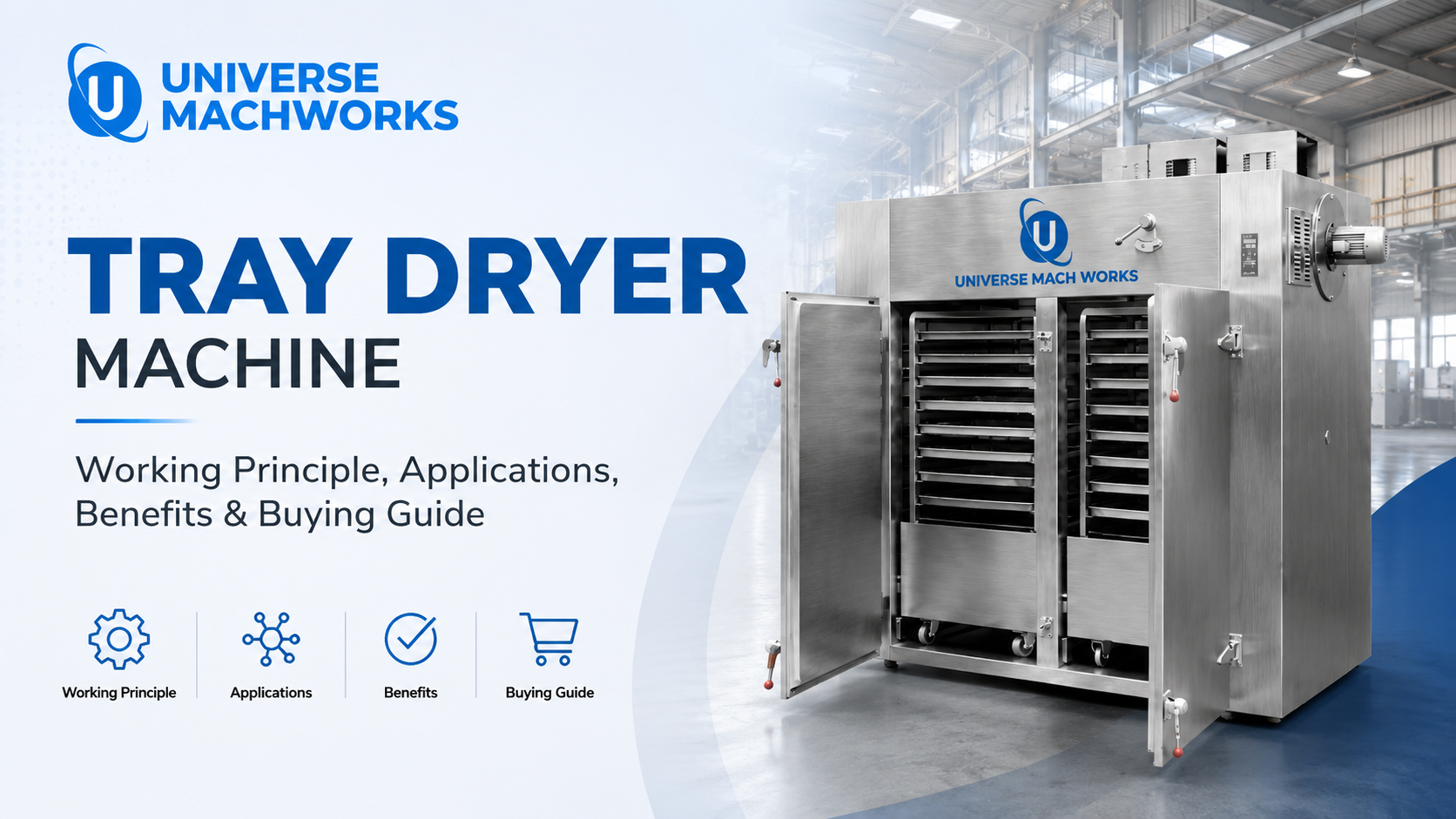
Wet granules contain moisture that must be removed before further processing. Common drying equipment includes the Fluid Bed Dryer (FBD) and Tray Dryer, which reduce moisture to the required level and improve product stability and compression performance.
Step 7: Milling & Sizing
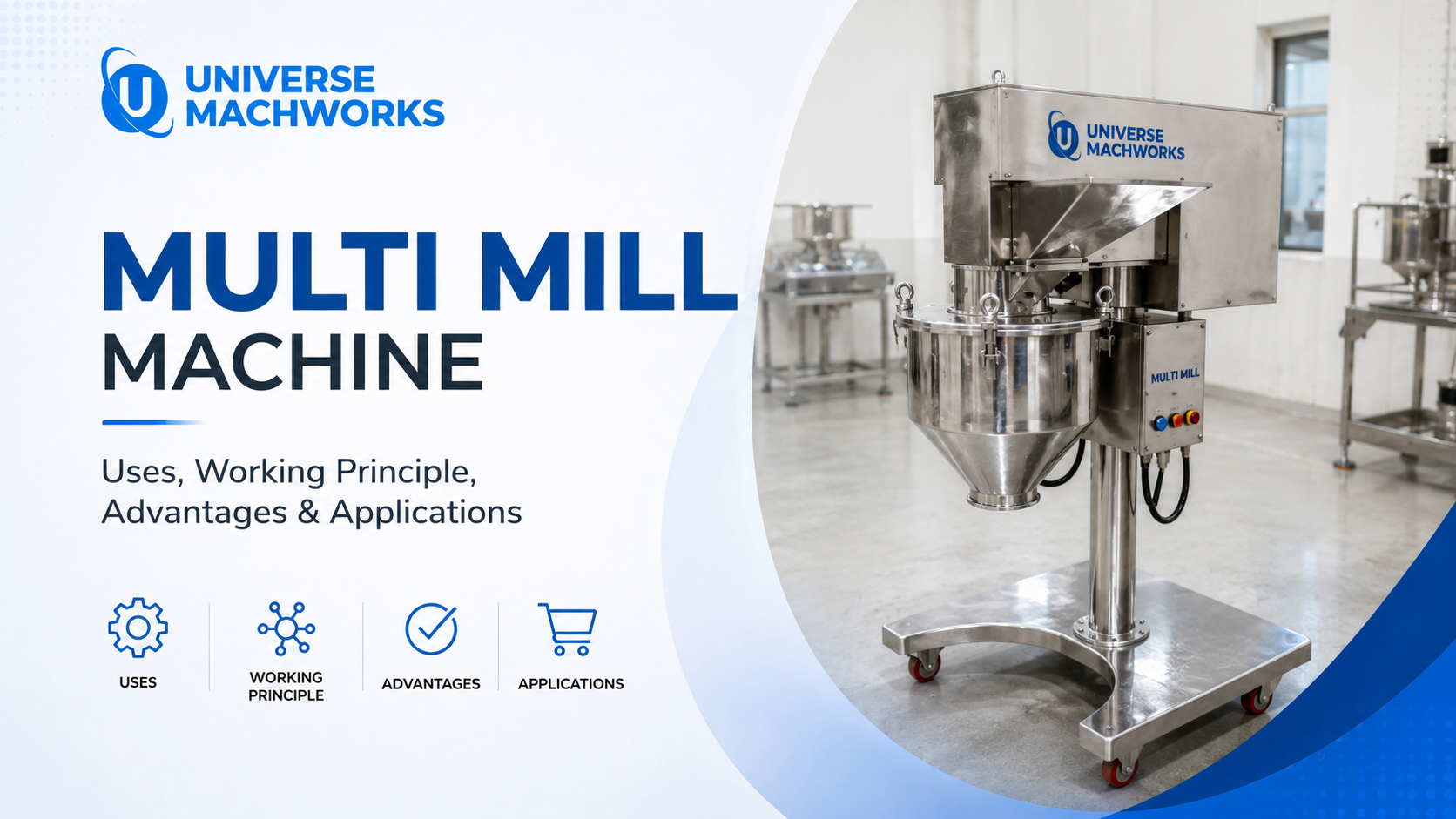
After drying, granules are milled to achieve uniform particle size using equipment such as a Multi Mill, Co-Mill, or Vibro Sifter. Uniform granule size improves tablet weight consistency and compression quality.
Step 8: Final Blending
Lubricants, glidants, and other excipients are added during the final blending stage. This step improves powder flow, compression efficiency, tablet ejection, and surface finish.
Step 9: Tablet Compression
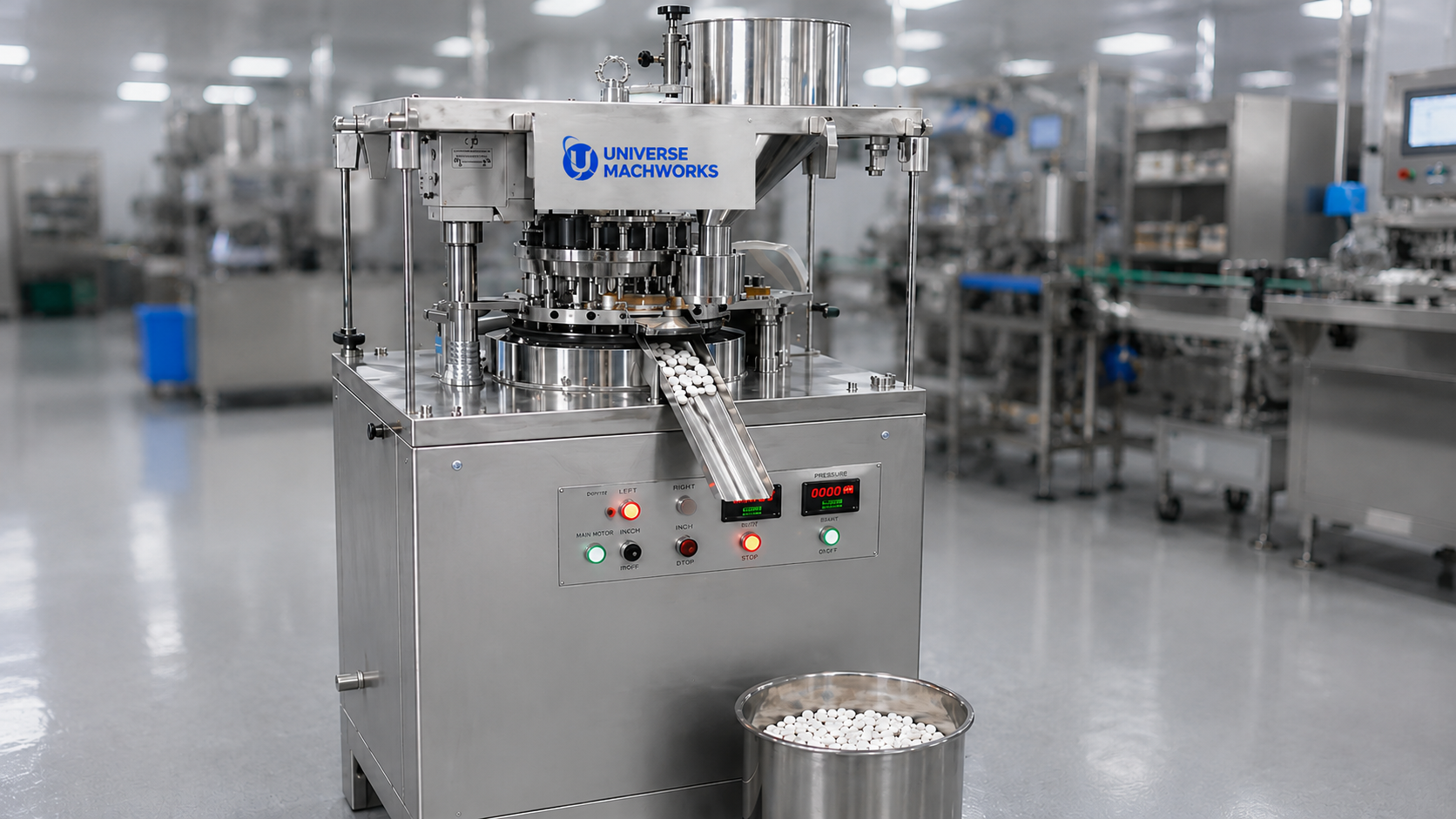
The blended granules are compressed into tablets using a Tablet Compression Machine or Rotary Tablet Press. During compression, manufacturers monitor tablet weight, hardness, thickness, friability, and compression force. Accurate compression is essential for producing high-quality tablets.
Step 10: Tablet Coating (Optional)
Depending on the product, tablets may undergo coating to improve appearance, stability, taste masking, or controlled drug release. Common coating types include film coating, sugar coating, and enteric coating — applied uniformly using a Tablet Coating Machine under controlled conditions.
Step 11: Inspection & Quality Control
Finished tablets undergo extensive quality testing, including weight variation, hardness testing, friability, dissolution, disintegration, content uniformity, visual inspection, and metal detection. Only tablets that meet all specifications proceed to packaging.
Step 12: Packaging
The final tablets are packed using automated packaging machinery such as Blister Packing Machines, Bottle Filling Machines, Labeling Machines, and Cartoning Machines. Proper packaging protects tablets from moisture, contamination, and physical damage while ensuring product traceability.
Machines Required for Tablet Manufacturing
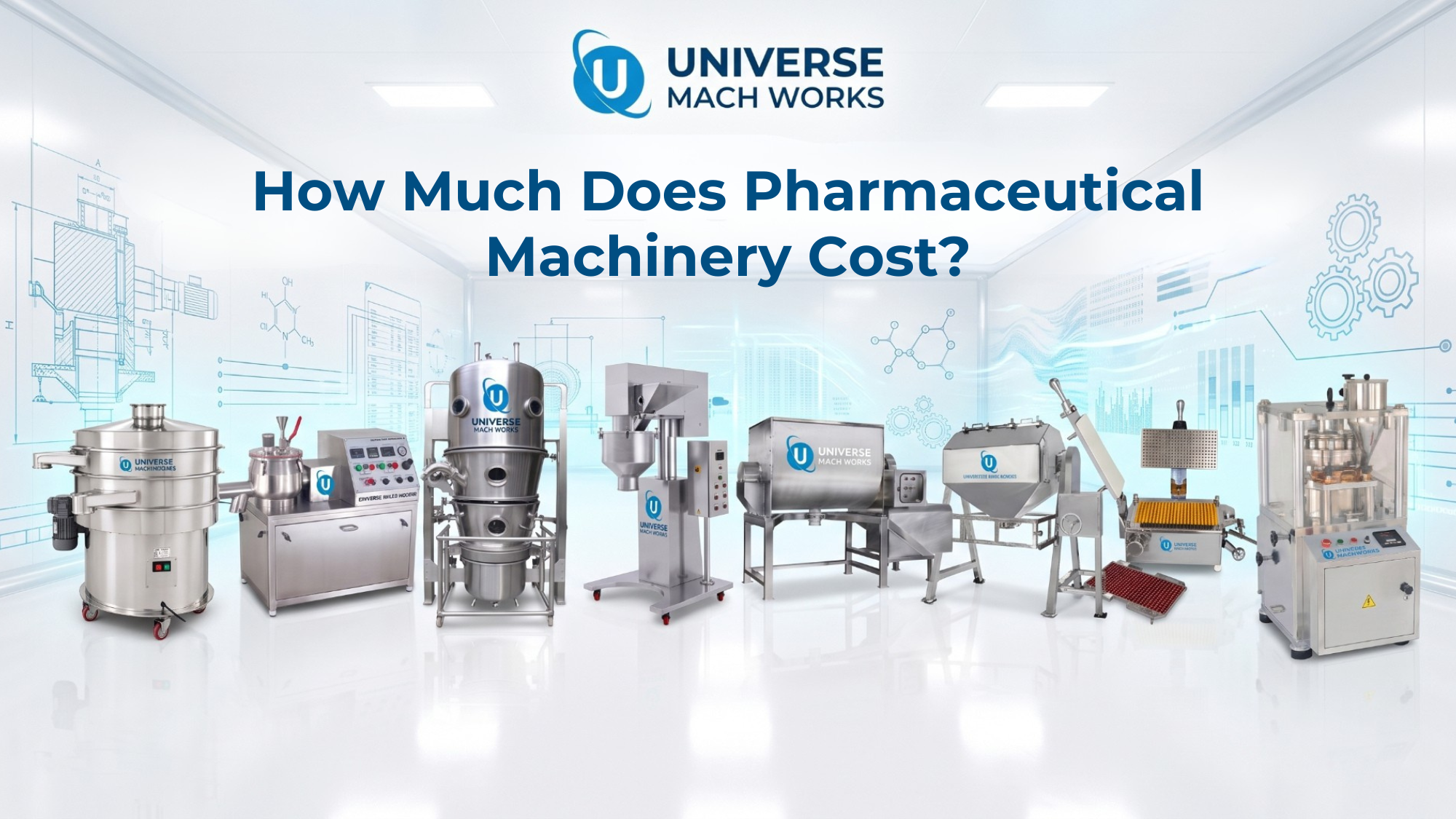
A modern tablet manufacturing facility requires multiple machines, each performing a specific function within the production process. Explore the essential equipment below and view detailed specifications on their respective product pages.
Explore Universe Mach Works Tablet Manufacturing Equipment
Vibro Sifter
Screens powders and granules to remove oversized particles and ensure uniform size distribution.
Ribbon Blender / Double Cone Blender / Octagonal Blender
Used for homogeneous mixing of APIs and excipients before granulation or compression, with each design suited to different formulation and batch requirements.
Rapid Mixer Granulator (RMG)
Performs high-shear wet granulation, improving powder flowability and compressibility before compression.
Fluid Bed Dryer (FBD) & Tray Dryer
The FBD efficiently removes moisture from wet granules with uniform drying, while a Tray Dryer suits heat-sensitive materials and smaller production batches.
Multi Mill / Co-Mill
Reduces particle size and produces uniform granules before compression, ensuring consistent tablet weight and hardness.
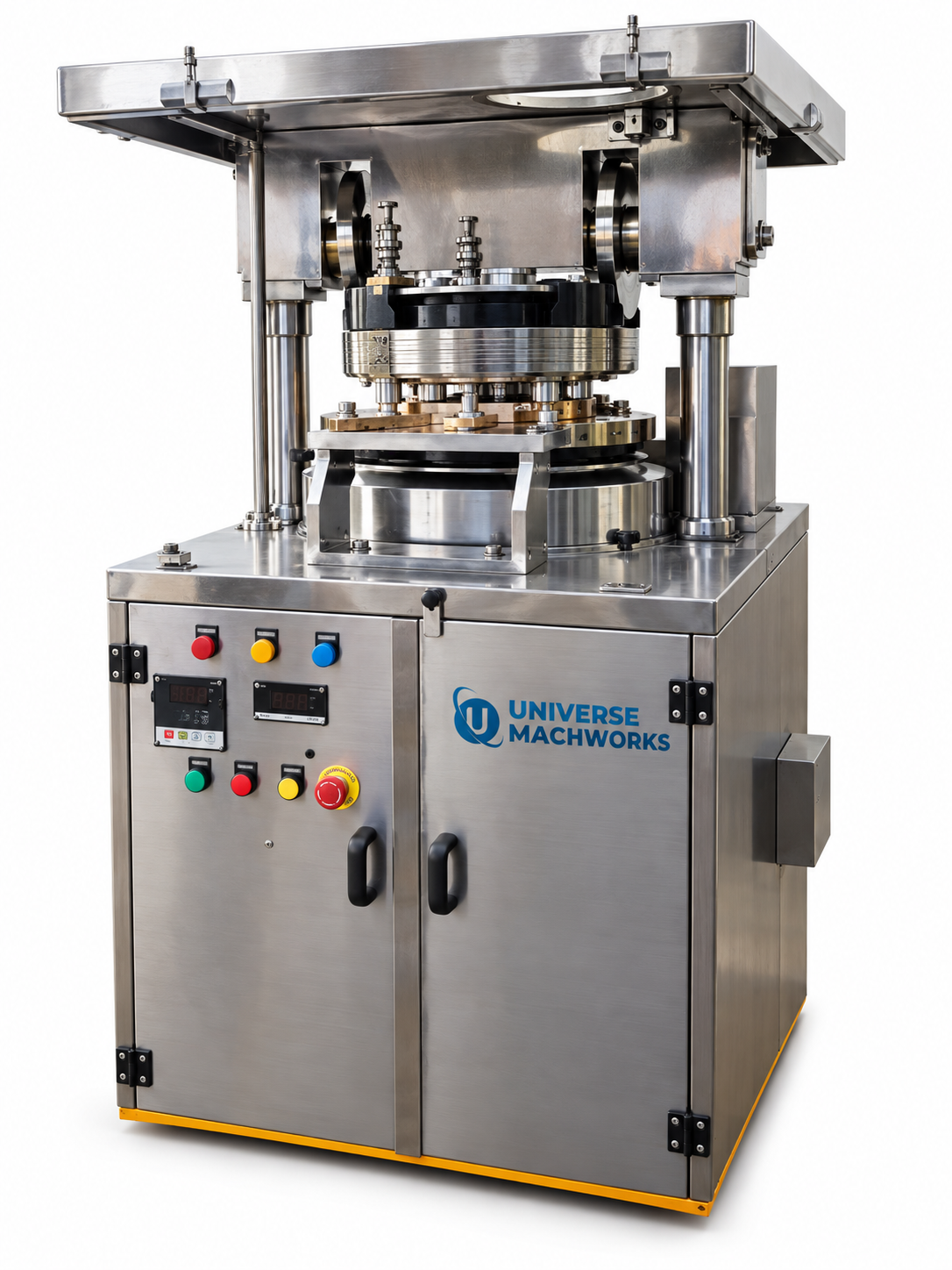
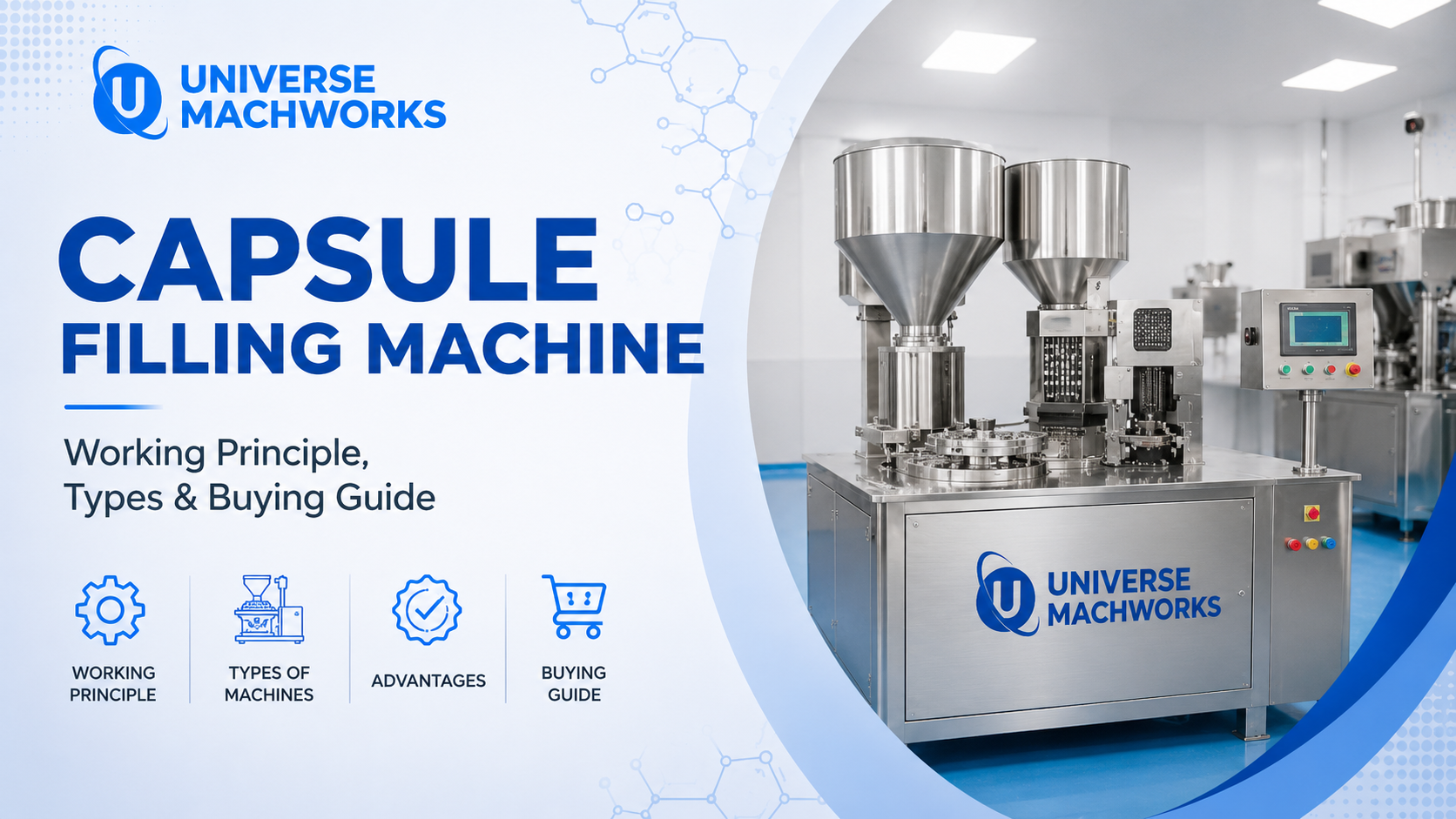
Tablet Compression Machine
Compresses granules into tablets with precise weight, hardness, and thickness. Available as Single Rotary Tablet Press, Double Rotary Tablet Press, and High-Speed Rotary Tablet Press.
Tablet Coating, Deduster, Metal Detector & Packaging
The Tablet Coating Machine applies protective and functional coatings; the deduster removes excess powder; metal detectors reject contaminated tablets; and blister, labeling, and cartoning machines complete the packaging line.
Importance of Choosing the Right Pharmaceutical Machinery Manufacturer
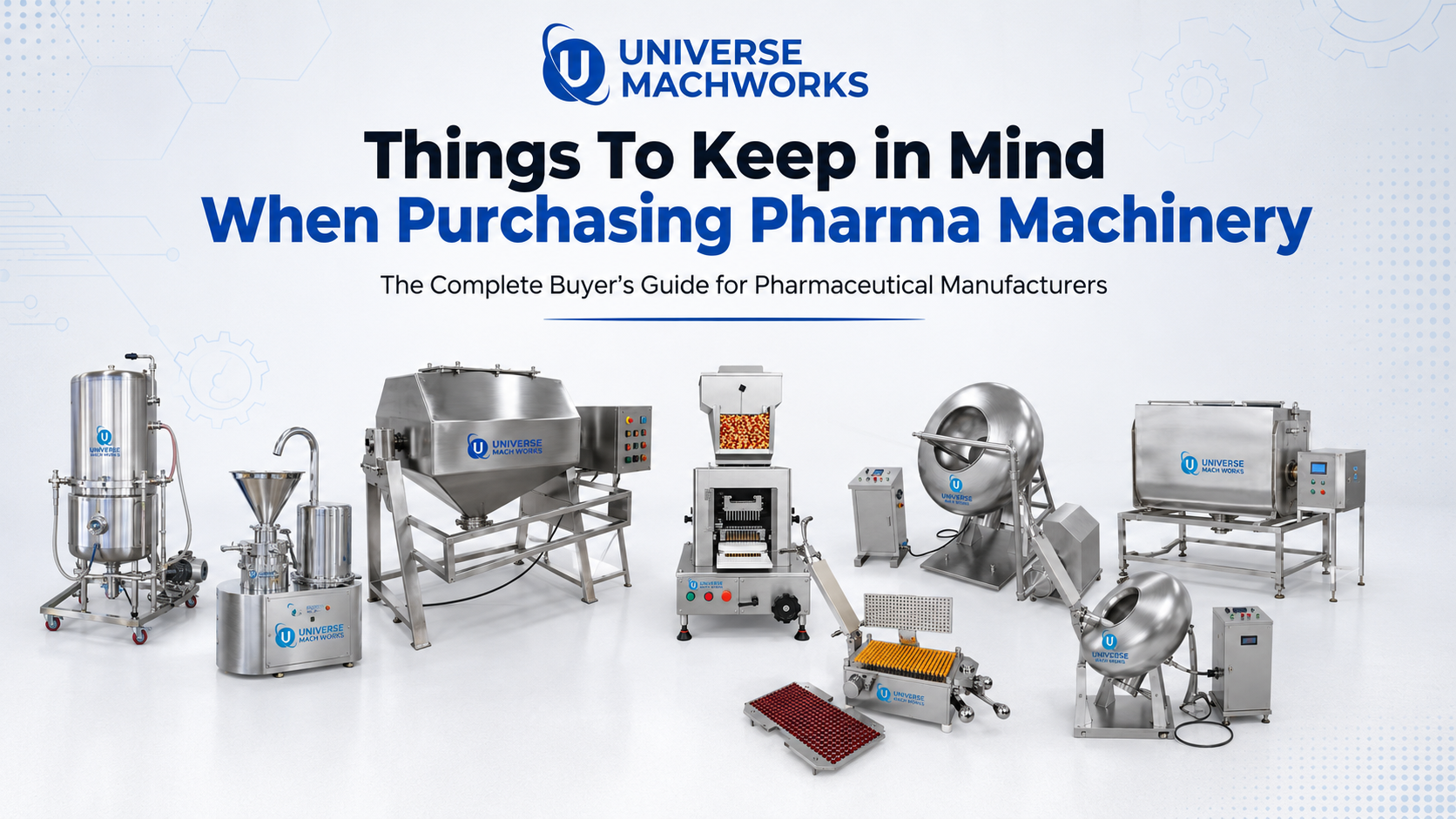
Selecting the right pharmaceutical machinery manufacturer is one of the most important decisions for any tablet manufacturing facility. Even the best formulation can fail if the equipment lacks precision, reliability, or compliance with pharmaceutical standards. A trusted manufacturer provides more than machinery — they deliver engineering expertise, process knowledge, customization, installation support, and long-term technical assistance.
Benefits of Choosing an Experienced Manufacturer
- Precision-engineered equipment
- GMP & cGMP-compliant machine design
- SS304 & SS316L stainless steel construction
- High production efficiency
- Consistent tablet quality
- Lower maintenance costs
- Energy-efficient operation
- Easy cleaning and validation
- Reliable spare parts availability
- Installation and commissioning support
- Operator training
- Long-term after-sales service
Features of High-Quality Tablet Manufacturing Equipment
1. GMP & cGMP Compliant Design
GMP-compliant machines minimize contamination, simplify cleaning, and support regulatory inspections through hygienic construction, smooth product-contact surfaces, minimal dead zones, easy dismantling, food-grade sealing materials, and sanitary welding.
2. Premium Stainless Steel Construction
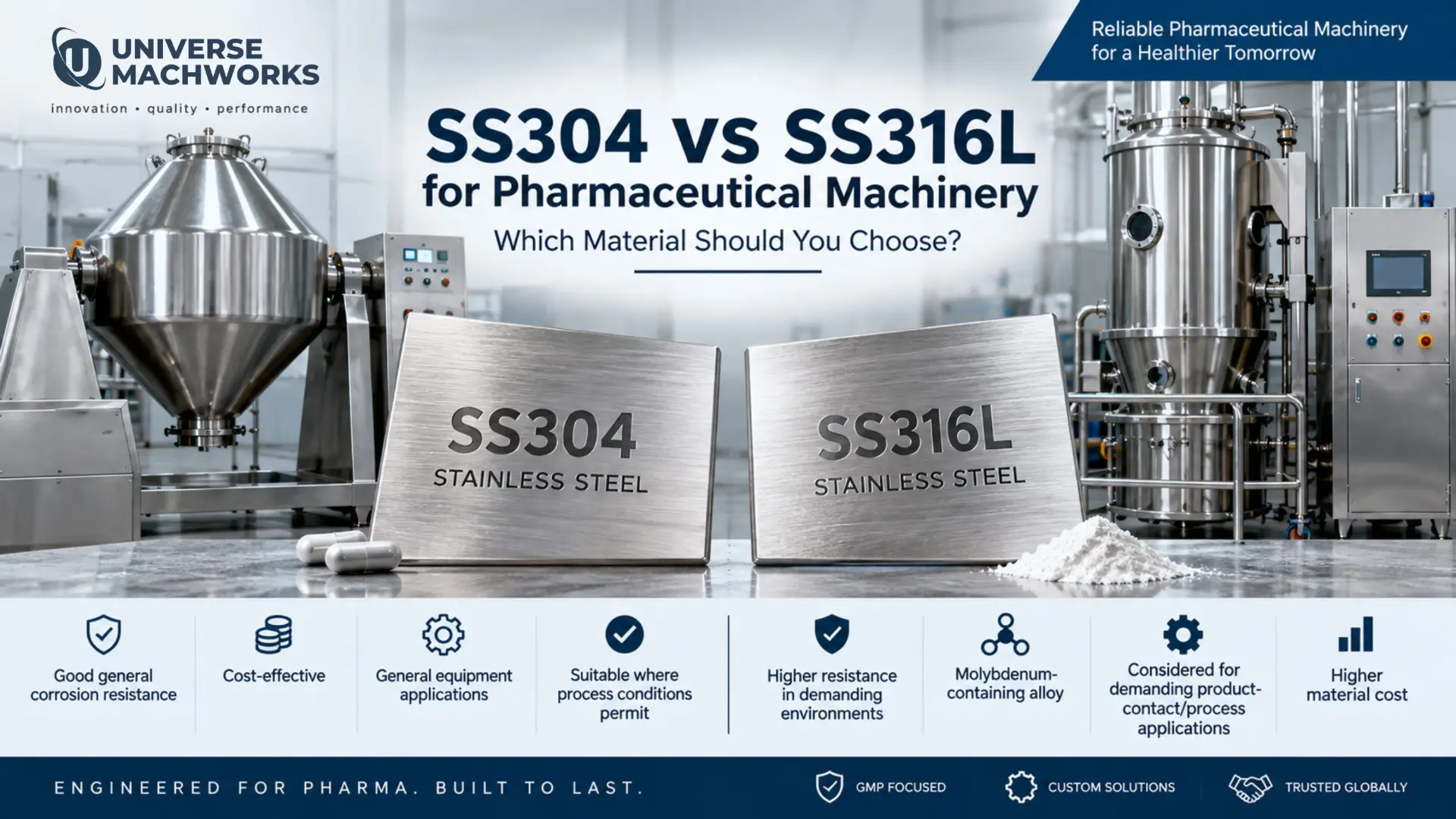
Tablet manufacturing equipment should be manufactured using SS304, SS316, or SS316L pharmaceutical-grade stainless steel for corrosion resistance, long equipment life, easy cleaning, and superior hygiene. For product-contact parts, SS316L is generally preferred.
3. Precision Engineering
Every machine should provide uniform blending, accurate granulation, consistent drying, controlled milling, and precise tablet compression so every batch meets pharmaceutical quality standards.
4. High Production Efficiency
Modern equipment delivers higher production output, faster processing, reduced downtime, lower operating costs, and better machine utilization — allowing manufacturers to meet growing market demand.
5. Advanced Automation
- PLC Control System
- Touchscreen HMI
- Variable Frequency Drive (VFD)
- Recipe Management
- Alarm System
- Batch Data Recording
- Password Protection
- Automatic Process Monitoring
6. Easy Cleaning & Maintenance
Look for mirror-polished surfaces, quick dismantling, tool-free maintenance, easy access panels, minimal product retention, and smooth internal finishes.
7. Energy Efficiency
Energy-efficient motors, optimized drive systems, low power consumption, reduced heat generation, and efficient process design lower operating costs over the equipment's lifetime.
8. Operator Safety
Reliable equipment includes emergency stop buttons, safety interlocks, protective guards, overload protection, electrical safety systems, and stable machine construction.
9. Low Maintenance
Well-designed machinery offers long service life, reduced wear, easy spare part replacement, reliable performance, and minimal breakdowns.
10. Scalability
Future-ready machines should support capacity upgrades, automation upgrades, process integration, and additional accessories — protecting long-term investments.
GMP Requirements for Tablet Manufacturing Equipment
Good Manufacturing Practices (GMP) define how pharmaceutical equipment should be designed, operated, maintained, and validated. High-quality tablet manufacturing equipment should comply with hygienic construction, pharmaceutical-grade materials (SS304/SS316/SS316L), easy cleaning, full documentation (user manual, drawings, material certificates, IQ/OQ, FAT, calibration), process validation (IQ, OQ, PQ), operator safety, and full production traceability including batch records, alarm history, user login, and recipe management.
Buying Guide
Investing in tablet manufacturing equipment is a long-term business decision. Before purchasing, evaluate production capacity (batch size, daily/monthly demand and future expansion), product type (tablets, nutraceuticals, herbal, effervescent, veterinary), automation requirements (semi-automatic vs fully automatic), machine quality (material of construction, weld quality, surface finish, mechanical and electrical components), spare parts availability, after-sales support, customization capability, and total cost of ownership rather than just the initial price.
Common Buying Mistakes
- Buying only on price
- Ignoring future expansion
- Choosing the wrong capacity
- Ignoring GMP compliance
- Overlooking spare parts availability
- Selecting inexperienced manufacturers
- Skipping Factory Acceptance Testing (FAT)
- Poor factory planning
Industry Trends
The pharmaceutical manufacturing industry is evolving rapidly with increasing emphasis on automation, digitalization, and sustainability. Smart pharmaceutical factories now use IoT-enabled equipment, cloud monitoring, predictive maintenance, real-time production analytics, and remote diagnostics. Intelligent automation with PLC controls, touchscreen HMIs, servo drives, automatic material handling, and batch recording is expanding across every stage of tablet manufacturing. Sustainable equipment with lower power consumption, efficient motors, and reduced material wastage supports both cost and environmental goals. Data-driven manufacturing enables integration with Manufacturing Execution Systems (MES) and digital production workflows, while flexible production lines allow quick product changeovers and modular upgrades.
Comparison Tables
Essential Machines Used in Tablet Manufacturing
| Manufacturing Stage | Recommended Machine |
|---|---|
| Raw Material Sieving | Vibro Sifter |
| Powder Blending | Ribbon Blender / Double Cone Blender / Octagonal Blender |
| Wet Granulation | Rapid Mixer Granulator (RMG) |
| Drying | Fluid Bed Dryer (FBD) / Tray Dryer |
| Milling | Multi Mill / Co-Mill |
| Final Blending | Double Cone Blender / Octagonal Blender |
| Tablet Compression | Single Rotary Tablet Press / Rotary Tablet Compression Machine |
| Tablet Coating | Tablet Coating Machine |
| Dedusting | Tablet Deduster |
| Packaging | Blister Packing Machine |
Tablet Manufacturing Equipment Comparison
| Machine | Primary Function | Suitable For |
|---|---|---|
| Vibro Sifter | Particle Size Separation | Powder Preparation |
| Ribbon Blender | Powder Mixing | Bulk Powder Blending |
| Double Cone Blender | Gentle Powder Blending | Pharmaceutical Powders |
| Octagonal Blender | Uniform Powder Mixing | Tablets & Capsules |
| Rapid Mixer Granulator | Wet Granulation | Tablet Production |
| Fluid Bed Dryer | Drying Granules | Wet Granules |
| Multi Mill | Particle Size Reduction | Granule Sizing |
| Tablet Press | Tablet Compression | Tablet Manufacturing |
Manual vs Semi-Automatic vs Automatic Production
| Feature | Manual | Semi-Automatic | Automatic |
|---|---|---|---|
| Production Capacity | Low | Medium | High |
| Labor Requirement | High | Medium | Low |
| Productivity | Moderate | High | Very High |
| Accuracy | Moderate | High | Excellent |
| Investment | Low | Medium | High |
| GMP Compliance | Limited | Good | Excellent |
Why Choose Universe Mach Works?
At Universe Mach Works, we specialize in designing and manufacturing premium pharmaceutical processing equipment engineered for reliability, precision, and high-performance production. Our complete range of tablet manufacturing equipment is built using high-quality stainless steel and follows GMP-compliant manufacturing practices to ensure superior hygiene, durability, and operational efficiency.
- Over 50 Years of Engineering Experience
- Complete Pharmaceutical Processing Equipment Range
- GMP & cGMP Compliant Machine Design
- SS304 & SS316L Stainless Steel Construction
- Precision Engineering for Consistent Performance
- High Production Efficiency
- Energy-Efficient Machinery
- Low Maintenance Design
- User-Friendly PLC & Touchscreen HMI Options
- Customized Machine Solutions
- Factory Acceptance Testing (FAT)
- Installation & Commissioning Support
- Operator Training
- Genuine Spare Parts Availability
- Reliable After-Sales Service
- Pan India Supply
- Export-Ready Pharmaceutical Machinery
Explore the Product
Complete Tablet Manufacturing Equipment Range by Universe Mach Works
View technical specifications, applications and request a customized quote.
View Complete Tablet Manufacturing Equipment RangeFrequently Asked Questions
What is tablet manufacturing?+
Tablet manufacturing is the pharmaceutical process of converting APIs and excipients into compressed tablets through blending, granulation, drying, milling, compression, coating, and packaging.
Which machines are required for tablet manufacturing?+
A complete tablet manufacturing line generally includes Vibro Sifter, Ribbon Blender, Double Cone Blender, Octagonal Blender, Rapid Mixer Granulator, Fluid Bed Dryer, Tray Dryer, Multi Mill, Tablet Compression Machine, Tablet Deduster, Tablet Coating Machine, and Blister Packing Machine.
Why is choosing the right pharmaceutical machinery manufacturer important?+
A reliable manufacturer provides GMP-compliant equipment, precision engineering, dependable after-sales support, genuine spare parts, and machinery designed for long-term performance.
What is GMP in pharmaceutical manufacturing?+
GMP (Good Manufacturing Practices) is a system of regulations that ensures pharmaceutical products are consistently produced and controlled according to quality standards.
What materials are used to manufacture pharmaceutical machinery?+
Most pharmaceutical machinery is manufactured using SS304 and SS316L stainless steel, offering excellent corrosion resistance, hygiene, and durability.
What is a Rapid Mixer Granulator used for?+
A Rapid Mixer Granulator (RMG) is used for wet granulation to improve powder flowability and compressibility before tablet compression.
What is the function of a Fluid Bed Dryer?+
A Fluid Bed Dryer removes moisture from wet granules quickly and uniformly, ensuring optimal moisture content before milling and compression.
Why is a Vibro Sifter used in tablet manufacturing?+
A Vibro Sifter removes oversized particles, breaks soft lumps, and ensures uniform particle size distribution for better blending and granulation.
Which blender is best for pharmaceutical powders?+
Ribbon Blenders, Double Cone Blenders, and Octagonal Blenders are widely used depending on the formulation, batch size, and blending requirements.
What is the role of a Tablet Compression Machine?+
It compresses pharmaceutical granules into tablets with accurate weight, hardness, and thickness while maintaining high production efficiency.
How do modern pharmaceutical machines improve production?+
Modern machines increase productivity through automation, PLC controls, improved accuracy, reduced downtime, and better process consistency.
What industries use tablet manufacturing equipment?+
Tablet manufacturing equipment is widely used in the pharmaceutical, nutraceutical, herbal and Ayurvedic, veterinary pharmaceutical, food supplement, and biotechnology industries.
How often should pharmaceutical machinery be maintained?+
Routine cleaning should be performed after each batch, while preventive maintenance should follow the manufacturer's recommended schedule to ensure reliable operation.
Can pharmaceutical machinery be customized?+
Yes. Universe Mach Works offers customization for capacity, automation, control systems, materials of construction, and specific production requirements.
Why choose Universe Mach Works?+
Universe Mach Works provides GMP-compliant pharmaceutical machinery with precision engineering, durable construction, comprehensive after-sales support, and customized solutions for pharmaceutical manufacturers.
Conclusion
The success of any tablet manufacturing facility depends on a combination of well-designed production processes, skilled personnel, and reliable pharmaceutical machinery. From raw material handling to blending, granulation, drying, milling, tablet compression, coating, inspection, and packaging, every stage requires precision-engineered equipment to ensure consistent product quality and regulatory compliance.
Choosing the right pharmaceutical machinery manufacturer is equally important. A trusted manufacturer provides not only advanced equipment but also technical expertise, installation support, spare parts availability, and long-term service that help maximize productivity and minimize downtime.
At Universe Mach Works, we manufacture a complete range of pharmaceutical processing equipment designed to meet the demanding requirements of modern pharmaceutical production. Whether you're establishing a new tablet manufacturing facility or upgrading an existing production line, our reliable, efficient, and future-ready machinery is tailored to your business needs.