Drying is one of the most important operations in pharmaceutical manufacturing and other industrial processing industries. After granulation, wet mixing, washing, or other moisture-related processes, materials often need to be dried to achieve the required moisture content before they can move to the next production stage.
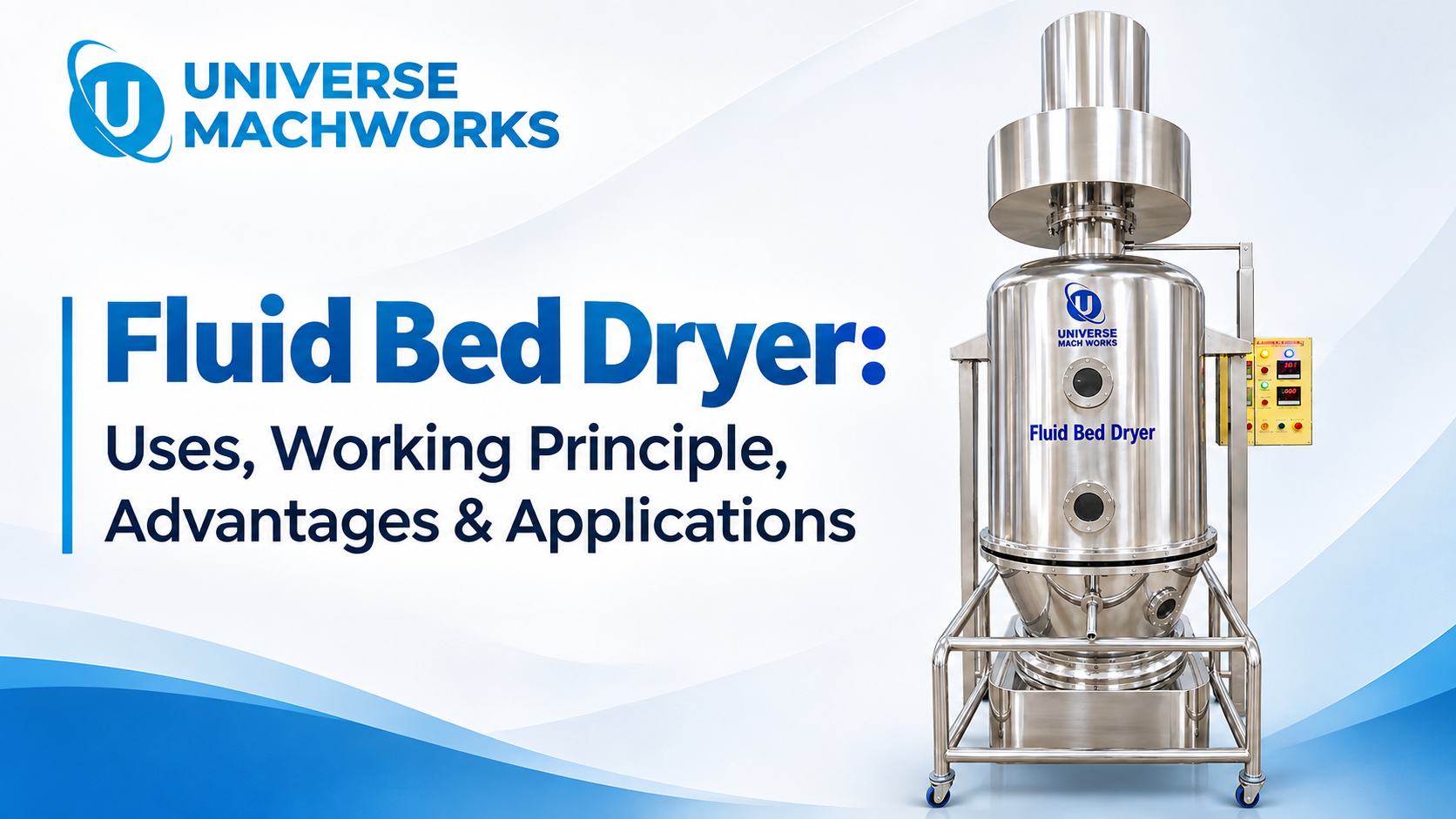
A Fluid Bed Dryer (FBD) is widely used for drying pharmaceutical powders and granules through controlled hot air circulation. It operates on the principle of fluidization, in which heated air passes upward through a bed of solid particles, causing them to become suspended and behave similarly to a fluid.
The Fluid Bed Dryer offers an efficient approach to drying suitable powders and granules by providing good contact between the drying air and the material. It is commonly used in pharmaceutical manufacturing, nutraceutical production, food processing, and chemical industries.
For manufacturers looking for consistent drying performance, understanding the fluid bed dryer working principle, applications, advantages, and equipment selection criteria is essential.
In this guide, we will explain how a Fluid Bed Dryer works, its major components, common uses, benefits, limitations, and important factors to consider before purchasing one.
What Is a Fluid Bed Dryer?
A Fluid Bed Dryer (FBD) is an industrial drying machine designed to remove moisture from suitable solid materials using a controlled stream of heated air.
The machine contains a product container or drying chamber in which wet granules or particles are placed. Heated air enters from the bottom through an air distribution plate and moves upward through the material.
When the airflow reaches an appropriate velocity, the particles become suspended and start moving freely within the drying chamber. This condition is called fluidization.
During fluidization, the particles come into contact with the heated air, allowing moisture to evaporate from their surfaces and, depending on the material and process conditions, migrate from within the particles.
The moisture-laden air exits through the exhaust system, while filters help prevent product particles from escaping with the outgoing air.
A Fluid Bed Dryer is commonly used after wet granulation in pharmaceutical tablet manufacturing. It helps dry granules before subsequent operations such as milling, blending, lubrication, and tablet compression.
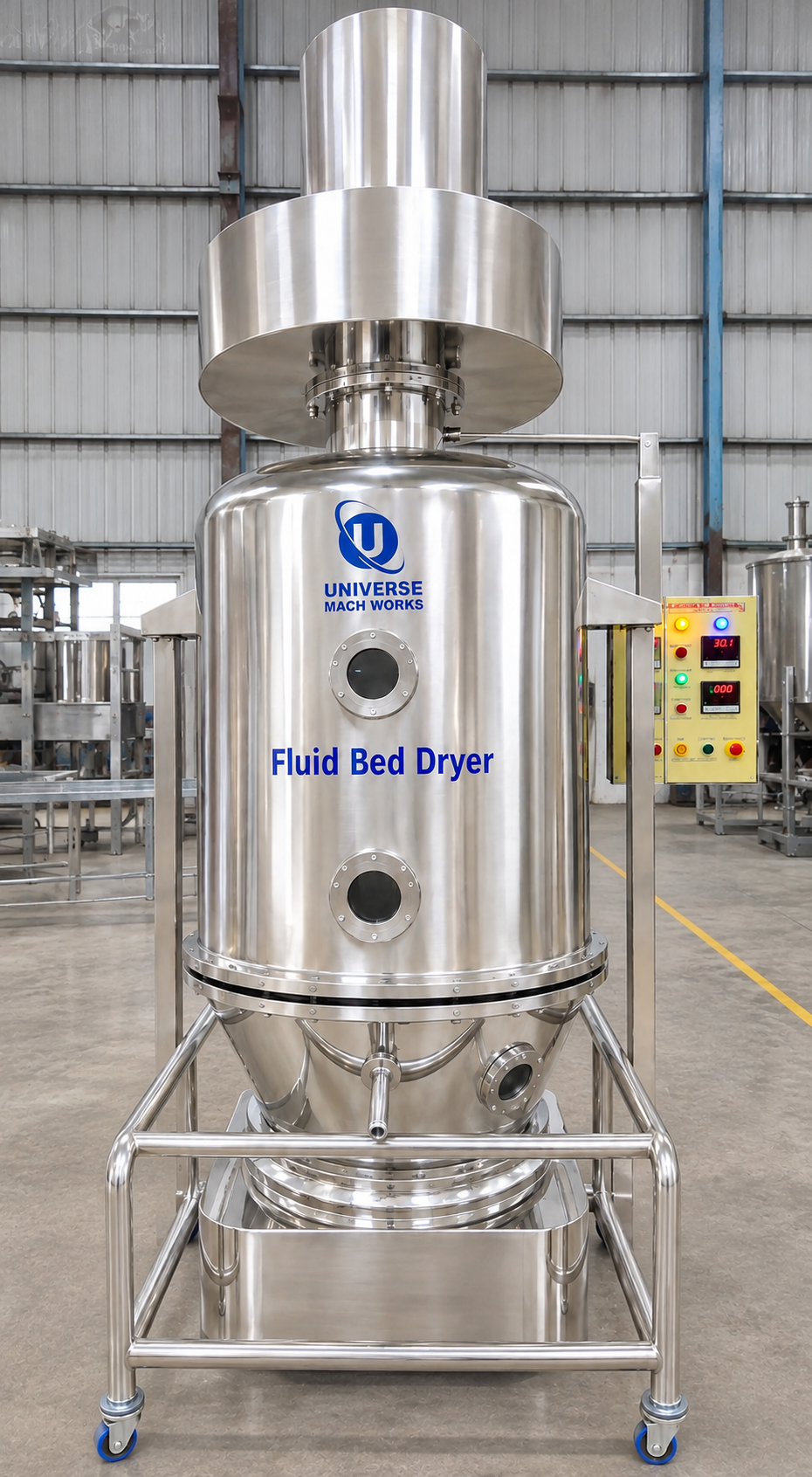
Fluid Bed Dryer Working Principle
The working principle of a Fluid Bed Dryer is based on fluidization and convective heat transfer.
In simple terms, the machine uses heated air to lift and circulate solid particles inside a drying chamber. The continuous movement increases contact between the particles and the drying air, supporting moisture removal.
Step-by-Step Working Process of a Fluid Bed Dryer
1. Loading of Wet Material
Wet granules or suitable solid particles are loaded into the product container. The quantity of material depends on the working capacity and design of the machine.
The material should be distributed appropriately to support effective airflow through the product bed.
2. Air Intake and Filtration
Atmospheric air enters the machine through the air handling arrangement.
The incoming air passes through suitable filters to reduce unwanted airborne particles before entering the heating section.
3. Heating of Air
The filtered air passes through a heating system, where it is heated to the required process temperature.
The heating arrangement may use steam, electricity, or another suitable heating medium depending on the machine configuration.
Temperature settings depend on the product's moisture content, heat sensitivity, drying requirements, and process validation.
4. Air Distribution
The heated air enters the lower section of the drying chamber and passes through an air distribution plate.
The distribution plate helps spread the airflow across the product bed to support more uniform fluidization.
5. Fluidization of Material
As air passes upward through the wet material, the airflow creates an upward force on the particles.
When the air velocity becomes sufficient to balance the effective weight of the particles, the bed begins to expand and fluidization occurs.
The particles move continuously inside the chamber, increasing their exposure to the heated air.
6. Moisture Evaporation
The heated air transfers energy to the particles. Moisture evaporates from the material and moves into the surrounding air.
Continuous particle movement supports heat and mass transfer between the drying air and the product.
7. Exhaust Air and Filtration
The moisture-containing air moves upward and exits through the exhaust arrangement.
Filter bags or suitable filtration systems help retain product particles and reduce product loss through the exhaust.
8. Drying Completion and Material Discharge
The drying process continues until the material reaches the required moisture level or other defined process endpoint.
After drying, the machine is stopped according to the operating procedure, and the dried material is unloaded for the next manufacturing operation.
The actual drying endpoint should be established through an appropriate process and product-specific testing method rather than relying only on a fixed drying time.
Main Components of a Fluid Bed Dryer
A Fluid Bed Dryer consists of several interconnected components that work together to provide controlled airflow, heating, fluidization, and moisture removal.
1. Product Container
The product container holds the wet granules or particles during the drying process.
It is designed to allow heated air to pass upward through the material while supporting controlled product movement.
2. Drying Chamber
The drying chamber provides the space where fluidization and moisture removal take place.
Its dimensions and design depend on the machine capacity and intended application.
3. Air Handling Unit (AHU)
The air handling arrangement supplies and conditions the air required for drying.
Depending on the machine design, it may include:
- Air inlet
- Pre-filters
- Fine filters
- Heating arrangement
- Blower or fan
- Airflow control components
The filtration stages should be selected according to the intended product and facility requirements.
4. Heating System
The heating system increases the temperature of the incoming air.
Common heating arrangements include:
- Steam heating
- Electrical heating
- Other configured heating systems
The selection depends on available utilities, operating costs, process requirements, and equipment design.
5. Blower or Air Handling Fan
The blower supplies the airflow required to fluidize the product bed.
Airflow must be properly controlled because insufficient airflow may result in poor fluidization, while excessive airflow can cause particle carryover or product damage.
6. Air Distribution Plate
The air distribution plate is located below the product container.
It distributes incoming air across the material bed and helps maintain suitable fluidization conditions.
7. Filter Bags
Filter bags help retain fine product particles within the drying chamber and reduce their loss through the exhaust air.
Their design, cleaning arrangement, and filtration performance depend on the machine configuration.
8. Exhaust System
The exhaust system removes moisture-laden air from the drying chamber.
Proper exhaust airflow is important for maintaining the required drying conditions.
9. Control Panel
The control panel allows operators to monitor and control operating parameters.
Depending on the model, controls may include:
- Inlet air temperature
- Product temperature
- Airflow or blower settings
- Drying time
- Filter cleaning sequence
- Process alarms
Advanced systems may include PLC-based controls and data recording features.
Uses of Fluid Bed Dryer in Pharmaceutical Manufacturing
Fluid Bed Dryers are widely used in pharmaceutical production because many tablet and capsule manufacturing processes require controlled drying of granules and suitable particulate materials.
1. Drying of Wet Granules
One of the most common uses of an FBD is drying wet granules produced through wet granulation.
After the granulation process, the material contains moisture that must be reduced before further processing.
A Fluid Bed Dryer helps remove this moisture and prepare granules for subsequent manufacturing operations.
2. Tablet Manufacturing
In tablet manufacturing, wet granulation is commonly followed by a drying operation.
The Fluid Bed Dryer helps prepare granules for processes such as:
- Sizing or milling
- Blending
- Lubrication
- Tablet compression
The required moisture level depends on the formulation and its processing characteristics.
3. Pharmaceutical Powder Drying
A Fluid Bed Dryer can be used for drying suitable pharmaceutical powders and particulate materials where fluidization is technically appropriate.
Material properties must be considered because very fine, cohesive, sticky, or highly heat-sensitive products may require special equipment configurations or alternative drying technologies.
4. Drying of Granules Before Capsule Filling
Some capsule formulations require granules to be dried before further processing.
A Fluid Bed Dryer can be incorporated into the manufacturing process to help achieve the required moisture level before blending and capsule filling.
5. Nutraceutical Manufacturing
Nutraceutical manufacturers may use fluid bed drying for suitable granules and particulate ingredients.
Applications depend on the moisture characteristics, formulation, temperature sensitivity, and product handling requirements.
Applications of Fluid Bed Dryer Across Different Industries
Although Fluid Bed Dryers are widely associated with pharmaceutical manufacturing, they are also used in other industries where suitable solid materials need controlled drying.
Pharmaceutical Industry
Common applications include:
- Wet granule drying
- Tablet granule processing
- Drying of suitable pharmaceutical particles
- Preparation of granules for further manufacturing
Nutraceutical Industry
Applications may include:
- Nutritional supplement granules
- Herbal formulation granules
- Suitable vitamin and mineral granules
- Drying of compatible particulate ingredients
Food Processing Industry
Fluid Bed Dryers can be used for selected food ingredients and particulate products, subject to food-contact material and hygiene requirements.
Examples include:
- Food granules
- Certain starch-based materials
- Suitable powdered or particulate ingredients
- Selected food processing intermediates
Chemical Industry
In chemical processing, Fluid Bed Dryers may be used for drying suitable granular and particulate materials.
Examples include:
- Chemical granules
- Selected industrial powders
- Compatible particulate intermediates
- Certain mineral-based materials
The actual suitability of an FBD depends on material characteristics, particle size distribution, moisture content, heat sensitivity, and process requirements.
Advantages of a Fluid Bed Dryer
Fluid Bed Dryers offer several advantages when selected and operated correctly for compatible materials.
1. Efficient Heat Transfer
Fluidization increases contact between the heated air and solid particles.
This supports effective heat transfer and moisture removal compared with drying methods where material movement and air contact are more limited.
2. Uniform Drying Potential
Continuous movement of particles helps expose different portions of the product bed to the drying air.
This can support more consistent drying, provided the airflow distribution, product loading, and process parameters are properly controlled.
3. Reduced Drying Time for Suitable Materials
The large contact area between the particles and heated air can support efficient moisture removal.
Actual drying time depends on product characteristics, initial moisture, batch size, air temperature, airflow, and the required final moisture content.
4. Controlled Drying Conditions
Modern Fluid Bed Dryers may include temperature monitoring, airflow adjustment, timers, and automated controls.
These features help operators maintain defined process conditions.
5. Suitable for Batch Processing
Many pharmaceutical Fluid Bed Dryers are designed for batch operations.
This makes them useful for production processes where different formulations or batches need to be processed separately.
6. Multiple Industrial Applications
Fluid Bed Dryers can be used across pharmaceutical, nutraceutical, food, and chemical industries when the material is suitable for fluidization.
7. Integration with Pharmaceutical Production Lines
In tablet manufacturing, a Fluid Bed Dryer can be positioned after a wet granulation operation and before sizing, blending, and compression-related processes.
8. Potential for Process Automation
Depending on the model, automated temperature control, airflow regulation, filter cleaning, and process monitoring can reduce manual intervention.
Automation features vary between equipment models.
Limitations of a Fluid Bed Dryer
Although FBD technology offers several advantages, it is not suitable for every material or drying requirement.
Understanding its limitations helps manufacturers choose the correct equipment.
1. Not Suitable for Every Material
Very sticky, cohesive, or highly wet materials may not fluidize properly.
Such materials may form lumps or adhere to equipment surfaces.
2. Particle Size Considerations
Very fine particles may be carried into the exhaust system, while very large or dense particles may require higher airflow to fluidize.
Particle size distribution must be considered during equipment selection.
3. Product Attrition
Some fragile particles may break or generate fines due to continuous movement inside the drying chamber.
The process should be evaluated to ensure the material can withstand the fluidization conditions.
4. Dust Management Requirements
Drying fine powders and granules can generate airborne particles.
Proper filtration, dust handling, containment, and facility-specific safety measures are important.
5. Energy Consumption
The blower and heating system require energy.
Energy consumption depends on the machine capacity, process temperature, drying duration, insulation, airflow, and heating arrangement.
Fluid Bed Dryer vs Tray Dryer
Fluid Bed Dryers and Tray Dryers are both used for industrial drying, but they operate differently.
A Fluid Bed Dryer uses upward-flowing heated air to fluidize and move particles, whereas a Tray Dryer generally dries material spread across trays using circulating heated air.
| Parameter | Fluid Bed Dryer | Tray Dryer |
|---|---|---|
| Working principle | Fluidization using upward airflow | Hot air circulation over material placed on trays |
| Material movement | Particles move within the drying chamber | Material generally remains on trays |
| Heat transfer | Convective heat transfer with moving particles | Convective heat transfer over tray-loaded material |
| Typical material | Suitable powders and granules | Powders, granules, and other tray-compatible materials |
| Loading method | Product container | Multiple trays |
| Drying uniformity | Depends on fluidization and airflow distribution | Depends on tray loading and air circulation |
| Common applications | Pharmaceutical granule drying | Pharmaceutical, food, and industrial batch drying |
| Material suitability | Requires suitable fluidization characteristics | Requires suitability for tray-based drying |
Which dryer should you choose?
A Fluid Bed Dryer may be preferable when the material can be fluidized and good contact with heated air is required.
A Tray Dryer may be more appropriate for materials that cannot be fluidized or are better handled in trays.
The final selection should be based on material testing, process requirements, and the desired product quality.
Fluid Bed Dryer vs Vacuum Tray Dryer
A Fluid Bed Dryer and a Vacuum Tray Dryer are designed for different drying conditions.
A Fluid Bed Dryer generally uses heated air at controlled operating conditions to dry suitable particles. A Vacuum Tray Dryer operates under reduced pressure, allowing moisture removal at lower temperatures than may be required under atmospheric conditions.
| Parameter | Fluid Bed Dryer | Vacuum Tray Dryer |
|---|---|---|
| Operating principle | Fluidization and hot air drying | Drying under reduced pressure |
| Material movement | Continuous particle movement within the bed | Material remains on trays |
| Operating environment | Generally air-based drying | Vacuum environment |
| Typical material | Suitable granules and particles | Heat-sensitive or vacuum-compatible materials |
| Equipment considerations | Airflow, filtration, and fluidization | Vacuum system, sealing, and heat transfer |
| Selection factor | Particle fluidization characteristics | Product sensitivity and vacuum compatibility |
The correct choice depends on the product's physical and chemical properties and the required drying conditions.
Factors to Consider Before Buying a Fluid Bed Dryer
Selecting the right Fluid Bed Dryer is important for achieving the required production performance and product quality.
Before purchasing an FBD machine, manufacturers should evaluate the following factors.
1. Required Batch Capacity
Determine the amount of material that needs to be processed in each batch.
The machine should be selected according to the required working capacity, not simply its maximum physical container volume.
2. Product Characteristics
Understand the material's:
- Particle size
- Bulk density
- Initial moisture content
- Required final moisture content
- Flow properties
- Heat sensitivity
- Tendency to become sticky or cohesive
These properties influence the machine design and drying performance.
3. Airflow Requirements
Airflow is one of the most important operating parameters in a Fluid Bed Dryer.
The blower and air distribution system should provide suitable airflow for the product to achieve stable fluidization.
4. Heating Arrangement
Consider whether the machine should use steam heating, electrical heating, or another suitable heating arrangement.
The decision should consider the utilities available at the manufacturing facility.
5. Material of Construction
Material selection is important for pharmaceutical equipment.
Common considerations include:
- Stainless steel product-contact surfaces
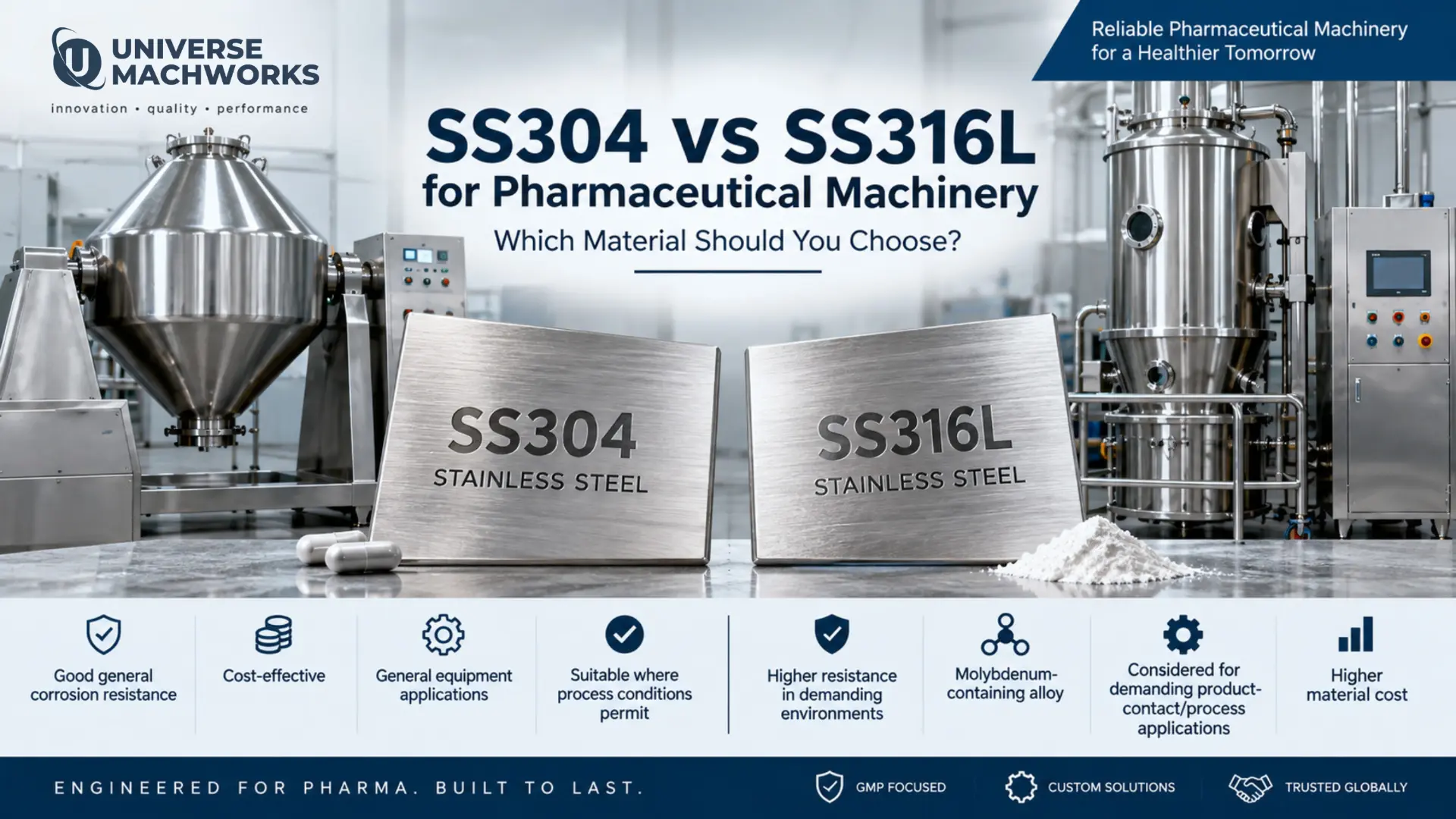
- SS304 or SS316L, depending on product and process requirements
- Suitable internal surface finish
- Corrosion resistance
- Cleaning accessibility
The required material grade should be confirmed based on the product, cleaning agents, and applicable facility requirements.
6. Filtration System
Check the air inlet filters and product-retention filters.
The filtration system should be appropriate for the product and the facility's environmental and contamination-control requirements.
7. Automation and Controls
Depending on production requirements, manufacturers may consider:
- PLC-based control systems
- Temperature monitoring
- Airflow control
- Process timers
- Alarm systems
- Automatic filter shaking or cleaning
- Batch process monitoring
8. Cleaning and Maintenance
For pharmaceutical manufacturing, equipment cleaning and product changeover are important considerations.
Check whether the product container, filter bags, and other contact components can be accessed and cleaned according to the required procedure.
9. Installation Space and Utilities
Before finalizing the machine, confirm:
- Available floor space
- Ceiling height
- Electrical supply
- Steam or other heating utilities
- Exhaust arrangements
- Maintenance access
- Material handling requirements
10. Manufacturer Support
Consider the manufacturer's technical support, installation assistance, documentation, spare parts availability, and after-sales service.
Fluid Bed Dryer Material of Construction
Material of construction plays an important role in pharmaceutical equipment selection.
A Fluid Bed Dryer may use stainless steel for product-contact and structural components, depending on the design and application.
SS304
SS304 stainless steel is used in many industrial equipment applications because of its general corrosion resistance and fabrication properties.
SS316L
SS316L is often considered for pharmaceutical product-contact applications where enhanced corrosion resistance is required.
The appropriate grade depends on the product, process conditions, cleaning chemicals, and applicable equipment requirements.
Other important considerations include:
- Internal surface finish
- Weld quality
- Surface accessibility
- Product-contact design
- Gasket and seal compatibility
- Cleaning procedure
A material certificate and surface-finish details should be requested when they are part of the equipment specification.
Cleaning and Maintenance of a Fluid Bed Dryer
Regular cleaning and maintenance help maintain equipment performance and support consistent manufacturing operations.
Cleaning Practices
- Follow the manufacturer's approved cleaning procedure.
- Remove residual product from the product container and accessible surfaces.
- Clean the air distribution plate according to the equipment instructions.
- Inspect and clean filter bags as recommended.
- Check product-contact surfaces for residue or damage.
- Confirm that components are properly dried before reassembly where required.
- Complete line clearance and cleaning verification according to the facility's quality procedures.
Maintenance Practices
- Inspect the blower and motor regularly.
- Check filter bags for wear, damage, or blockage.
- Inspect gaskets and seals.
- Monitor heating system performance.
- Check airflow and temperature sensors.
- Inspect electrical connections and control systems.
- Maintain records of preventive maintenance.
The exact cleaning and maintenance frequency should be determined by the manufacturer's instructions and the facility's maintenance programme.
Common Problems in Fluid Bed Dryers and Their Possible Causes
Understanding common operational problems can help production teams identify issues and improve process control.
| Problem | Possible Cause |
|---|---|
| Uneven drying | Poor airflow distribution or unsuitable product loading |
| Slow drying | Low inlet temperature, insufficient airflow, or high initial moisture |
| Poor fluidization | Incorrect airflow or unsuitable particle characteristics |
| Excessive dust carryover | Incorrect airflow, unsuitable filtration, or damaged filters |
| Filter blockage | Dust accumulation or inadequate filter cleaning |
| Product sticking | High moisture, sticky formulation, or unsuitable process conditions |
| Excessive fines | Product attrition or excessive fluidization |
These are general troubleshooting possibilities, not a substitute for machine-specific diagnosis. Operators should follow the manufacturer's instructions before changing process settings.
Importance of a Fluid Bed Dryer in Modern Pharmaceutical Manufacturing
Modern pharmaceutical manufacturing requires controlled processing conditions, reliable equipment, and repeatable product quality.
A Fluid Bed Dryer plays an important role in wet granulation-based tablet manufacturing by reducing moisture in granules before further processing.
The equipment supports production workflows where suitable granules must reach a defined moisture level before milling, blending, lubrication, and compression.
When correctly selected and operated, an FBD can contribute to:
- More controlled granule drying
- Better integration between granulation and downstream processes
- Improved production workflow
- Consistent processing conditions
- Reduced manual handling in suitable configurations
The machine must be selected and qualified according to the formulation, process requirements, and applicable manufacturing standards.
Why Choose Universe Mach Works for Pharmaceutical Machinery?
Universe Mach Works provides pharmaceutical machinery solutions for manufacturers looking for equipment for pharmaceutical and industrial processing applications.
We support customers with machinery requirements across different stages of production, including drying, mixing, granulation, and material processing.
Our services include:
- New pharmaceutical machinery
- Refurbished pharmaceutical machinery
- Custom manufacturing solutions
- Technical support
- Installation assistance
If you are looking for a Fluid Bed Dryer Machine for pharmaceutical manufacturing, contact Universe Mach Works to discuss your batch capacity, product characteristics, heating requirements, and machine configuration.
Explore the Product
Fluid Bed Dryer by Universe Mach Works
View technical specifications, applications and request a customized quote.
View Fluid Bed DryerFrequently Asked Questions
What is a Fluid Bed Dryer used for?+
A Fluid Bed Dryer is used to remove moisture from suitable powders, granules, and particulate materials using heated air and the principle of fluidization. It is commonly used in pharmaceutical wet granule drying.
What is the working principle of an FBD machine?+
An FBD works on the principle of fluidization. Heated air passes upward through the product bed, suspending and moving the particles. Heat transfer from the air supports moisture evaporation, and moisture-laden air is removed through the exhaust system.
What does FBD stand for in the pharmaceutical industry?+
FBD stands for Fluid Bed Dryer. It is commonly used in pharmaceutical manufacturing for drying wet granules and other suitable particulate materials.
Why is a Fluid Bed Dryer used after wet granulation?+
Wet granulation produces granules containing moisture. A Fluid Bed Dryer helps reduce this moisture before the granules move to further operations such as milling, blending, lubrication, and tablet compression.
What are the main advantages of a Fluid Bed Dryer?+
Major advantages include efficient heat transfer, good contact between heated air and particles, controlled drying conditions, suitability for batch processing, and potential integration with pharmaceutical production lines.
What industries use Fluid Bed Dryers?+
Fluid Bed Dryers are used in pharmaceutical, nutraceutical, food processing, and chemical industries for suitable powders and granules.
What is the difference between a Fluid Bed Dryer and a Tray Dryer?+
A Fluid Bed Dryer uses upward airflow to suspend and move particles during drying. A Tray Dryer uses heated air circulation over material spread across trays. Their suitability depends on the material and drying requirements.
Which materials can be dried in a Fluid Bed Dryer?+
Suitable materials include many pharmaceutical granules, particulate ingredients, and selected industrial powders. Material properties such as particle size, density, moisture, flowability, and heat sensitivity determine suitability.
What is the role of filter bags in an FBD?+
Filter bags help retain product particles inside the drying system and reduce powder loss through the exhaust air.
What heating systems are used in Fluid Bed Dryers?+
Depending on the equipment configuration, Fluid Bed Dryers may use steam heating, electrical heating, or other suitable heating arrangements.
Is a Fluid Bed Dryer suitable for heat-sensitive materials?+
It may be suitable for certain heat-sensitive materials when the process temperature, airflow, and exposure time can be controlled within the product's acceptable limits. Product-specific evaluation is essential.
How do I select the right Fluid Bed Dryer capacity?+
Consider the required batch size, product bulk density, initial and final moisture content, particle characteristics, and production schedule. Request a machine recommendation based on actual process data.
What is the difference between a Fluid Bed Dryer and a Fluid Bed Processor?+
A Fluid Bed Dryer is primarily designed for drying. A Fluid Bed Processor is a broader term for equipment that may perform drying and, depending on its configuration, additional operations such as granulation or coating.
How can I purchase a Fluid Bed Dryer from Universe Mach Works?+
Contact Universe Mach Works at +91 9888885581 or visit https://universemachworks.com/ to discuss your equipment requirements and request technical details.
Conclusion
A Fluid Bed Dryer is an important piece of equipment in pharmaceutical manufacturing, particularly for drying wet granules used in tablet production. Its working principle is based on fluidization, where heated air moves through a bed of particles to support heat transfer and moisture removal.
Its advantages include efficient drying, good air-particle contact, controlled process conditions, and compatibility with suitable production workflows.
Before purchasing a Fluid Bed Dryer, manufacturers should evaluate batch capacity, product characteristics, airflow requirements, heating arrangements, filtration, material of construction, cleaning requirements, and technical support.
Choosing the correct machine configuration helps support reliable drying performance and efficient manufacturing operations.
Looking for a Fluid Bed Dryer for your pharmaceutical production facility? Get in touch with Universe Mach Works for pharmaceutical machinery enquiries, equipment details, and installation support. Call: +91 9888885581 or visit universemachworks.com.